
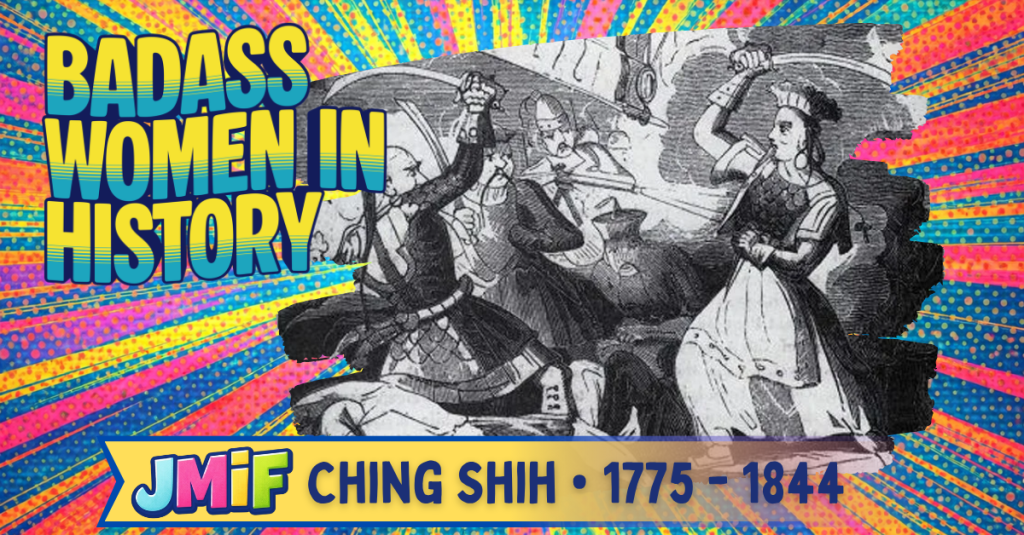
Retired • Undefeated • Unbothered
—
Ching Shih commanded 1,800 ships and 80,000 sailors. She never lost a war. She chose when it ended.
South China Sea • 1801–1810 • Bad-Ass Women in History
—
Introduction
Here is something the history books don’t always lead with: when the combined might of the Chinese Imperial Navy, the Portuguese colonial fleet, and the British East India Company all took their turns trying to crush the most powerful pirate confederation in recorded history, they lost. Every single time. The fleets limped home. Officers were demoted. Governments quietly renegotiated their understanding of what was and wasn’t possible on the South China Sea. And the person who handed them all those losses was a woman who, a decade earlier, had been working in a floating brothel in the Pearl River Delta and had no particular reason to believe the world owed her anything at all.
Her name — the name history gave her, anyway — was Ching Shih. Or Zheng Yi Sao. Or Cheng I Sau. The transliteration depends on which scholar you’re reading, which is one of those small reminders that she has spent two centuries being filtered through other people’s frameworks. What all the versions agree on is the meaning: wife of Zheng Yi. She is, even now, most commonly identified in relation to the man she married. The man she then decisively outlasted. The man whose entire operation she took over and made exponentially more successful the moment he was gone.
Let’s be honest about what that name tells us — and what it refuses to.
I — Against the Grain
The Pearl River Delta Was Not Asking for This
The world Ching Shih was born into around 1775 was one that had decided, with considerable thoroughness, exactly what a woman of her circumstances could expect. She was likely from Guangdong province — the southeastern coast of China, Canton territory, a region that smelled of salt water and commerce and hierarchy. The details of her early life are genuinely murky, which is itself a telling fact: the historical record only starts paying attention to her once she became impossible to ignore.
What we know is that she worked in a floating brothel — one of the many flower boats that dotted the Pearl River. These weren’t hidden establishments. They were woven into the texture of port life, frequented by merchants, sailors, officials. The women who worked on them occupied a legal and social category that the Qing Dynasty had more or less designed to be inescapable: low enough in status that they had limited recourse, visible enough in the economy that they couldn’t be fully ignored. It was a world built, quite deliberately, to keep certain people small.
In 1801, a pirate commander named Zheng Yi came to that flower boat and proposed marriage to a woman he’d apparently been impressed by. Here is where the mythology usually kicks in and starts doing damage: the story gets romanticized into a kind of swashbuckling fairy tale, the pirate captain sweeping a beautiful woman off her feet. The more interesting and more honest version is that Ching Shih negotiated. She didn’t just say yes. According to several accounts, she agreed to the marriage on the condition that she would hold co-equal authority over his fleet and receive an agreed share of all plunder. She extracted terms. She walked into a business negotiation and treated it like one.
She didn’t escape her circumstances. She leveraged them — which is a harder thing to do, and a less comfortable thing to celebrate, and the truth.
What she was up against, if you want to enumerate it plainly: the legal and social erasure of women in Qing China, the stigma of her profession, the inherent instability and violence of the pirate world she was marrying into, a maritime culture that was almost entirely male, and the very real possibility that any power she accumulated could be dissolved the moment the man whose name she’d taken decided to change the arrangement. She navigated all of that. With apparent deliberateness.
II — Motivation Beyond the Mythology
She Wasn’t Fighting for Freedom
This is the part where I’m going to say something that might make some readers uncomfortable, because we’ve spent a lot of time in recent years reclaiming historical women as feminist icons, and Ching Shih is absolutely on that list. She shows up in listicles. She has a Wikipedia page that runs very long. Keira Knightley’s Pirates of the Caribbean universe gave a nod to her. She’s been adopted, with enthusiasm, as a symbol of female power breaking through patriarchal walls.
And she was that. She absolutely was. But she was also running a criminal empire.
The Red Flag Fleet at its peak commanded somewhere between 1,500 and 1,800 vessels — accounts vary, and the sheer scale makes precise numbers slippery — and somewhere in the range of 80,000 people. It was, by any reasonable measure, larger than most of the world’s national navies at the time. It dominated the South China Sea and significant stretches of the Chinese coastline. It extorted merchants. It raided villages. It enslaved captives — including women, including children. The code of conduct Ching Shih famously implemented, which prohibited her sailors from raping female prisoners and mandated relatively humane treatment for captives who didn’t resist, was a genuine improvement over the norms of the day. It was also, let’s be clear, a management decision. A woman who ran enslaved captives more humanely was still running enslaved captives.
Her motivations were power, survival, and profit — roughly in that order, and depending on the year, the order probably shifted. She wasn’t liberating the sea routes. She was controlling them. The distinction matters, not to diminish her, but because the real story — a woman of almost no social standing who outmaneuvered an empire through strategic brilliance and iron nerve — is actually more interesting than the sanitized version where she’s just a feminist hero operating in moral clarity.
The Red Flag Fleet — At Peak Power
The Numbers That Made Empires Nervous
- Approximately 1,500–1,800 active vessels across six squadrons
- Estimated 70,000–80,000 sailors, soldiers, and associated crew
- Dominated the South China Sea coastline from Guangdong to Vietnam
- Defeated the Chinese Imperial Navy in multiple engagements, 1807–1809
- Repelled Portuguese naval forces sent from Macau, 1809
- Compelled the East India Company to avoid certain routes entirely
- Collected tribute from coastal villages and taxed merchant shipping
- Negotiated her own peace terms with the Qing government in 1810 — and kept most of her wealth
III — The Support System
The Men Who Helped, the Men Who Tried
Zheng Yi — her first husband — deserves more credit than he usually gets in the Ching Shih story, not because he was exceptional but because he was essential. He was already a significant pirate lord when they married, and in the six years of their partnership, the two of them accomplished something genuinely unusual: they united the warring pirate factions of the South China Sea into a single confederation. The Red Flag Fleet was the largest of six color-coded fleets, each commanded by a different captain but all operating under a common framework. This required diplomacy, coercion, and no small amount of violence. Zheng Yi did much of the external political work. Ching Shih, by most accounts, was deeply involved in the internal organization.
Then in 1807, Zheng Yi died. The circumstances are somewhat disputed — some accounts say he was killed in a typhoon, others suggest combat — but the political reality was immediate and brutal: a woman in a world of violent men had just lost the primary source of her legitimate authority. What happened next is the hinge point of the whole story.
She didn’t step back. She stepped forward — and sideways, in a move that still raises eyebrows. Zheng Yi had an adopted son, Chang Pao (also written Cheung Po Tsai), a young man he’d taken in years earlier, possibly formerly a fisherman’s son captured by pirates who’d so impressed Zheng Yi that he’d essentially made him an heir. Chang Pao was charismatic, genuinely talented as a military commander, and popular with the sailors. Ching Shih understood that she needed him, and she needed him loyal. She forged an alliance — and within a few years, they married.
The relationship is almost always noted with a kind of knowing discomfort. Chang Pao had been her husband’s adopted son. The age gap was significant. Was it love? Strategic partnership? Something more complicated? Almost certainly the latter two, probably some version of the first. What matters is that it worked. Chang Pao served as her military commander while she ran the organization’s logistics, finances, and legal framework. They were, in the most functional sense, co-CEOs of the largest criminal enterprise the South China Sea had ever seen.
The code she wrote for the Red Flag Fleet would not have been out of place in a military handbook. Desertion: death. Stealing from the fleet’s treasury: death. Disobeying orders: death, on the second offense. But also: no unauthorized looting, fair distribution of plunder, protection of captive women. She built a navy, and then she gave it rules.
IV — What It Cost Her
The Price of Running the South China Sea
Here is the uncomfortable accounting that the celebratory articles tend to skip past: Ching Shih spent the decade of her peak power in a state of constant existential threat that most of us genuinely cannot imagine. She was commanding tens of thousands of people who were, in many cases, only loyal because the alternative was worse. She operated in an environment where the Chinese government, the Portuguese, and the British all actively wanted her dead or captured. She had to manage internal power struggles, keep six semi-autonomous fleet commanders aligned, and somehow maintain an organizational culture that prevented the whole thing from collapsing into chaos — all while being a woman whose authority was, in the eyes of nearly everyone around her, inherently provisional.
She lost her husband. She gave up any pretense of a private life — there was no version of her position that allowed for privacy, softness, or the ordinary comforts that people of her era associated with femininity. She almost certainly carried the weight of knowing that the moment she showed weakness, the structure she’d built would collapse around her. The historical record doesn’t give us her interior life — we don’t have her diaries, her letters, her moments of doubt — and that silence is its own kind of cost. She has been remembered as a force of nature rather than a person, partly because the people doing the remembering never cared enough to see her as one.
And then there’s the retirement — which gets framed as a triumph, and in many ways was, but which also deserves honesty. In 1810, Ching Shih negotiated a peace agreement with the Qing government. She kept most of her wealth. Chang Pao received a military commission. Many of her sailors were pardoned or absorbed into government service. She walked away from the most powerful criminal operation in Chinese history and the government essentially let her go, because the alternative — a prolonged military campaign against a fleet they’d already repeatedly failed to defeat — was simply more expensive than the deal she was offering.
She went on to run a gambling house in Guangzhou, and possibly a salt smuggling operation on the side. She died in 1844, at around age 69, which is genuinely remarkable given everything. She died old, and comfortable, and free — which is not what most women in her position, in her era, in any era, got to do. But the gambling house is worth sitting with for a moment. The woman who commanded 80,000 people spent her last decades running a gambling establishment. That’s not a failure. It’s also not nothing to notice.
V — The Gap
How She Was Remembered vs. How She Actually Lived
Western audiences encountered Ching Shih mostly through the accounts of people who were, to put it diplomatically, not rooting for her. Portuguese naval reports. British merchant logs. Qing official dispatches. These sources share a common quality: they are bewildered. There’s a particular texture to historical documents written by men who have just been comprehensively defeated by a woman they had no framework for. Some of them don’t even use her name. She appears as “the pirate woman,” or “the widow,” or in some translations just as the wife of the late Zheng Yi — as though her identity only existed in relation to the man she’d already replaced.
Chinese historical records were similarly complicated. The Qing government, in negotiating its face-saving peace, was not exactly rushing to commemorate the woman who’d made them look incapable for three years. The deal was framed as a pardon, an imperial magnanimity, rather than what it actually was: a government paying a criminal to stop embarrassing them.
The modern reclamation of Ching Shih — and there has been one, particularly in the last twenty years — has overcorrected in the other direction. The moral complexity got filed off. The enslaved captives got omitted. The gambling house got left out. What remained was a clean, cinematic narrative: extraordinary woman defies patriarchy, wins, retires. It’s a great story. It’s also a significantly edited one.
The most honest version of Ching Shih’s legacy is also the most interesting one: she was brilliant, ruthless, pragmatic, and human — and history spent two centuries being uncomfortable with all four of those things at once.
VI — Contemporaries & Context
The World She Was Operating In
In 1807, when Ching Shih was consolidating her control over the Red Flag Fleet, Napoleon Bonaparte was at the absolute height of his power in Europe, the Treaty of Tilsit reshaping the continent. The British East India Company was deepening its grip on the Indian subcontinent, running what was effectively a private empire backed by a private army. The Qing Dynasty was in the early stages of a long, slow unraveling that would culminate in the Opium Wars three decades later — though no one knew that yet. The world was being reorganized by force, constantly, on every front.
On the Atlantic, female pirates Anne Bonny and Mary Read had their brief, blazing careers about ninety years earlier — early 1700s, Caribbean waters, executed or disappeared before anyone had time to fully reckon with what they’d been. Ching Shih knew nothing of them, almost certainly. But the parallel is worth noting: in every maritime culture, in every era, the water seems to have been one of the few places where the usual rules bent a little. Not because the sea was generous to women — it wasn’t — but because competence, in extremity, tends to be the only currency that matters.
What makes Ching Shih different from Bonny, Read, or any of the other women who have occasional pirate chapters, is scale and duration. She didn’t have a chapter. She had a decade. She built something institutional. And she built it in a context — imperial China, with its rigid Confucian hierarchies of gender and class — that was arguably more resistant to a woman in power than the relatively chaotic Atlantic pirate culture of a century before.
VII — The Long Tail
What She Actually Changed
Piracy in the South China Sea did not end when Ching Shih negotiated her peace. It continued, in various forms, for another century and more. The structural conditions that made it possible — poverty, the brutal economics of the fishing and trading classes, the vast and ungovernable coastline — did not change because one exceptional woman retired to run a gambling house. Her fleet was not a revolution. It was an anomaly, a peak that nothing else reached.
What she changed, more subtly, was what was understood to be possible — though even that came with asterisks, because the primary lesson that the Qing government took from the experience was apparently “negotiate faster,” rather than anything more transformative. The Chinese merchant class that had paid tribute to her fleet for years went back to operating under the usual risks. Chang Pao, her husband and co-commander, served out his years in the Imperial Navy without particularly distinguishing himself. The organization that had briefly unified the most chaotic maritime region in the world dissolved, as organizations do when the person holding them together steps away.
Her longer legacy is stranger and less tidy than the listicles would suggest. She is studied, now, in business schools — her organizational code, her fleet management, the negotiation that ended her career. Her peace deal is legitimately one of the most impressive examples of negotiating from strength in a losing position that history offers: she was undefeated militarily, but she understood that indefinite war was not in her interest, and she extracted the best possible terms for her exit before her opponents figured out a way to change the balance. That is a lesson with no expiration date.
VIII — A Direct Line to Now
What the South China Sea Still Carries
The South China Sea in 2025 is one of the most contested bodies of water on earth. China, the Philippines, Vietnam, Malaysia, Brunei, and Taiwan all have overlapping territorial claims there. The United States Navy runs freedom-of-navigation operations through it regularly. There are artificial islands now — whole landmasses built from scratch to assert presence in disputed waters. The sea that Ching Shih once effectively taxed is still, two centuries later, a place where power is constantly being negotiated, asserted, and contested. Nothing about the South China Sea ever really settled.
But the more direct line to now isn’t geographic. It’s structural. We still live in a world that has specific, largely unspoken ideas about what kind of ambition is acceptable in women, what kind of power is legible as legitimate, what kind of leader gets to be called a leader rather than an anomaly. Ching Shih spent her career being called an anomaly — and then, two hundred years later, got reclaimed as an icon — and neither label quite captures what she actually was, which was a person who saw the systems around her with unusual clarity and navigated them with unusual skill and paid the unusual prices that came with doing that without apology.
The gap between how she was recorded and how she actually lived is, honestly, a map of what societies erase when they write history — the complexity, the moral ambiguity, the human cost, the fact that the people who changed things were often not the people the official story was built to celebrate. Ching Shih didn’t fit the story. She ran through the wall of it and built something on the other side that nobody had seen before and nobody has quite replicated since.
She died in 1844, aged approximately 69, in Guangzhou. Comfortable. Free. Surrounded, probably, by people who were still slightly afraid of her.
Good.
 Jeffy Makes It Fun
Leave a comment