
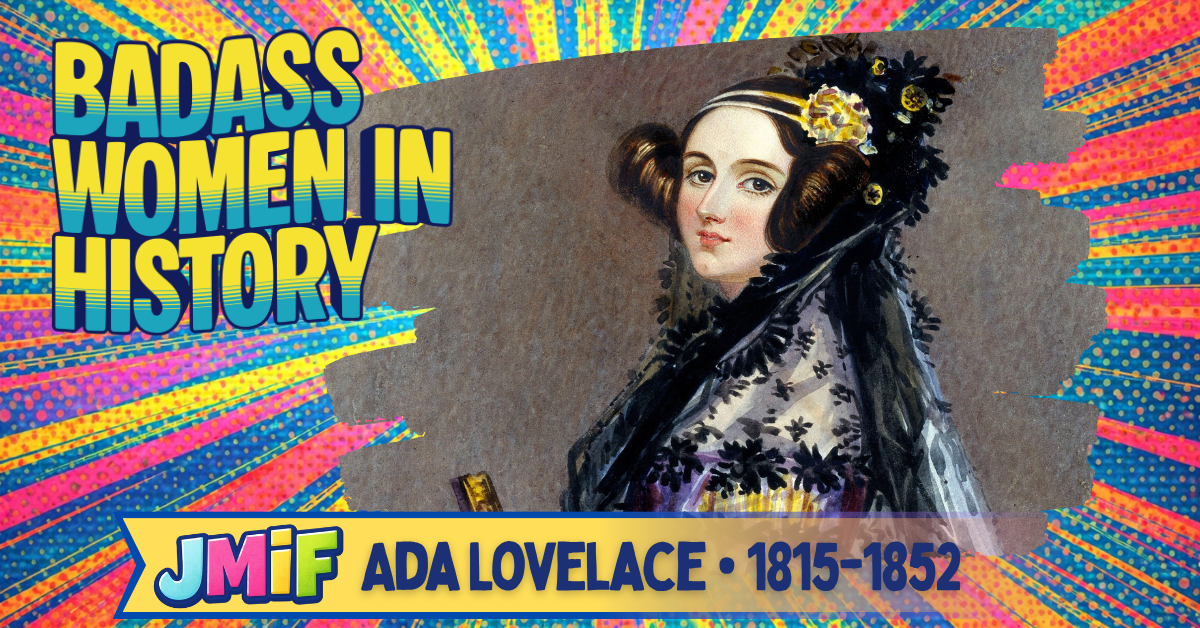
Poet’s Daughter • Visionary • 100 Years Too Early
—
Ada Lovelace wrote the first algorithm in 1843. The computer it was meant to run wouldn’t be built for another hundred years. She was almost forgotten.
London, England • 1815–1852 • Bad-Ass Women in History
—
There is a particular cruelty to being right about something a century before anyone can verify it. You can’t point to the thing you built and say there, that’s what I meant. You leave behind papers, notes in the margins, letters to colleagues who are themselves only partly following you — and then you die at thirty-six, and the papers go into boxes, and the boxes go into archives, and the archives collect dust for a hundred years until someone opens them and says, quietly, oh. She knew. This was Ada Lovelace’s particular inheritance: a mind that outran her moment by at least a century, working inside a body that would betray her long before the world was ready to catch up.
She is remembered now, mostly correctly, as the world’s first computer programmer — the person who wrote what historians recognize as the first algorithm intended for a computing machine. She is celebrated with a holiday in October, commemorated by a programming language the U.S. Department of Defense named after her in the 1980s, and cited routinely in conversations about women in STEM as proof that women have always belonged in technical fields. All of that is true, and all of it misses something important about who she actually was, which was: complicated, contradicted, ambitious in ways Victorian England had no framework for, and desperately human in ways the hagiography keeps smoothing over.
Let’s start at the beginning — which is, in Ada’s case, also the beginning of a specific problem she spent her whole life trying to outrun.
01 | Against the Grain
Lord Byron’s daughter was not supposed to do mathematics.
Augusta Ada Byron was born in December 1815 to one of the most famous men in England and one of the most determined women. Lord Byron: the poet, the scandal, the man whose name still carries a particular dark electricity was her father for exactly one month before he and her mother separated permanently. Ada never knew him. He died in Greece when she was eight, and she reportedly once asked to see his portrait and then had to be taken out of the room when she began crying and couldn’t stop.
Her mother, Lady Anne Isabella Milbanke — Annabella — was the person who actually shaped Ada, and she did it with a specific, almost clinical intention. Annabella was intelligent, educated, and had been so thoroughly wounded by her marriage to Byron that she spent the rest of her life doing everything she could to make sure her daughter did not inherit his temperament. Byron had been chaotic, romantic, emotionally devastating. Annabella’s response was to immerse Ada in mathematics from the earliest possible age. Logic, she seems to have believed, was the antidote to poetry. Order was the cure for passion. Annabella hired a series of tutors. She monitored Ada’s emotional states with a slightly alarming attentiveness. She called herself “the hen” watching over her chick, and the metaphor is revealing: warm on the surface, fiercely controlling underneath.
What Annabella couldn’t have anticipated was that her plan would work so well it would exceed her own capacity to understand it. Ada was not cured of imagination by mathematics — she was ignited by it. She didn’t experience numbers as a cage. She experienced them as a vocabulary for the kind of thinking she was already doing, the kind that slipped between what existed and what could exist, between mechanism and possibility. By her early teens, she was corresponding with some of the leading scientific minds of Britain, not as a curiosity or a pet project, but as someone who had actual things to say.
The walls around her were architectural: the education she could receive was limited, the societies she could join were closed, the journals that would have published her work would not print a woman’s name on a byline — and yet she kept thinking anyway, kept writing, kept insisting that the thinking mattered.
The formal barriers to a woman doing scientific work in 1830s Britain were not subtle. The Royal Society didn’t admit women. Most universities were functionally inaccessible. The scientific establishment was a private club that occasionally tolerated women as muses, patrons, or charming dinner guests, but not, generally, as peers. Ada navigated this through a combination of social position — being an earl’s daughter, later a countess by marriage, gave her access that working-class men with equivalent minds would have been denied entirely — and through a series of personal relationships with scientists who were willing to treat her seriously. That access was a privilege that shaped everything. Her story is extraordinary, and it is also the story of a white aristocratic woman in a system that excluded nearly everyone else from the room.
02 | Motivation Beyond the Mythology
She Wasn’t Trying to Be A Pioneer
Here’s what the Ada Lovelace Day posts leave out: she was also restless, often unwell, prone to what she called “flyings” — intense, almost manic periods of intellectual productivity — and prone, equally, to periods of debilitating illness and depression. She gambled. Significantly. In the last years of her life, she was part of a syndicate that attempted to build a mathematical model for betting on horse races, and it failed spectacularly, leaving her in debt that she hid from her husband William King, the Earl of Lovelace, until she couldn’t hide it anymore. She may have had affairs. The historical record is murky on this but suggestive. She was not the serene, other-worldly mathematical saint of the commemorative illustrations.
She was someone who wanted — badly, urgently — to be taken seriously, on her own terms, for her own ideas. That’s a different and more interesting motivation than pure visionary genius. When she encountered Charles Babbage’s Analytical Engine at age seventeen, the first thing she did was understand it more quickly than almost anyone else who’d seen the designs. Babbage himself later wrote that he’d never met anyone who grasped the machine’s implications as immediately as she had. That wasn’t a detached intellectual exercise for Ada. That was the moment she saw a place where her particular way of thinking — the place where the mathematical and the imaginative fused, which no one had quite had a category for yet — was not just acceptable but necessary.
She wrote to Babbage that she believed herself to possess “a peculiar combination of qualities exactly fitted to make me pre-eminently a discoverer of the hidden realities of nature.” That line is usually quoted to show her confidence. It also shows her hunger. She wasn’t describing a gift. She was making an argument for her own relevance in a world that kept looking for reasons to ignore her.
The flyings were real, and so were the dark periods. Her health had been fragile since childhood — she had measles at thirteen that left her partially paralyzed for years, and she never fully shook the physical instability that followed. She worked through illness constantly, sometimes writing at a pace and depth that doctors around her found alarming and that she herself described as a kind of compulsion. When she was in a flying, she’d stay up all night working on problems. When she crashed, she’d be bedridden for weeks. She was doing her most important intellectual work while managing a body that was actively failing her, inside a social structure that would have preferred she do needlework instead.
03 | The Support System
Babbage, the Mothers, and the Complicated Men
Charles Babbage is the person Ada Lovelace is most associated with, and their relationship is the intellectual romance at the center of her story. He was nearly thirty years older, already famous for his Difference Engine — an early mechanical calculator — and deep in the conceptual work of the far more ambitious Analytical Engine when they met. He called her the Enchantress of Numbers, which is the kind of nickname that can read as patronizing or as genuine admiration depending on your mood, and was probably both at different moments.
Their partnership was real and productive and also, eventually, a source of friction that the hagiographic version of the story tends to smooth over. In 1842, an Italian mathematician named Luigi Menabrea published a paper about the Analytical Engine in French, and Ada was asked to translate it into English. What she produced was not a translation — it was a translation with appended notes that were roughly three times longer than the original paper, filled with her own analysis, extensions, and crucially, what historians now recognize as the first algorithm written for a machine: a sequence of operations for computing Bernoulli numbers using the Analytical Engine’s structure.
Babbage later claimed, in his autobiography, that he had written a significant portion of those notes himself. Ada disputed this, through intermediaries, and the historical consensus now leans toward the view that the notes were primarily hers — but the dispute itself is worth sitting with. Even in her most significant professional collaboration, she had to fight for credit within the relationship. The man who championed her also, at least partially, tried to claim her work. That’s not a unique story. It’s an ancient one.
Her Support Network; and What it Cost Them Too
Mary Somerville
Mathematician and astronomer who introduced Ada to Babbage at a dinner party in 1833. Somerville was one of the first two women elected to the Royal Astronomical Society and served as something of a model for what a serious female scientist could look like in that era. She mentored Ada without condescension, which was rare.
Lady Annabella Milbanke
Complicated beyond any single characterization. She created the conditions for Ada’s mathematical education and also surveilled her obsessively, intercepted her letters, and contributed to the psychological instability Ada carried her whole life. Indispensable and damaging, sometimes simultaneously.
Augustus de Morgan
The mathematician who tutored Ada at university level, via correspondence, because she could not attend university. He wrote to Annabella privately that Ada’s abilities were extraordinary, and that if she were a man, he would predict a significant career. He said this as a compliment. It also tells you everything about the ceiling she was working under.
William King, Earl of Lovelace
Supportive in ways that were genuinely unusual for the era. He allowed, even encouraged, her intellectual work and correspondence. He was also the person she hid the gambling debts from, which suggests the limits of even the most supportive Victorian marriage.
04 | What It Cost Her
She Gave Everything to a Machine That Didn’t Exist Yet
Ada Lovelace died in November 1852 of uterine cancer. She was thirty-six years old. The parallels to her father — who also died young, also consumed by intensity, also too much for his moment — were not lost on the people around her, and probably not on her either. She had asked to be buried next to Byron in Nottinghamshire, at the church where the family had their estate. The man she never knew, whose portrait made her cry, whose temperament her mother had spent her whole childhood trying to engineer out of her — she wanted to lie next to him at the end. Make of that what you will. I find it quietly devastating.
Her final months were brutal. The cancer progressed while she continued trying to work, continued her correspondence, continued existing in the space between the intellectual life she’d built and the body that was dismantling itself around her. Her mother moved back into the household toward the end — Annabella, still controlling, still convinced she knew best, reportedly driving away some of Ada’s friends and managing her daughter’s final weeks in ways that Ada herself may not have fully sanctioned. The deathbed was not peaceful. Few deaths involving Victorian mothers and their complicated adult daughters are.
The gambling debts she’d hidden came out. The full weight of what she’d juggled — the mathematical work, the illness, the debts, the social performance of aristocratic womanhood, the years of correspondence and intellectual effort in a context that never quite acknowledged what she was — became visible only once she was gone and couldn’t speak for herself about any of it.
She poured the best of herself into notes about a machine that didn’t exist, in service of ideas that wouldn’t be understood for a century, while managing a body in active revolt and a social world that kept asking her to be something smaller than she was. That’s not a tragedy with a silver lining. That’s just the actual cost.
05 | The Gap
How She Was Filed Away & Then Rediscovered
After Ada died, her notes on the Analytical Engine — the work that would eventually earn her the “first programmer” designation — were published and then largely ignored. Babbage’s Analytical Engine itself was never built. Without the machine, there was no context in which her algorithm could be demonstrated, tested, or validated. It was a solution to a problem that didn’t yet exist in material form. So the notes sat. They were cited occasionally, referenced by historians of science in the narrow way that Victorian scientific correspondence gets referenced, and largely filed under “interesting historical footnote.”
In 1953 — a hundred and one years after Ada’s death — a British scientist named B.V. Bowden republished her notes in a book about computing. The field of computing, by that point, actually existed. Turing had published his foundational work. The first electronic computers had been built and were running. Suddenly, Ada’s notes were not a historical curiosity but something that looked remarkably like a document written by someone who understood, at a conceptual level, what a computer was and how it should be programmed — decades before the first computer existed.
The rediscovery launched the modern Ada Lovelace mythology. And with it came, inevitably, the overcorrection. The messy parts got cleaned up. The gambling got omitted. The Babbage credit dispute got softened. The complicated mother, the hidden debts, the “flyings” and the crashes — none of that fit the clean arc of “visionary woman ahead of her time,” so it mostly got left in the archival footnotes where the serious historians could find it and the commemorative articles didn’t have to deal with it.
And there’s one more wrinkle worth naming honestly: the question of whether she actually wrote the algorithm herself, or whether Babbage’s claim had more merit than the consensus allows, is genuinely not settled to everyone’s satisfaction. Most historians believe the notes were primarily hers. Some don’t. The fact that we’re still arguing about the authorship of a woman’s intellectual work, a hundred and seventy years later, is its own kind of answer to the question of what she was up against.
06 | Contemporaries & Context
The World That Produced Her
The 1840s were, in scientific terms, an extraordinary moment. Michael Faraday was working on electromagnetism in ways that would eventually lead to the electrical grid. Charles Darwin was turning over the observations he’d collected on the Beagle voyage, building toward what would become On the Origin of Species — published seven years after Ada’s death. Charles Dickens was writing at the peak of his powers, and Ada knew him socially; they moved in overlapping circles, the literary world and the scientific world not yet as separate as they’d later become. Mary Shelley — who had written Frankenstein in 1818, a novel about a man who builds a thinking creature and then cannot reckon with what he’s made — was still alive and part of the cultural conversation. The question of what machines might eventually be capable of was not abstract. It was, for people paying attention, urgent and slightly alarming.
Ada was paying attention. Her notes on the Analytical Engine contain a passage that is now famous, in which she explicitly addresses the question of whether the machine could be said to think. Her answer was no — she argued that the Analytical Engine could only do what it was programmed to do, could not originate anything, could only act on what humans directed it toward. This position, often called Lovelace’s objection, became a reference point for Alan Turing a century later when he was working on what we now call artificial intelligence, and he engaged with it directly in his 1950 paper that introduced the Turing Test. She was wrong, it turns out, or at least the question is more complicated than her objection allowed. But being wrong in a way that Turing found worth arguing with, from the vantage point of 1843, is a different category of wrong than most of us will ever achieve.
07 | The Long Tail
What a Dead Woman’s Notes Eventually Became
In 1980, the United States Department of Defense completed a new programming language intended to unify the dozens of incompatible languages then being used across military computing systems. They named it Ada. This is, depending on how you feel about the Department of Defense and the history of computing, either a moving tribute or a somewhat ironic one — the woman who wrote an algorithm for a machine that didn’t exist became the namesake of a language used primarily for weapons systems and aerospace. She might have found it funny. She might have found it entirely appropriate. She had a taste for the grand and the slightly absurd.
Ada Lovelace Day — the second Tuesday in October, observed internationally — was founded in 2009 as an annual celebration of women in STEM. It has, by most accounts, done genuine good: creating visibility, providing a focal point for conversations about gender in technical fields, giving young women in science and mathematics a historical figure to point to. The criticism of this kind of commemorative structure is also worth noting: it tends to flatten the complexity of the person being commemorated into a usable symbol, and Ada has been flattened in very specific ways to make her maximally inspiring and minimally complicated.
The work she actually did — the notes, the algorithm, the insistence that the Analytical Engine was something categorically different from a calculator because it could operate on symbols rather than just numbers — these ideas form a genuine part of the conceptual foundation of computing. Not in a direct, traceable line, because the field developed largely independently and her specific contributions were rediscovered rather than continuously built upon. But as evidence that the essential conceptual leap — from machine-as-arithmetic-tool to machine-as-general-symbol-processor — was available to human thought in 1843 if you were paying a particular kind of attention. She was paying that attention. Almost no one else was.
08 | A Direct Line to Now
You Are Reading This on The Great Grandchild of Her Machine
You are reading these words on a device that is, in the most fundamental conceptual sense, the thing Ada Lovelace was writing about in 1843. Not the same machine — the gap between the Analytical Engine’s punch-card-driven gears and whatever screen you’re holding right now is enormous, and the engineers who built the actual computers deserve every credit for the distance traveled. But the underlying idea — that a machine could manipulate symbols according to a set of instructions, that it could be programmed to do things its builder didn’t specifically anticipate, that the machine itself was a general-purpose tool rather than a single-purpose calculator — that idea was what Ada was working with. She saw the shape of the thing before anyone had the materials to build it.
The more uncomfortable direct line is this: we are still, in 2025, having the conversation that Ada was trying to force in 1843, which is the conversation about who gets to be a scientist. Women are still underrepresented in computing, in mathematics, in engineering. The pipeline problem that everyone talks about having solutions to has been described as a pipeline problem for decades now, and the pipeline still leaks in the same places. The specific walls Ada ran into — the universities that wouldn’t admit her, the journals that wouldn’t print her name, the collaborators who claimed her work — have changed form without entirely disappearing. The form they take now is subtler and in some ways harder to name, which makes it harder to fight.
Ada’s story gets told as a triumph because she got there first, because her notes survived, because someone eventually opened the boxes. But the triumph rests on a foundation of what was lost — all the other women of her era and before and after who had the same quality of mind and didn’t have the social position to access Babbage’s dinner table, didn’t have the mother who hired the tutors, didn’t have the letters preserved, didn’t have someone to publish their notes a century later. Ada got remembered. The structural question is how many didn’t, and what we lost along with them.
She was the enchantress of numbers. She was also a sick woman with gambling debts and a controlling mother and a hundred-year head start on everyone around her, working herself to death on a machine that didn’t exist yet, insisting — with the particular stubbornness of someone who knows they’re right and knows they can’t prove it — that the thinking mattered anyway.
It did. It does. It will.
Leave a Reply