
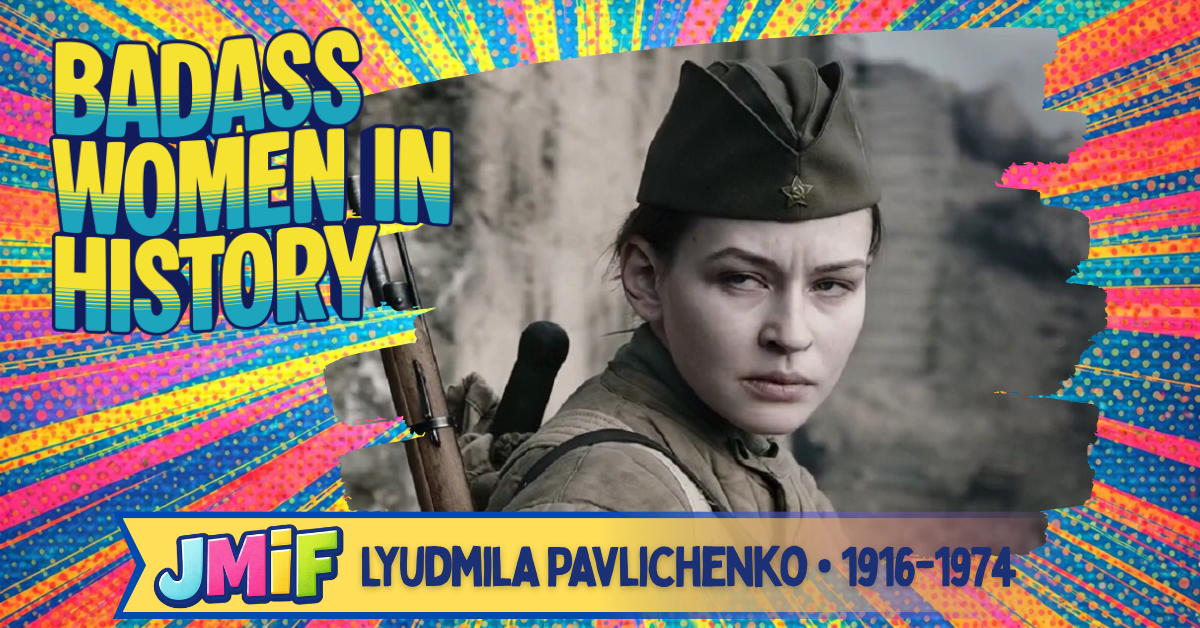
Lady Death
Bad-Ass Women in History — Lyudmila Pavlichenko, 1916–1974
309 Confirmed Kills • Undefeated • Unsilenced
She had 309 confirmed kills. The Nazis put a bounty on her head. American journalists asked her about her nail polish.
Kyiv → Odessa → Sevastopol • 1941–1942 • Bad-Ass Women in History
Introduction
Here is the scene. September 1942. The Commodore Hotel in New York City. Lyudmila Pavlichenko — twenty-five years old, a Lieutenant in the Red Army, one of the most lethal human beings alive — is standing in front of a press corps that has apparently decided the most interesting thing about her is her clothing. A reporter suggests that her uniform skirt is cut unflatteringly. Another asks if she is jealous of American women and their nylon stockings. A third wants to know if she wears makeup on the front lines. She waits. She lets them finish. And then, through her interpreter, she says: “I am 25 years old and I have killed 309 fascist occupants by now. Don’t you think, gentlemen, that you have been hiding behind my back for too long?”
The room, by several accounts, went quiet.
That moment has been sitting with me for a long time — what it took to say it, what it cost her to be in that room at all, and what it tells us about the particular cruelty of being extraordinary in a world that has already decided what you are. The American press had a woman in front of them who had survived two years of the most brutal land warfare of the twentieth century, who had outlasted adversaries who knew her name and her sniper position and had tried repeatedly to kill her, who had watched her companion and partner die at her side in the dirt of Sevastopol — and they asked her about her skirt.
This is about what was on the other side of that press conference. The version of Lyudmila Pavlichenko that the cameras kept missing.
I — Against the Grain
The Walls She Was Already Running Through
Let’s set the stage honestly. In 1941, the Soviet Union was the only nation on earth actively deploying women in frontline combat roles at scale, and even the Soviet Union was not entirely comfortable with it. The official ideology said women were equal. The actual army said: can you type? Can you nurse? The recruiting officers, when the Germans crossed the border in June 1941 and the full catastrophe of Operation Barbarossa began to unfold, were sending women to the auxiliary corps, to communications, to medical units. That was the box that existed for them. Lyudmila Pavlichenko walked into an enlistment office in Kyiv and told them she wanted to be a sniper.
The officer she spoke to reportedly laughed. Or offered her a nursing position. The accounts differ slightly, but they agree on the core texture: a young woman saying she wanted to fight was treated as a novelty requiring gentle redirection. What the officer perhaps didn’t know, and what the war was about to teach a great many people, was that Lyudmila had been a competitive shooter since she was fourteen — a member of the Osoaviakhim, the paramilitary training organization that produced a generation of Soviet sharpshooters — and that she had a skill set the Red Army very desperately needed at a moment when they were losing men at a rate that defied comprehension.
She was eventually assigned to the 25th Chapayev Rifle Division. And then she was in it — the actual war, the siege of Odessa, the catastrophic defense of Sevastopol — in a way that most of the men around her could not have imagined doing and did not do with the sustained effectiveness she demonstrated. The walls she was running through weren’t just the walls of German defensive positions. They were the constant, grinding bureaucratic and social resistance of a military culture that needed her skill and was still embarrassed to admit it.
She didn’t get to be a hero first and prove herself later. She had to prove herself in order to be allowed to be in the same room as the war.
And then, once she was good enough that her record became impossible to ignore — once the 309 number started circulating and the nickname Lady Death started appearing in dispatches — a new wall materialized. The Soviet state decided she was more valuable as a symbol than as a sniper. After she was wounded in August 1942 by mortar shrapnel that left fragments in her cheek and ended her front-line career, the military did not give her time to recover and return to service. They sent her on a propaganda tour. To Canada. To the United States. To those press conferences, with those reporters, and those questions about her skirt.
II — Motivation Beyond the Mythology
She Wasn’t Fighting for the Marble Statue Version
The version of Lyudmila Pavlichenko that Soviet propaganda wanted — and that Western reclamations have largely recycled — is a pure thing: patriot, defender of the motherland, symbol of Soviet womanhood proving her equality through sacrifice. Clean. Usable. Inspiring in the ways that propaganda requires inspiration to be inspiring.
The actual person is more interesting, and more recognizable as a person.
She was a history student. When the war started, she was midway through a degree at Kyiv State University, writing a thesis on Bohdan Khmelnytsky — the seventeenth-century Cossack Hetman who led a famous uprising. This matters because it tells us something about the particular quality of mind she had: someone drawn to the study of power, resistance, military history, the mechanics of how ordinary people change the course of events. She chose to study the past as a set of arguments about what was possible. Then the present arrived and handed her a rifle.
She also had a son. Rostislav, born in 1932 — she had married at fifteen, briefly and unhappily, and her son was nine years old when the war started. This fact gets mentioned in passing in most accounts and then set aside, but it’s worth sitting with. She was a mother. She left her child — with family, presumably, while the country she loved was being dismantled — and went to the front. The specific weight of that decision, the texture of what she chose and what she was choosing against, rarely makes it into the commemorative articles. She wasn’t a figure carved from pure heroism. She was a young woman making impossible choices under impossible pressure, which is a more honest version of what courage actually looks like.
And then there’s the shooting itself. She was genuinely good at it — not in the way someone is good at something they’ve been pushed into, but in the way someone is good at something they love. She’d been training competitively since fourteen. The Osoaviakhim programs were the Soviet version of organized athletic marksmanship, and she’d taken them seriously, the way another young woman in another context might have taken to swimming or track. The war didn’t create her skill. It just gave it an application that the world could not ignore. Which is a strange and uncomfortable thing to be given.
What 309 Actually Means
Lyudmila Pavlichenko’s 309 confirmed kills remains the highest recorded total of any female sniper in history. Of those, 36 were themselves enemy snipers — counter-sniper work, the most dangerous kind, requiring not just accuracy but the ability to out-think and out-wait someone who is doing exactly what you are doing. Each confirmed kill required independent verification. The actual number may have been higher.
- Served in active combat: June 1941 – August 1942 (14 months)
- Primary theaters: Siege of Odessa, Siege of Sevastopol
- Awarded: Hero of the Soviet Union, Order of Lenin (twice), various combat medals
- Enemy snipers eliminated: 36 confirmed
- Wound that ended combat career: mortar shrapnel, August 1942, Sevastopol
III — The Support System
Who Had Her Back — and Who Didn’t
Lyudmila Pavlichenko did not go through the war alone, and the people around her shaped her story in ways that deserve more than a footnote.
The most important figure in her combat life was Leonid Kutsenko. He was a fellow sniper, became her partner at the front, and eventually — in the chaos and intimacy that wartime generates between people who are trying to keep each other alive — became her partner in a more personal sense too. He was killed at her side during the siege of Sevastopol, in the summer of 1942. She was already wounded by then. She watched him die. Whatever emotional calculus she’d been running to stay functional in the field — the discipline required to lie still for hours, to make decisions that kill human beings at distance, to keep doing it day after day for over a year — the death of Leonid Kutsenko is not separable from the cost of that calculus. She rarely talked about him publicly. When she did, it was brief. The grief was hers to keep.
Then there was Eleanor Roosevelt.
The First Lady met Pavlichenko during the 1942 North American tour, and what began as a diplomatic protocol obligation became something that looked, genuinely, like friendship. Roosevelt invited her to stay at the White House — the first Soviet citizen to sleep there. She attended Pavlichenko’s speeches, vouched for her publicly, and their correspondence continued for years after the tour ended. Roosevelt was also, crucially, the only prominent American who seems to have engaged Pavlichenko on her own terms — as a soldier, as a person, as a political figure with something real to say — rather than as a curiosity or a propaganda exhibit. When American journalists kept pressing on the femininity angle, it was Roosevelt who helped redirect those conversations, or at minimum lent legitimacy to Pavlichenko’s pointed responses.
This was not a small thing. Pavlichenko was twenty-five years old, in a foreign country, speaking through interpreters, representing a government that was also managing and constraining her presentation at every moment. She needed an ally in the room who had independent credibility, and Roosevelt was it.
Who deserves her own article in this series: Roza Shanina, Soviet sniper, 59 confirmed kills, killed in action January 1945 at age nineteen. Her diary entries from the front are some of the most devastating primary source documents of the war. She is almost entirely unknown in the West.
Back in the Soviet Union, the support structure was more complicated. The state celebrated her publicly and managed her privately. After the tour, she was assigned to train new snipers — a role that used her expertise but kept her away from the front she’d spent the war fighting toward. She served as an instructor at the Red Army sniper school, training hundreds of marksmen. This was genuinely valuable work. It was also, unmistakably, the military deciding that a famous woman was more usefully deployed as a pedagogical asset than as a combat operator. The decision was probably medically justified — her wound was real. Whether it would have been made the same way for a male soldier with equivalent credentials is a question history doesn’t let us answer cleanly.
IV — What It Cost Her
An Honest Accounting of the Price
The mortar shrapnel that ended her combat career left fragments in her face that were never fully removed. She carried the war in her body for the rest of her life. That’s the most visible cost, but probably not the most significant one.
Leonid Kutsenko. She had survived the front for over a year — an achievement that most of the soldiers around her did not manage — and the person closest to her in that world died while she was present. She didn’t get to grieve him in any public or officially sanctioned way. The Soviet propaganda apparatus had no use for a grief-stricken heroine, and she was, from the moment of her wounding, a propaganda asset being actively managed. She traveled to America months after losing him. She stood in press conferences and answered questions about nail polish. Whatever she did with the grief, she did it alone and she did it quietly, and the public record doesn’t reach into where she put it.
The post-war years are where the story gets harder to tell, because the primary sources get thinner. What is documented is that Pavlichenko struggled. She completed her history degree after the war, worked as a researcher for the Soviet Navy, and participated in veterans’ organizations for the rest of her life. She gave speeches. She attended commemorations. She was, by every official measure, a celebrated hero of the Soviet state, which meant that the state needed her to keep performing her heroism in specific and controlled ways for decades after the heroism itself had happened. There are accounts, pieced together from memoirs and interviews with people who knew her, suggesting she drank more than was good for her in the postwar years. There were health problems — she had a stroke in her mid-fifties and died in 1974 at fifty-eight, which is not old. The war was long over by then and it was still, in various ways, killing people who had survived it.
She spent fourteen months lying in the dirt of Odessa and Sevastopol keeping the Soviet Union alive at the end of a rifle — and the country spent the next thirty years asking her to be a symbol of it at the end of a microphone.
The other cost that doesn’t get discussed: the 309 people she killed. She discussed it herself, which is more than most veterans manage. In interviews, she was direct about the weight of the work — she didn’t dress it in abstraction or hide behind language about duty. She said that she understood the magnitude of what she had done, that it was not nothing, that each of those kills was a human being. This is not what the commemorations emphasize. The commemorations want the number. She seemed to understand that the number was the smallest part of what she’d carried home.
V — The Gap
How She Was Filed Away and What Got Left Out
The Soviet version of Lyudmila Pavlichenko was, for most of the Cold War, the only version the world had easy access to. And the Soviet version had specific requirements: she was a hero, a symbol, a proof point for the ideology’s claim that Soviet women were equal. What that version didn’t accommodate was grief, or doubt, or the complicated psychological aftermath of being one of the most effective killers in one of the most violent conflicts in human history, or the fact that the state had taken her off the front lines she’d been willing to die on and sent her to talk to journalists who asked about her eyebrows.
The Western version of her, when she entered the popular imagination more broadly — primarily through a 2015 Russian film, Battle for Sevastopol, and a wave of “badass women in history” content over the last decade — simplified in a different direction. The moral weight got distributed more cleanly. The grief got aestheticized. The shooting became heroic spectacle rather than sustained psychological labor. The Soviet propagandization of her image got swapped for a contemporary one that serves different ideological purposes but is, in some structural ways, doing the same work: taking a complex human being and compressing her into a serviceable symbol.
Neither version reckoned fully with what the 1942 American press tour actually represented, which is one of the more uncomfortable episodes in the history of inter-Allied relations: the United States, which had not yet opened a second front in Europe, received as a guest a woman who had been fighting the war it was still deciding whether to fully commit to, and responded by asking her what she wore to bed. She was there, in part, to put human weight behind the Soviet argument that the Allies needed to act. The political mission mattered. The press corps treated it as a fashion story.
What’s also missing from most accounts: the Soviet women who served alongside her, and after her. The Soviet Union trained approximately two thousand female snipers during the war. About five hundred of them survived it. Their collective story is one of the most significant chapters in the history of women in combat, and it is almost entirely absent from the popular Western WWII narrative, which has centered the American and British experience so completely that the Eastern Front — where the actual weight of the war was being decided — functions mainly as backdrop. Lyudmila Pavlichenko is the face that occasionally surfaces from that backdrop. The women who didn’t survive it have almost no faces at all.
VI — Contemporaries & Context
She Was Not the Only One
Nineteen forty-two. Place that year on a map of what was happening. Stalingrad is unfolding — the turning point of the war, the most catastrophic urban battle in recorded history, where the Soviet Union holds the line at a cost measured in millions. The Night Witches — the 588th Night Bomber Regiment, all female — are flying open-cockpit biplanes over German positions in the dark, dropping bombs by hand, so underpowered that their engines could be heard cutting in and out, a sound the Germans called the sound of a witch’s broom. They were flying the war’s most dangerous missions in the war’s worst aircraft, and they flew over 23,000 of them before it ended. In Britain, the Auxiliary Territorial Service is putting women in anti-aircraft batteries — but not, officially, pulling the trigger. The gap between what the British and American women were doing and what Lyudmila Pavlichenko was doing was not a gap of courage. It was a gap of permission.
Eleanor Roosevelt, who befriended Pavlichenko during the tour, was at that moment pushing to expand American women’s roles in the military — the WAAC, the WAVES, the female ferry pilots of the WASP program. She understood, better than most American officials, what she was looking at when she looked at Pavlichenko: not an exception, but an argument. An argument about what was possible when you stopped predetermining what women were capable of and simply gave them the same tools and the same mission.
And then there is the German side of the equation, because it’s worth knowing: the Wehrmacht also had women in the war, but almost exclusively in support, clerical, and communications roles. The Nazi ideology about women — the Kinder, Küche, Kirche framework — was in direct tension with the operational demands of total war, and the Nazis never fully resolved it. The Soviet Union resolved it, however imperfectly, by fielding women with rifles. The ideological flexibility wasn’t enlightenment; it was desperation. But it was also, unmistakably, the truth: when survival is at stake, competence doesn’t care about gender. Only institutions do.
VII — The Long Tail
What She Actually Changed — and What She Didn’t
Her 1942 North American tour contributed — in a real, documentable way — to the political pressure that eventually led to the opening of the second front. She gave speeches to thousands of people in Chicago, in New York, in Washington, in Canada. She spoke at labor union halls and in university auditoriums. She told American audiences, directly, that the Soviet people were dying while they waited for the Allies to act. Eleanor Roosevelt amplified the message through the White House. The Normandy landings were still two years away, and the causal chains of geopolitics are never clean, but historians who study the period credit the 1942 propaganda tour — Pavlichenko’s tour — with shifting American public opinion in ways that mattered. She was not just a soldier. She was, whether she asked for it or not, a diplomat.
At the sniper school, she trained hundreds of marksmen who went back to the front and used what she taught them. The multiplicative effect of her post-combat career — the skills she transmitted, the doctrine she refined — is almost certainly larger than the impact of her individual kills, though it is also, almost certainly, impossible to quantify. She is credited with shaping a generation of Soviet snipers. That is a long tail that runs through the entirety of the war’s final three years.
What she didn’t change, or couldn’t: the Soviet military’s structural treatment of women after the war. When it ended, the women who had served in combat roles were, in many cases, encouraged or pressured to downplay what they had done — to return to conventional femininity, to not emphasize the combat service in official documents or social settings. The medals got put in drawers. The stories didn’t get told. The Soviet state that had needed them on the front lines in 1942 didn’t quite know what to do with them in peacetime, and the resolution it reached was roughly: thank you, that was an emergency, please be a wife now. Pavlichenko was spared the worst of this, because she was too famous to be easily erased — but the women who served alongside her were not.
Woody Guthrie wrote a song about her in 1942. “Miss Pavlichenko” — it called her the “pride of the Soviet land” and told the story of her kills with the plainspoken reverence of a folk ballad. It was not a hit, and it is mostly forgotten. But someone paid attention.
VIII — A Direct Line to Now
The Press Conference Never Really Ended
In 2016 — seventy-four years after Lyudmila Pavlichenko stood in that New York press room — the United States military officially opened all combat roles to women. All of them. Including the roles that had been building walls around female soldiers for the entire history of the American military. The announcement was met with a mix of celebration and controversy that will be familiar to anyone who has been paying attention to any argument about women and institutional power since, roughly, forever. There were serious people, on record, arguing that women were not psychologically suited for close-quarters combat. In 2016. Seven decades after a twenty-five-year-old woman with a rifle had done it better than almost everyone around her.
The conversation hasn’t ended. Female soldiers in the United States military still face hazing, sexual harassment, and institutional resistance that their male counterparts don’t navigate in the same way. The data is not ambiguous on this. The argument that was supposedly settled in 2016 keeps having to be re-settled, which is what happens when the settlement was institutional rather than cultural — the rules changed, the assumptions didn’t.
There is also this: we have spent eighty years celebrating Lyudmila Pavlichenko primarily as a number. 309. The highest. The most. The record. And in doing so we have done to her, in miniature, the same thing that 1942 press corps did to her in that hotel room: reduced her to a single, quantifiable, spectacular attribute, and treated the rest of her — the grief, the history thesis, the son, the dead partner, the shrapnel still in her face, the decades of post-war life — as supporting material for the highlight reel. She was a person. The 309 was something she did, not something she was.
The most honest version of Lyudmila Pavlichenko is also the most interesting one: she was brilliant, precise, grieving, and deeply human — and history spent eighty years being more comfortable with the first two than the last two.
She was also right, and the room went quiet when she said it, and then they all went back to their typewriters and filed the story about her uniform skirt anyway — because that’s what institutions do when they can’t absorb what they’re being told. They file the story they came to file. They write the version that fits the space they already had. They put the complicated woman back in the drawer.
She died in 1974 at fifty-eight. She is buried at the Novodevichye Cemetery in Moscow, with Soviet military honors, among generals and statesmen and artists. Her gravestone reads: Hero of the Soviet Union. The number is not on it.
I think she would have preferred that.
Leave a Reply