
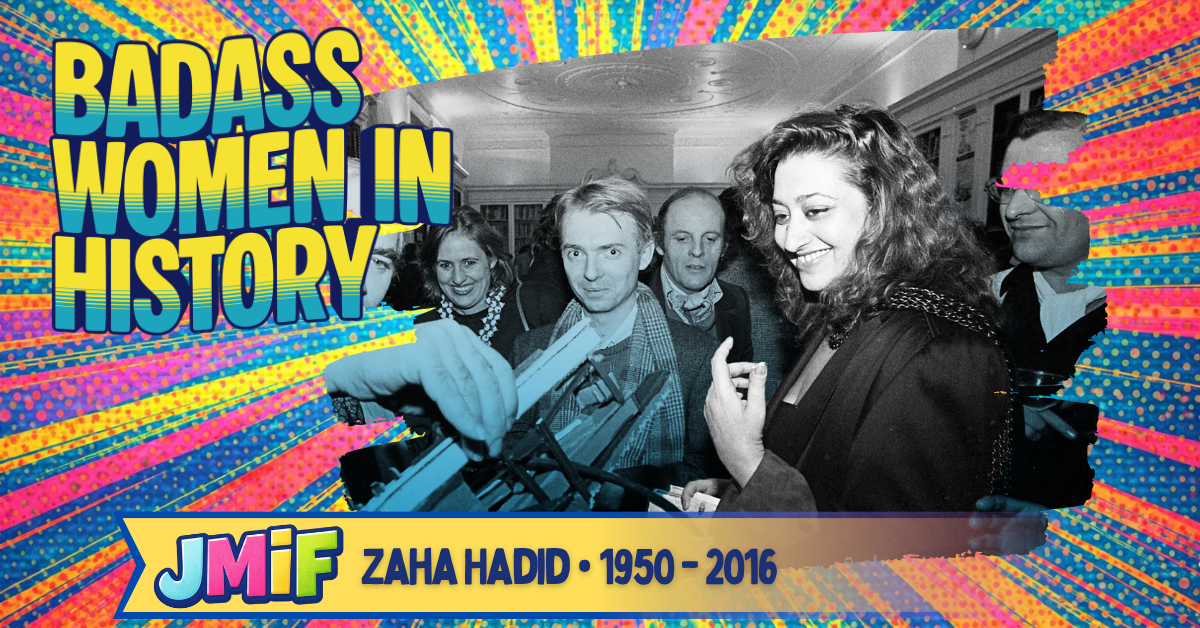
Bad-Ass Women in History — Zaha Hadid | 1950 – 2016
Architect • Visionary • Queen of Curves
She bent steel, concrete, and expectation.
Zaha Hadid designed buildings that looked like the future had finally gotten bored with straight lines. Critics doubted her. Engineers sweated. Cities changed shape. Then she became the first woman to win architecture’s highest prize.
Iraq / United Kingdom • 1950–2016 • Bad-Ass Women in History
The Woman Who Bent Buildings (And Refused to Bend Herself)
For a decade, the world called Zaha Hadid a “paper architect” whose impossible designs would never be built. Then she became the most famous architect alive, the first woman to win her field’s top prize, and one of its most genuinely controversial figures. She earned all three labels. Let’s look at the whole woman, not just the flattering parts.
Badass Women in History • A JMIF Original Series
In 1983, a young architect almost nobody had heard of won a major international competition to design a leisure complex called The Peak, perched in the hills above Hong Kong. Her winning entry didn’t look like a building. It looked like an explosion frozen mid-blast, shards of structure flying apart and reassembling at impossible angles, rendered in vivid, abstract paintings that owed as much to Russian avant-garde art as to anything in an engineering textbook. It was thrilling. It was also, in the eyes of much of the profession, faintly absurd, the kind of thing that wins prizes and never, ever gets built.
They were right, in the short term. The Peak was never constructed. And for roughly a decade afterward, that became the story of Zaha Hadid: the brilliant provocateur whose visions were too wild, too radical, too physically impossible to ever become real buildings. The profession had a slightly cruel term for people like her. A paper architect. Someone whose work lived on paper, in galleries and competition boards, and never in steel and concrete. It was praise and dismissal in the same breath: you’re a genius, dear, but a fantasist, not a real architect.
Here is what makes her one of the most satisfying subjects in this series. She did not soften her vision to win acceptance. She did not make her buildings more normal, more buildable, more polite, to get the establishment to take her seriously. She kept pushing the same radical ideas, waited for technology and the world to catch up to her, and then spent the back half of her life covering the planet in buildings that genuinely looked like nothing anyone had built before. She made the impossible get built. And along the way she became famous, decorated, and, it has to be said honestly, genuinely controversial. This is not a tidy hero story. It’s better than that. Let’s get into it.
From Baghdad to the Avant-Garde
Zaha Hadid was born in 1950 in Baghdad, Iraq, into a wealthy, cultured, and notably progressive family. Her father was a prominent industrialist and a significant liberal political figure; her mother was an artist. This matters, because the Iraq of Hadid’s childhood was not the Iraq that later headlines would lead you to imagine. It was a cosmopolitan, optimistic, modernizing place, and she grew up in a household that took ideas, art, and the education of its daughter completely seriously. She would later recall childhood trips to the ancient Sumerian cities of southern Iraq, the marshes and the ruins of one of the world’s oldest civilizations, and credit those landscapes with seeding her sense of space and form. The woman who would reshape global architecture started with the oldest architecture on earth.
She studied mathematics at the American University of Beirut, a detail that is easy to skip past but shouldn’t be, because the mathematical mind, the comfort with complex geometry and abstract space, runs through everything she later built. Then, in 1972, she moved to London to study at the Architectural Association, the legendary hothouse of radical architectural thinking. There she fell in with the field’s most experimental minds, studying under and later working with figures like Rem Koolhaas, who once described her, admiringly, as a planet in her own orbit. In 1979 she founded her own firm in London. And then she set about being almost aggressively, uncompromisingly herself.
Now, the walls. Hadid was up against an unusually thick stack of them, and it’s worth being specific, because the badassery only lands if you see what she was running through. She was a woman in one of the most male-dominated professions on earth, a field where, even today, the people who design the buildings are overwhelmingly men. She was an Arab and a Muslim by background, an immigrant, working in a Western establishment not always inclined to hand its highest honors to outsiders. And her actual ideas were radical enough to alarm even people with no prejudice at all. She was, in other words, an outsider three or four times over, asking the most tradition-bound corners of a conservative profession to trust her with enormous, expensive, permanent public buildings. The wonder is not that it took her a long time. The wonder is that she got through at all.
The Paper Years, and the Cold Shoulder
For much of the 1980s and into the 1990s, Hadid won acclaim, taught, exhibited, and designed dazzling projects that did not get built. The Peak in Hong Kong. A project in Berlin. An art and media center in Düsseldorf. Brilliant, celebrated on paper, unrealized. She was building a towering reputation and almost nothing else.
The most painful episode came in Wales. In 1994 she won the competition to design the Cardiff Bay Opera House, a major public building. And then it fell apart, in a drawn-out, humiliating public saga. Her design was attacked as disrespectful to the city and its traditions; local opinion turned against it; and ultimately the project was killed, the money redirected, in the end, to a sports stadium instead. Hadid pointed to Cardiff for years afterward as the rawest example of the disrespect she’d faced. And listen to how she described the experience, because it’s telling: she said that when she was in Cardiff, some quite specific people would not even talk to her, would look at her sideways, or past her, or behind her. Not engage her as the architect who had won the competition, but treat her as something to be looked around.
It is impossible to read that and not hear the texture of it. A foreign woman with a strange name and stranger ideas, winning a prestigious British commission, and being made to feel, by the way people physically would not meet her eye, that she did not belong in the room she had earned her way into. Hadid herself was clear that she believed she faced obstacles other architects simply did not. Whether every setback was bias is impossible to prove case by case, and I won’t pretend it is. But the pattern, the way her ambition and force were read as threatening in a way a man’s would not have been, is real and recurring, and Cardiff is its sharpest expression.
The “difficult” woman
This is the place to deal with the word that trailed Hadid her entire career: diva. She was described, endlessly, as difficult, imperious, demanding, temperamental, a diva. Some of this she earned; by many accounts she could be genuinely formidable and hard to work for, exacting to the point of fearsome, with a temper. People who knew her don’t all paint a saint.
But hold it up to the light and look at the double standard baked into it. The architecture world is full of celebrated male geniuses famous for being tyrannical, egotistical, impossible, and ruthless on the job, and when those men behave that way, the words used are visionary, uncompromising, exacting, a perfectionist. A man who screams at his staff in pursuit of greatness is a great man. A woman who does the same is a diva, a word that manages to be dismissive and gendered at once, reducing her authority to a tantrum and her standards to vanity. Hadid operated under a microscope no male starchitect ever faced, where her every sharp edge was read as proof that women like her were too much. She was, by all accounts, a strong, sometimes harsh personality. The injustice isn’t that people said so. It’s that they would have called the identical behavior in a man by an entirely more flattering name.
When the Impossible Got Built
The dam finally broke in the 1990s, and the thing that broke it is worth understanding, because it’s the heart of why she matters technically and not just symbolically.
Her first major built work, the Vitra Fire Station in Germany, completed in 1993, proved that the explosive, gravity-defying forms in her paintings could actually stand up as real architecture. And then technology caught up with her imagination. The rise of advanced computer-aided design and new engineering and fabrication methods meant that the wild, fluid, curving geometries Hadid had been drawing for years could finally be calculated, modeled, and constructed. She had been, in a real sense, designing for a future that hadn’t arrived yet. When it arrived, she was ready, and the floodgates opened.
What followed was an astonishing run of buildings unlike anything that had come before. The MAXXI museum in Rome. The Rosenthal Center in Cincinnati. The Guangzhou Opera House. The London Aquatics Centre for the 2012 Olympics. The Heydar Aliyev Center in Baku, a building that seems to have been poured rather than constructed, walls and roof flowing into one continuous liquid surface with no hard corners anywhere. Her early style got labeled deconstructivism, all sharp shards and fragments; her later work flowed into something more fluid and organic, sweeping curves that made concrete and steel look like they were in motion. People started calling her the Queen of the Curve. She pioneered approaches she and her firm called parametricism, using computation to generate forms no human hand could have drafted. Her firm grew from a handful of people into a global operation of hundreds.
And in 2004, the establishment that had spent a decade calling her a fantasist gave her its highest honor: she became the first woman ever to win the Pritzker Architecture Prize, the field’s equivalent of the Nobel, in the entire history of the award. Later she became the first woman to win the Royal Gold Medal from the Royal Institute of British Architects in her own right, won Britain’s top architecture prize twice, and was made a Dame. The paper architect had become, arguably, the most famous architect alive. She had not bent her vision to win. The world had bent to her vision instead.
The Part Where It Gets Complicated
Now I have to do the thing this series promises to always do, which is refuse to hand you a clean hero. Because the same qualities that made Zaha Hadid unstoppable, the towering self-assurance, the focus on the work above all else, also produced genuine controversy, and the most serious of it deserves a clear-eyed look rather than a quiet edit.
The hardest episode is Qatar. Hadid’s firm designed a stadium, Al-Wakrah, for the 2022 World Cup, a tournament whose construction across Qatar became a global scandal because of the deaths of large numbers of migrant laborers working in brutal conditions. In 2014, asked about those worker deaths, Hadid said it was not her duty as an architect to address the issue, that she had no power to do anything about it, and that the problem belonged to governments. The remarks landed as cold and dismissive, and they drew fierce criticism. There is a defensible argument buried in what she said, that an architect genuinely doesn’t control the labor practices of a foreign state, and that the responsibility lies with the governments and contractors who run the sites. But the tone, the apparent absence of even basic human concern for the people dying to build her design, struck many people as callous, and not without reason. She later walked out of a BBC interview when pressed on it.
Here’s where it gets genuinely tangled, and where honesty cuts in more than one direction. A critic at a prominent literary review then wrote that Hadid had shown no concern for the roughly one thousand workers who had died building her stadium. That specific claim was false: construction on her stadium had not even begun, and there had been zero worker deaths on her actual project. The thousand figure referred to deaths across all construction in Qatar, not her site. Hadid sued for libel and won a retraction and a settlement, which she reportedly donated to a workers’-rights charity. So both things are true at once, and this series exists precisely to hold both: she was genuinely, specifically libeled by a false statement, and she had also said something coldly dismissive about real human deaths that no retraction could unsay. She was wronged and she was callous, in the same news cycle. Flattening it to either “innocent victim of the press” or “heartless starchitect” would be a lie.
And there’s a broader unease worth naming plainly. Hadid built spectacular, fabulously expensive monuments for some of the world’s wealthiest and least democratic clients, governments and rulers in the Gulf and beyond, including a glittering cultural center in Azerbaijan named for an authoritarian leader and major projects in Saudi Arabia. You can read this generously, as an architect taking the commissions that let her realize her art at the highest level, which is what nearly every great architect in history has done with whatever patrons had the money, popes and kings and tyrants included. Or you can read it critically, as world-class talent lending its prestige to regimes using dazzling buildings to launder their image. Both readings have teeth. Hadid was an artist of staggering ability who also, repeatedly, worked for power and money without much visible agonizing about whose. That’s part of the record, and pretending otherwise would insult your intelligence.
What It Cost, and Who Was Around Her
The costs Hadid paid were real, if different from the violence and exile some women in this series endured. She paid in the lost decade, the years of being brilliant and unbuilt, watching her visions die on competition boards while lesser, safer work got constructed. She paid in the relentless gendered scrutiny, the diva label, the sense, which she clearly carried, that she was made to fight for respect that came more cheaply to her male peers. She never married and had no children; the work was, by every account, the overwhelming center of her life. And she paid, in the end, with an early death. In 2016, while being treated for bronchitis in a Miami hospital, she suffered a sudden heart attack and died at just sixty-five, at the absolute height of her powers, leaving dozens of unfinished projects behind. She was still ascending when she stopped.
It would flatten her to call her a lone genius, though she cut a famously solitary figure at the top. She came out of the hothouse of the Architectural Association and a network of radical thinkers; she built an enormous firm of hundreds of architects who translated her vision into buildable reality; her longtime partner Patrik Schumacher was central to developing and theorizing the firm’s approach and took it over after her death. The buildings carry her name and her unmistakable hand, but they were realized by teams, engineers, and collaborators on a scale no single person could manage. The myth of the solitary architect-genius is, as critics have long noted, always partly a myth. Hadid was the singular vision at the center, but she was surrounded, as every architect of scale must be.
Icon, Exception, or Door-Opener?
The legacy-versus-reality question for Hadid is unusually live, because she’s recent enough that we’re still arguing about what she meant, and the arguments cut against each other in interesting ways.
The triumphant version is the one you’ll see most: Zaha Hadid shattered the glass ceiling of architecture, the first woman to win the Pritzker, proof that a woman could reach the absolute summit of a brutally male field, an inspiration to a generation of women designers. That’s true, and it matters, and it shouldn’t be waved away. Representation at the top is not nothing; a great many young women looked at Zaha Hadid and understood, for the first time, that the door was openable.
But here’s the harder question this series can’t resist asking. Did she open the door, or did the profession let exactly one woman through and call the problem solved? Years after her death, architecture remains overwhelmingly male at the top; the Pritzker has gone to only a small handful of women since. There’s a recurring pattern in male-dominated fields where a single extraordinary woman is admitted to the pantheon, celebrated precisely as exceptional, in a way that can actually relieve the pressure to change the underlying structure. Look, we gave one to a woman, the system gets to say, and carries on as before. Hadid herself was famously prickly about being labeled a “woman architect” at all; she wanted to be judged as an architect, full stop, not as a representative of her gender. Whether she was a battering ram that opened the field or a singular exception the field absorbed without truly changing is genuinely unresolved, and probably both are partly true. The honest answer is that one Zaha Hadid is not a revolution. She’s the proof a revolution is possible, which is a different and more fragile thing.
The Long Tail, and the Line to Now
So what did Zaha Hadid actually change?
Concretely, she changed what a building can be. Before Hadid, the fluid, curving, gravity-defying forms she imagined were considered essentially unbuildable, the stuff of paintings and dreams. She, more than almost anyone, dragged those forms into reality and helped pioneer the computational design methods that made them possible, expanding the actual vocabulary of architecture for everyone who came after. Walk through an airport or a museum or a stadium today and see a sweeping, sculptural, impossible-looking curve, and you are looking at a world Hadid helped make buildable. Her buildings stand on multiple continents and will stand for generations. That is about as concrete a legacy as a human being can leave; it is made of concrete.
The lines to now run in several directions, and the fact that they don’t all flatter her is exactly why she belongs here. The encouraging line is the obvious one: a multiply-marginalized outsider refused to dilute her vision to win acceptance, waited for the world to catch up, and reshaped a global art form on her own terms. That’s a genuinely thrilling model of integrity, the refusal to make yourself smaller and safer to be allowed in.
The uncomfortable line is just as current. Hadid’s career raises questions we are still very much fighting over: about who builds the monuments of the powerful and what responsibility comes with it, about the human cost hidden inside spectacular architecture, about whether the celebration of one boundary-breaking woman is progress or a substitute for it, about the gendered language we still use to punish ambitious women as “difficult” while praising identical men as “visionary.” She sits at the center of all of those live arguments, not as a clean answer but as a case study. The diva double standard hasn’t gone away. The ethics of building beautiful things for ugly regimes hasn’t been settled. The question of whether a field changes or just collects a token hasn’t closed.
She was called a fantasist and became the most famous architect on earth. She was treated as an outsider three times over and won every honor her field could give. She made the impossible stand up in steel and concrete on five continents, refused to soften herself to be allowed in, and was both genuinely wronged and genuinely callous in ways that don’t cancel out but coexist. The marble-statue version would file her under inspirational girlboss and move on. The real Zaha Hadid is more interesting and more useful than that: a brilliant, flawed, uncompromising, complicated human being who bent the built world to her imagination and refused, to the end, to bend herself. That’s why she’s a Badass Woman in History, complications very much included. Especially because of them.
More Resources to Learn About This Subject From
A note on sources. Hadid is recent and heavily covered, which means there’s no shortage of material, but a lot of it tilts, either glossy hagiography from the design world or sharp-elbowed criticism from her detractors. The trick is reading both and holding the tension. Where I described the Qatar controversy, I tried to be precise about what was actually false (the specific death claim that got retracted) versus what was genuinely said (her cold remarks). To go deeper, start here.
- Zaha Hadid (Britannica) — a clear overview of the career, the major buildings, and a straight account of the controversies, including the Qatar episode and the Tokyo stadium that got scrapped.
- Biography: Zaha Hadid (The Pritzker Architecture Prize) — the official record of the prize that made her the first woman laureate, with the jury’s own framing of her work.
- About Zaha (Zaha Hadid Foundation) — the foundation’s own account; read it for the fullest picture of the work, while keeping in mind it’s the in-house, admiring version.
- The NY Review of Books libel settlement (iMediaEthics) — for the precise, documented account of the Qatar libel case: what was claimed, what was false, and how it was resolved.
- And the simplest research of all: go look at her buildings. Search the Heydar Aliyev Center, the MAXXI in Rome, the Guangzhou Opera House, the London Aquatics Centre. No description does the forms justice; you have to see them to understand what she actually pulled off.
If you take one thing from her: you do not always have to make yourself smaller and safer to be let in. Sometimes you hold your vision steady and wait for the world to catch up. Just don’t mistake winning for being above the questions the rest of us get to ask.
Leave a Reply