
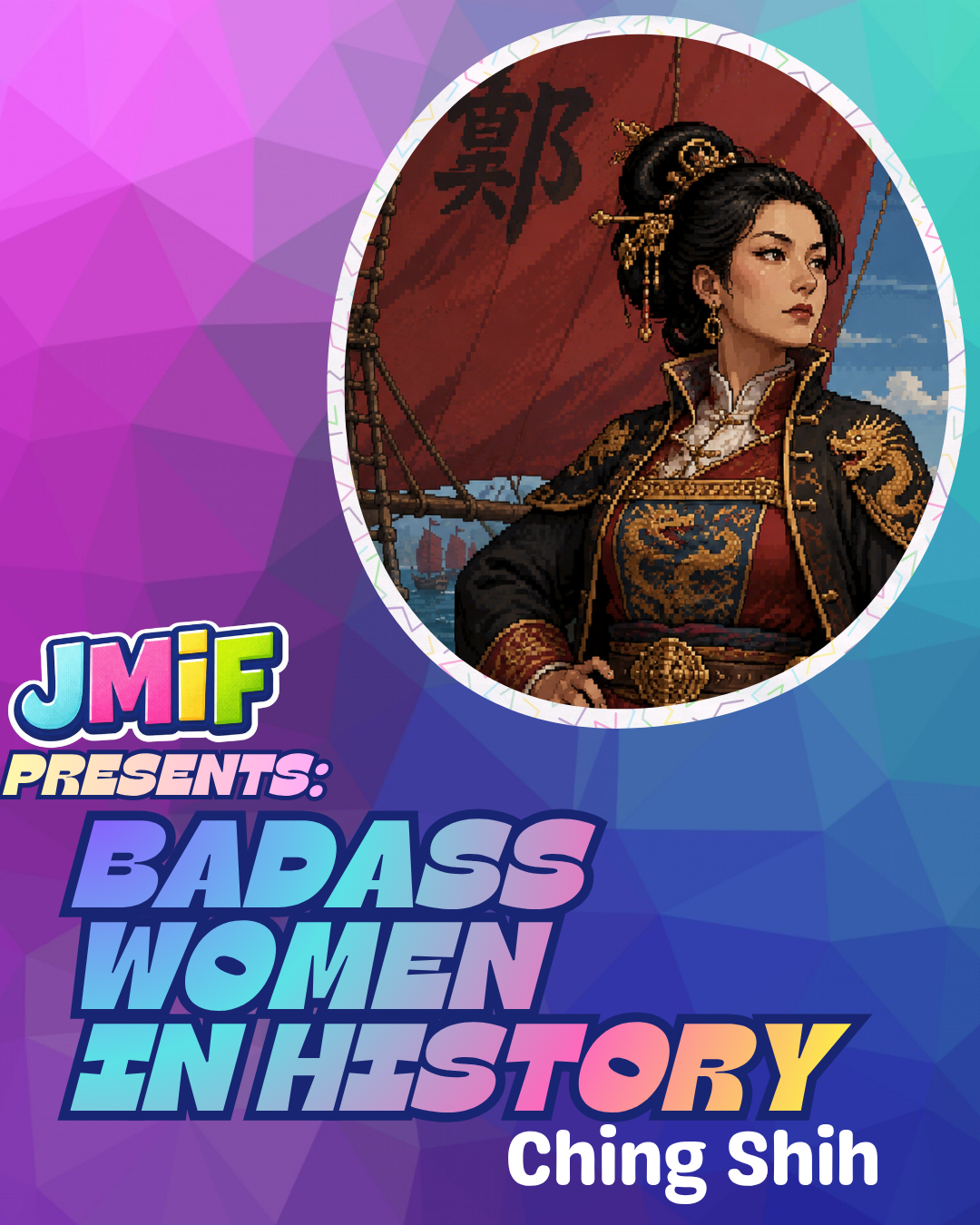
The Pirate Queen Who Built a Shadow State
How Zheng Yi Sao turned a loose network of outlaws into a functioning maritime government, and why that matters more than the sword fights
—
Zheng Yi Sao did not liberate the South China Sea. She took control of it.
Under her leadership, a scattered collection of pirate gangs became a regulated maritime confederation, complete with registered ships, shared finances, a military chain of command, protection rackets, tax collection, and tens of thousands of people operating under one system. She inherited command after her husband’s death, outlasted the men who assumed she would fail, forced the Qing government to the negotiating table, and retired without giving up everything she had built.
The impressive part isn’t that she was a woman with a sword. It’s that she became the governing authority of something that increasingly looked like a state.
It Wasn’t the Sword. It Was the System.
Start by clearing away the cinematic version of this story.
Zheng Yi Sao isn’t historically significant because she personally boarded the most ships or delivered the best dramatic speech on deck. She likely participated in violence and cultivated a fearsome reputation, but her actual weapon was organization.
The Guangdong pirate confederation ran ship registries, split its fleet into color-coded squadrons, pooled most captured wealth into a shared fund, resupplied crews that came back empty-handed, and maintained working relationships with businesses and communities on land. Under her leadership, that machinery grew into what historians describe as a state-like entity. Popular retellings often cite numbers like 1,800 ships and 80,000 pirates. The real figures are harder to pin down, with contemporary scholarship placing the confederation closer to 400 ships and 70,000 people by 1804, expanding from there. The exact count is uncertain. The scale is not.
Blackbeard had a ship. Zheng Yi Sao had infrastructure.
A Name That Was Never Really Hers
The woman most English-language sources call Ching Shih also appears as Cheng I Sao, Ching Yih Saou, and several other spellings. The most useful version is probably Zheng Yi Sao, which translates to “wife of Zheng Yi.” That isn’t a nickname. It’s a record of how thoroughly history preserved her relationship to a man while losing track of her own identity. Some modern sources name her Shi Yang, though historians still disagree on her birth name and much of her early life.
What we do know with reasonable confidence: she was born around 1775 near Canton and likely worked, or was trafficked into working, on one of the floating brothels known as flower boats.
That origin story usually gets rewritten as a seduction plot: beautiful sex worker meets dangerous pirate captain, negotiates a legendary partnership agreement, sails off to build an empire. It’s a great scene. It’s also more confident than the evidence supports. European accounts of her early life were frequently speculative and sensationalized. What we can verify is that she married the pirate leader Zheng Yi in 1801 and became an influential partner in his operation. What we can’t verify is the exact terms of that courtship, no matter how many times a particular version gets repeated online.
That distinction matters, because the invented version is actually less interesting than the truth. It turns a marginalized woman navigating trafficking, poverty, and rigid gender expectations into a clever seductress who talked her way into a promotion. The real story is harder and more useful: she entered one of the only systems available to her, studied how power moved through it, and eventually redirected the current.
She Didn’t Escape the System. She Learned to Run It.
Zheng Yi Sao didn’t gain authority by ignoring gender roles. She used the ones available to her, wife, widow, mother, and pushed each one further than the social order expected.
Her marriage gave her access to a growing pirate network, but she wasn’t a passive presence beside her husband while he built it. Historian Dian Murray describes Zheng Yi as the confederation’s unifier, and Zheng Yi Sao as its consolidator, the one who turned loose alliances between pirate leaders into something durable and centralized.
Then, in 1807, Zheng Yi died. By the logic of the time, that should have ended her authority. A widow might retain some influence through a son or a male relative in a controlled household role. Zheng Yi Sao had none of that scaffolding. She was a former sex worker trying to hold onto command over armed men whose careers ran on robbery, extortion, and violence. There was no succession plan. There was only the question of whether she could make herself indispensable before someone decided to remove her.
So she moved fast. She reinforced relationships with key fleet commanders, called on the loyalty they owed her husband, and secured the backing of Zhang Bao (also known as Chang Pao), Zheng Yi’s adopted son and a popular commander in his own right. Zhang Bao became the visible military face of the Red Flag Fleet, while Zheng Yi Sao held the strategic, financial, and political control behind it. She later married him, which broke every expectation attached to widowhood and locked in an alliance that further secured her position.
Yes, the family tree gets strange. Pirate succession planning did not go through HR. But treating this as scandal misses the point. Zheng Yi Sao understood that authority isn’t something you get to declare. It has to be recognized by the people who control the ships, the weapons, and the money. She built relational power first, then converted it into formal power. That’s leadership, even when the organization being led is objectively terrible.
Order, By Force
It’s tempting to picture the pirate confederation as 70,000 free agents doing whatever they wanted. It was the opposite. The entire reason this organization became formidable is that people were not allowed to do whatever they wanted.
The Guangdong Pact of 1805 had already introduced serious administrative structure: ships sorted into squadrons, assigned colors, given registration numbers. That requires recordkeeping and enforcement. After taking power, Zheng Yi Sao tightened the code further. A ship or squadron that captured a prize kept roughly twenty percent, while the rest went into a shared fund used to supply, arm, and repair the wider fleet. That single rule meant a bad month didn’t sink a crew, and no captain could hoard resources while the rest of the confederation ran dry.
That’s not a fun pirate anecdote. That’s supply chain management.
She also expanded protection rackets, invested in land-based businesses, organized tax collection, and enforced a strict chain of command, with punishments up to mutilation or death for desertion, theft, or disobedience. The system worked because it solved the core problem every outlaw organization eventually faces: how do you keep ambitious criminals cooperating once cooperation stops being convenient? Her answer combined incentives, shared resources, personal loyalty, bureaucracy, and the credible threat that she’d have you beheaded if you stepped out of line.
The culture was almost certainly brutal. The execution, as a system, was exceptional.
No, She Wasn’t a Feminist Icon
This is where a lot of modern retellings start sanding off the uncomfortable parts.
Zheng Yi Sao exercised extraordinary power in a society that offered almost no formal authority to women of her class. That makes her historically significant. It does not make her a feminist. She never organized women against Qing gender hierarchies, never campaigned for legal equality, and never tried to dismantle the systems that had exploited her early in life. She built power for herself and her organization, full stop.
That organization raided coastal settlements, extorted communities, took captives for ransom, and held its authority through fear. Her often-cited rules protecting female captives, punishable by death for unauthorized assault, get held up as evidence of a surprisingly progressive pirate society. Keep reading and the picture gets more complicated: the same regulations also controlled who captives could have relationships with and treated captured women as people whose futures could be administered by whoever was holding them. Historians caution against reading this code as proto-feminist. Its purpose was discipline and operational stability, not justice.
A rule against assault is better than no rule at all. A woman enforcing that rule while running an operation built on kidnapping is still running an operation built on kidnapping. We don’t have to choose between pretending she was secretly a humanitarian and dismissing her because she was ruthless. Letting women be morally complicated historical actors, instead of saints or cautionary tales, is the entire point of telling this story honestly.
Her Greatest Win Might Have Been Knowing When to Stop
By 1809 and 1810, the confederation was still powerful, but no longer untouchable. Internal rivalries were worsening, rival fleets were defecting, Qing forces were intensifying their campaigns, and Portuguese naval involvement threatened to shift the balance further. Zheng Yi Sao had built a system that could absorb enormous pressure. She also understood that no system absorbs pressure forever.
Early negotiations stalled because the government wanted full submission and disarmament. Zhang Bao tried and failed to secure acceptable terms. So Zheng Yi Sao changed the approach entirely. In April 1810, she walked into Canton unarmed, alongside a group of women and children, and personally reopened talks with the governor-general. It was a calculated piece of political theater. She didn’t show up looking like the leader of an invading fleet. She showed up performing the socially recognizable role of wife, widow, and protector, while everyone in the room understood exactly what she was capable of if talks failed.
She’d spent years breaking gender expectations. In that room, she weaponized them.
The resulting agreement pardoned huge numbers of pirates, let many keep their wealth, preserved a smaller force under Zhang Bao, and gave him a position in the Qing military. Records describe more than 17,000 pirates and 200 ships participating in the formal surrender, with Zheng Yi Sao retaining direct command of a smaller group. The exact numbers vary by source. The terms were remarkably favorable for someone the government had spent years trying to destroy.
She didn’t retire because she’d been defeated. She retired because the structure was starting to crack, the costs were rising, and she knew the difference between waiting for total defeat and negotiating an exit while she still had leverage. The myth says she never lost. The more useful version is that she knew the difference between winning the next fight and keeping the win she already had.
So What Did She Actually Change for Women?
Here’s where it’s worth resisting the urge to hand her a cleaner legacy than the evidence supports.
Zheng Yi Sao didn’t create a visible line of female pirate commanders who followed her. She didn’t reform Chinese law. She didn’t build an institution that kept opening leadership roles to women after she stepped away. Her confederation dissolved, piracy continued, and nobody in Canton walked away from the experience newly committed to gender equality.
Her influence isn’t developmental the way Ada Lovelace shaped computing or Elizabeth Blackwell opened medicine. It’s disruptive. She’s evidence that a poor, marginalized woman in early nineteenth-century China could master diplomacy, logistics, finance, military strategy, and government negotiation at a level few leaders, of any gender, ever reach. She’s evidence that women weren’t kept out of large-scale command because they lacked the capacity for it. They were kept out because the systems around them were built to deny access, legitimacy, and even their own names.
She didn’t dismantle that system. She found a seam in it, forced it open, and became too powerful to remove without sitting down at the table.
That’s not liberation. It absolutely wrecks the argument that women were historically absent from command because they weren’t suited for it.
History Got Her Wrong Twice
The first distortion shrank her. Most surviving accounts came from Qing officials, European merchants, or former captives, none of whom had much access to the confederation’s actual leadership and most of whom were more interested in the violence than the woman running the operation. Some histories centered Zhang Bao instead. Others reduced her to “the widow” or “Zheng Yi’s wife.” Western pirate history, meanwhile, built its entire mythology around the Atlantic, giving the world Blackbeard and Captain Kidd while leaving one of the largest pirate organizations in history almost entirely offstage.
The second distortion inflated her into a slogan. Modern retellings turn her into the undefeated pirate queen who demanded half her husband’s fortune, wrote feminist law, crushed every navy sent after her, and walked away to run a legendary casino because she was simply too iconic to kill. That version corrects the erasure by replacing it with a different kind of fiction. It smooths over the uncertainty around her origins, romanticizes what was likely trafficking, hands her modern political beliefs she never expressed, and rewrites her surrender as a mic-drop instead of a calculated exit under pressure.
One version says she only mattered because of the men around her. The other says she only matters if she can be repackaged as a modern feminist superhero. Both refuse to leave her as what she actually was: brilliant, strategic, ruthless, constrained, powerful, and human.
Why This Still Matters
Zheng Yi Sao’s story asks a question that hasn’t gone anywhere: what does leadership look like when the system in front of you refuses to recognize you as a legitimate leader?
She didn’t receive her authority from a government, a university, or a respectable family name. She assembled it out of relationships, protected it with systems, and made herself operationally necessary until the people around her had no choice but to acknowledge it. When her position became unsustainable, she negotiated her way out before her enemies could write the ending for her.
The lessons here aren’t the motivational-poster kind. Competence doesn’t automatically produce legitimacy. Representation doesn’t automatically produce justice. A woman reaching the top of a violent system doesn’t make that system less violent. Rules meant to protect women can still be used to control them. And history is fully capable of erasing a woman and mythologizing her at the same time.
Zheng Yi Sao belongs in this series not because she was secretly good, but because she pulled off something historically extraordinary under conditions specifically designed to make it nearly impossible for someone of her background, and because the myths built around her reveal exactly how uncomfortable we still are with women whose ambition can’t be neatly packaged as noble or pure.
She died in 1844, around age sixty-nine, having outlived the husband whose name history handed her, the confederation she helped build, the officials who failed to bring her down, and nearly everyone who expected her story to end in violence.
She didn’t make the South China Sea free. She made it answer to her, then negotiated her way home on her own terms.
She didn’t rewrite the rules for every woman who came after her. She proved the rules never described what women were capable of in the first place.
Leave a Reply