
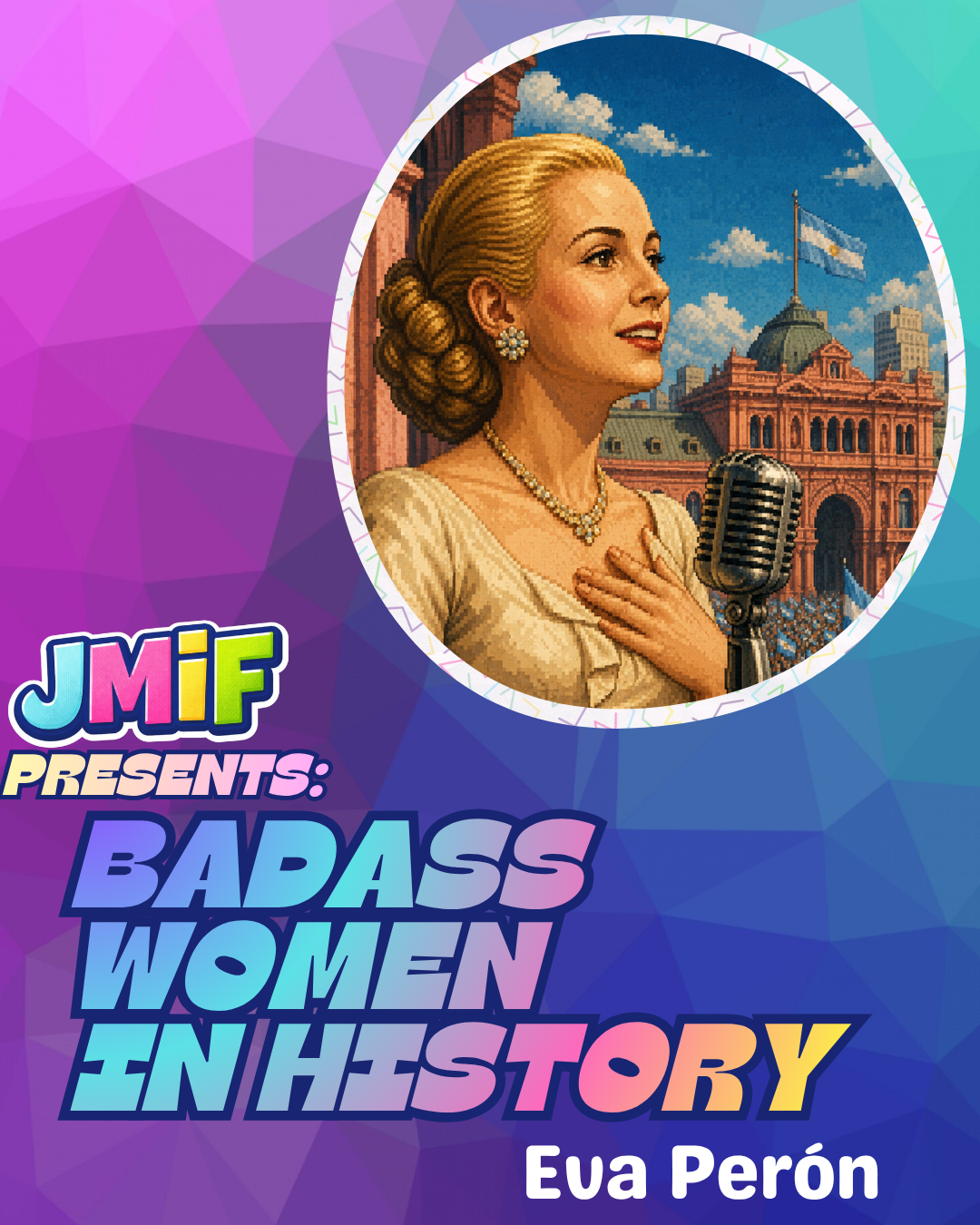
The Saint, the Demagogue, and the Body That Wouldn’t Stay Buried
Bad-Ass Women in History — Eva Perón | 1911 – 1952
First Lady • Labor Advocate • Political Icon
She made power look down and notice the poor.
Eva Perón turned fame into a weapon for Argentina’s workers, women, and forgotten poor. Loved like a saint and hated like a threat, she became impossible to ignore before dying at just 33.
Argentina • 1919–1952 • Bad-Ass Women in History
Let’s start at the end, because the end of Eva Perón’s story is so strange it sounds made up, and it tells you everything about how much she mattered.
She died in 1952, of cancer, at thirty-three. Her body was embalmed by a specialist so it could be displayed forever, the way you’d preserve a relic. Then a military coup overthrew her husband, and the new government realized they had a problem. A dead woman, lying in a casket, was still one of the most politically dangerous objects in the country. Crowds wanted to pray to her. So the regime did what you do with a weapon you can’t destroy. They hid it.
For roughly sixteen years, the embalmed corpse of Eva Perón was a state secret. It was moved, concealed, and eventually buried in Italy under a false name. When it finally surfaced, it was flown to her exiled husband in Madrid, who reportedly kept the open casket in his dining room. His next wife is said to have combed the dead woman’s hair. The body bounced between countries and regimes for nearly two decades before it was finally allowed to rest in a cemetery in Buenos Aires, ringed, with grim irony, by the tombs of the wealthy families who had despised her while she lived.
Stop and think about what it takes to frighten a government that badly. They were not scared of a living rival; she was already dead. They were scared of what she meant. A woman so potent as a symbol that her enemies felt they had to kidnap her corpse to break the spell. That is the level we are operating at with Eva Perón. So who was she, really, underneath the sainthood and the slander? Let’s dig in, and I’ll warn you now: this is one where I am not going to hand you a tidy verdict, because the honest truth doesn’t come in tidy.
The Illegitimate Girl From Nowhere
María Eva Duarte was born in 1919 in Los Toldos, a small town out on the Argentine Pampas. The records wobble a little, some say nearby Junín, and there’s reason to think the date itself was later tidied up, but the circumstances are not in doubt, and they are the key to everything that followed.
She was illegitimate. Her father, Juan Duarte, had a whole other family, a legitimate wife and children, elsewhere. Eva and her siblings were the second, unofficial family, the kind that polite society in rural Catholic Argentina treated as a stain. When her father died, Eva was around six, and the humiliation was made brutally public. By some accounts the second family was barely permitted to attend the funeral. Picture being a small child, already poor, and being told in front of everyone that you don’t quite count, that your existence is an embarrassment to be managed.
That is the wall this woman was born behind, and it is a particular kind of wall. It was not just poverty, though there was plenty of that. It was the specific, sneering judgment of a class system that had decided who was respectable and who was not, and had filed Eva firmly under not. She grew up watching the gente bien, the “good people,” the well-born, look straight through people like her. She never forgot it. And here is the thing to hold onto as we go: a great deal of what Eva Perón later did, the good and the questionable alike, makes the most sense when you read it as a woman settling a score with the people who had made her feel like nothing.
At fifteen she got on a train to Buenos Aires with one plan: become an actress. By her twenties she had clawed out a real career in radio and film. She was not a great artist, but she was a working professional who had pulled herself out of rural shame by sheer will, and crucially, she had learned the most important skill of her life. She knew how to use her voice. She knew how a performance worked, how to reach people through a microphone, how to make a listening stranger feel spoken to. Remember that, because it is the engine of all the power that came later.
The Night the Crowd Saved Him
In 1944 she met Colonel Juan Perón, a rising figure in the military government and the man in charge of labor policy. They became a couple. And in October 1945, the relationship was forged into something historic by a single dramatic event.
Perón had grown popular enough, especially with workers, that rivals in the military got nervous and had him arrested. What happened next became Peronist scripture. Hundreds of thousands of working-class Argentines, the people Perón had been courting, poured into the plaza in front of the government house, the Casa Rosada, and refused to leave until he was freed. And freed he was. He stepped onto that balcony to the roar of the crowd. The very next day, he and Eva married.
How much of that uprising Eva personally organized is genuinely debated, and I won’t overstate it; the Peronist legend gives her more credit than the sober record can fully confirm. But the symbolism locked into place regardless. From that moment, Eva and the crowd were fused. When Perón ran for president in 1946, she campaigned at his side, openly, loudly, in a way no Argentine woman in her position ever had. And she found her name for the people she spoke to: los descamisados, “the shirtless ones.” The ones without suit jackets. The ones society looked through, exactly the way it had once looked through her.
The Power She Was Never Officially Given
Here is the part that earns her a place in this series, and it is worth being precise about, because Eva Perón’s power was strange. She never held elected office. She was, on paper, just the First Lady. And yet she became one of the most powerful people in the country, operating a parallel government out of sheer force of personality and her bond with the masses.
She functioned as a de facto minister of labor and of health, even without the titles. Union leaders came to her. She brokered wage increases and, in return, helped deliver the unions’ loyalty to her husband. That arrangement is itself a fascinating tell, and historians have noted it: by routing labor’s relationship with the government through his wife rather than through another ambitious man, Perón got to keep the workers close without creating a male rival who might one day come for his job. Eva was indispensable and, conveniently, could not legally replace him. It was a brilliant and slightly cynical division of labor, and she made it sing.
And she did two things that genuinely changed Argentina.
The first was women’s suffrage. Argentine women could not vote. Eva threw her full weight, her voice, her platform, her relentless public pressure, behind changing that, and in 1947 the law passed. Women voted in a national election for the first time in 1951. She then built the Peronist Women’s Party into a massive political organization. Now, the honest caveat: she did not invent Argentine feminism, and there were suffrage activists who had been pushing this rock uphill for decades before she arrived and who got somewhat eclipsed by her star power. But it is also true that the thing had stalled for a generation, and when Eva picked it up, it moved. Both of those facts deserve to sit in the same paragraph.
The second was the Eva Perón Foundation, and this is where she becomes truly hard to sort into a box.
The Foundation: Charity, Machine, or Both?
The Foundation was Eva’s monument, and it was enormous. It built and funded hospitals, schools, orphanages, homes for the elderly, and countless other institutions. It distributed sewing machines, shoes, medicine, food. Eva herself would sit for endless hours receiving the poor in person, listening to their troubles, and pressing cash directly into their hands. For people who had spent their whole lives being treated as invisible by the state and the upper class, this was overwhelming. A glamorous, powerful woman who looked like a movie star was sitting across from them, calling them her people, and helping them. You can understand the devotion. It was real, and so, for many of them, was the help.
Now the other half of the ledger, because this series does not do hagiography.
The Foundation was funded in ways that ranged from generous to coerced. “Contributions” from unions and businesses were, by many accounts, not entirely voluntary; the word shows up in scare quotes in serious reference works for a reason. There was little in the way of transparent accounting, and rumors of money flowing in directions it shouldn’t have followed the operation. To launch it, Eva gutted and effectively destroyed the old, elite-run charitable society that had handled this sort of work, partly, it’s widely believed, because that society had snubbed her. So a charity was born partly out of a personal grudge, funded partly by arm-twisting, with no real oversight, run entirely by and credited entirely to one woman.
And here is the uncomfortable synthesis you have to hold: it was a genuine engine of help for the poor, and it was a political patronage machine that bought loyalty and consolidated the Peróns’ power, at the same time, using the same pesos. The aid was real. The gratitude was real. The political payoff was also real and entirely intended. Eva did not see a contradiction there, and honestly, maybe there isn’t one. She was helping her people and building her power, and to her those were the same project. Whether you call that compassionate populism or a personality cult dressed as charity tends to depend on which side of the Argentine class line you were standing on. That is not me dodging the question. That is the actual, unresolved heart of the question.
So… Was It Fascism?
We have to deal with this, because it hangs over everything, and because flattening it in either direction would be dishonest.
Peronism has been called fascism more or less since it began, and the comparison is not crazy on its face. Juan Perón had spent time in Mussolini’s Italy in the late 1930s and openly admired aspects of how the regime organized itself. Peronism had the hallmarks that make people reach for the f-word: a cult of personality around a charismatic leader, mass mobilization, fierce nationalism, a corporatist approach to organizing the economy through state-managed unions, and real intolerance of opposition. By the checklist some scholars use to define fascism, Peronism ticks an uncomfortable number of boxes.
But, and this is a real but, plenty of serious historians argue that calling it fascism is too easy. The blunt version of the counterargument: if you label every nationalist strongman regime “fascist,” the word stops meaning anything. Peronism came to power through elections rather than abolishing them. It was built on lifting up the working class and organized labor, which is not exactly the Mussolini playbook. It positioned itself in what it called a “third position,” neither American capitalism nor Soviet communism, something it claimed was distinctly Argentine. And tellingly, it survived its founder’s fall and is still a living political force in Argentina today, which classic fascism did not do. The most careful scholars tend to land somewhere in the middle: fascism was clearly one of the ingredients in Peronism’s DNA, an influence and a genealogy, but the finished thing was its own creature, a populism that borrowed fascist tools without being a simple copy.
I’ll be straight about where this leaves us, since the whole point of this series is to respect your intelligence. There is no scholarly consensus on what Peronism fundamentally was. Historians have argued about it for the better part of a century without settling it. Anyone who tells you the answer is obvious, in either direction, is selling you something. What we can say cleanly is this: Eva operated inside a movement with authoritarian features and fascist influences, and she also used that movement to deliver real material gains to people who had been ground down for generations. You do not have to resolve that tension to take her seriously. You just have to refuse to pretend it isn’t there.
What It Cost Her
Whatever you make of the politics, the price Eva paid was staggering and short.
She worked herself to the bone, literally. By the late 1940s she was visibly unwell, fainting, losing weight, exhausted, needing an aide at her side. The diagnosis, when it finally came clear after surgery in 1951, was cervical cancer, and it was terminal. She was in her early thirties.
And in the middle of dying, she reached for the one thing that would have crowned her power and broke against the wall that had been there all along. In 1951, the unions and the descamisados clamored for her to run as vice president on her husband’s reelection ticket. She wanted it. But the military, and likely Perón’s own calculations about how much power his wife could safely hold, would not allow it. Dying and pressured, she withdrew. There is even a contested, genuinely dark claim in the medical record that she may have undergone a lobotomy in her final months, officially to manage her pain, with at least one later analyst speculating about more sinister political motives. I flag it because it’s out there and it’s chilling, but I’d treat it as unproven rather than fact.
She gave a famous, fevered declaration that she would gladly surrender herself completely and fanatically to Perón and to the descamisados, that a life only has real value when you give it away to an ideal bigger than yourself. Read coldly, it’s unsettling, that word fanatically. Read in context, it’s a dying woman who had decided her own life was a worthwhile fuel to burn for the people she came from. She did burn it. She was thirty-three when she died, on July 26, 1952. Two million people are said to have filed past her coffin. The country shut down in grief.
How She’s Remembered vs. How She Lived
The gap between the legend of Eva Perón and the woman is maybe the widest in this entire series, because she didn’t get one afterlife. She got two, running in opposite directions.
To her devotees, she became Santa Evita, a secular saint. Congress named her the “Spiritual Chief of the Nation.” Followers literally petitioned the Catholic Church to make her a saint for real. She was the selfless mother of the poor, the woman who loved the shirtless ones and died for them. To her enemies, she was the opposite: a grasping former actress who had slept her way to power, a vulgar demagogue, the brains behind an authoritarian cult, a woman whose “charity” was a slush fund and whose sainthood was a marketing campaign. These two Evitas have been at war for seventy years. Neither is the whole woman, and the real one keeps slipping out of both frames.
And then there is the third afterlife, the one most of the English-speaking world actually knows: the Broadway and Hollywood Evita, the musical, the Madonna film, “Don’t Cry for Me, Argentina.” It made her a global pop icon and, in the process, sanded her down into spectacle, a tragic glamorous figure floating somewhere above the actual, furiously contested politics. Argentines, left and right, have often found that version maddening precisely because it drains out the thing that made her matter. The real Eva was not a melody. She was a fight.
It’s worth saying clearly: she also did not operate in a vacuum, and the legend tends to erase that. There were suffragists before her, labor organizers around her, and above all Juan Perón beside her, the actual president, whose movement this was. Eva’s genius was as a communicator and a symbol and a doer, but she rose through a man’s power structure and never fully escaped its limits, as the vice presidency episode proved. The marble saint and the cartoon villain both make her a solo act. She wasn’t one.
The Long Tail, and the Line to Now
So what did Eva Perón actually change?
An enormous amount, and it outlived her by generations. Argentine women have voted ever since 1947, and that is partly her doing. More than that, she permanently rewired the relationship between Argentine politics and the working poor. Before Perón, the descamisados were essentially outside the political system, spoken about but never to. Eva pulled them inside it and told them they belonged there, and they have refused to leave ever since. Peronism is still, decades later, one of the most powerful forces in Argentine political life, and you cannot understand it without understanding her. She did not just win some policies. She changed who counted as a citizen with a voice. That is the long tail, and it is huge.
The line to right now almost draws itself, and it cuts in more than one direction, which is exactly why she’s worth your time. Eva Perón is the original modern template for a politics built on raw emotional connection between a charismatic figure and a forgotten class, a politics that delivers real benefits to real people while also concentrating power, blurring the line between public good and personal loyalty, and treating opposition as the enemy. If that combination sounds familiar in the year you’re reading this, it should. The whole world is arguing about populism right now, about leaders who genuinely champion the overlooked and who also genuinely strain the institutions around them. Eva ran that experiment in the 1940s, and Argentina is still living inside the results. She is not a quaint historical curiosity. She is a live wire.
Here is where I land, and it’s the most honest place I can leave you. Eva Perón was not a saint and she was not a fraud. She was a poor, illegitimate, humiliated girl who turned a radio voice and a bottomless need to be respected into one of the most consequential political lives of the twentieth century, lifted up millions of people who had never been lifted before, did it through a movement with a dark authoritarian streak, and burned herself to ash before she was thirty-four. Her enemies were so afraid of what she meant that they hid her body for sixteen years and still could not make the country forget her. You do not have to admire all of that. But you cannot call it small. A woman that the powerful felt they had to kidnap in death, just to be safe, has more than earned her place among the Badass Women in History, complications and all. Maybe especially because of the complications.
More Resources to Learn About This Subject From
A real warning on sourcing for this one, because Eva Perón is the most propagandized woman in this series so far. Nearly every source about her tilts, Peronist or anti-Peronist, devotional or hostile, and you should read all of them with that in mind, including the encyclopedic ones. Birth dates and birthplaces are genuinely muddled, some details of her early life were polished by the legend, and the fascism question has no settled answer. Where I gave you a clean fact, I tried to make sure it was clean; where I gave you a contested one, I tried to say so. To go deeper, the best move is to read across the divide rather than picking one camp.
- Fraser and Navarro’s Eva Perón is widely regarded as the standard serious biography in English, and it works hard to separate the woman from both myths.
- Eva Perón (Britannica) — a solid, relatively even-handed overview of the life, the Foundation, and the bizarre journey of her body afterward.
- The Post-Mortem Kidnapping of Eva Perón (Buenos Aires Herald) — for the full, jaw-dropping saga of the embalming and the sixteen-year odyssey of her corpse.
- Peronism and the fascism debate (Wikipedia’s overview is a starting point), and for the serious scholarly argument, Federico Finchelstein’s work on the fascism-to-populism lineage is the deep end of the pool if you want it.
- Read her own autobiography, La Razón de Mi Vida (My Mission in Life), with full awareness that it is a piece of Peronist self-mythology. It’s less useful as fact than as a window into exactly how Eva wanted to be seen, which is its own kind of evidence.
If you only do one thing: hold the saint and the demagogue in your head at the same time and resist the urge to drop one of them. That discomfort is the closest you’ll get to the real woman.
Leave a Reply