
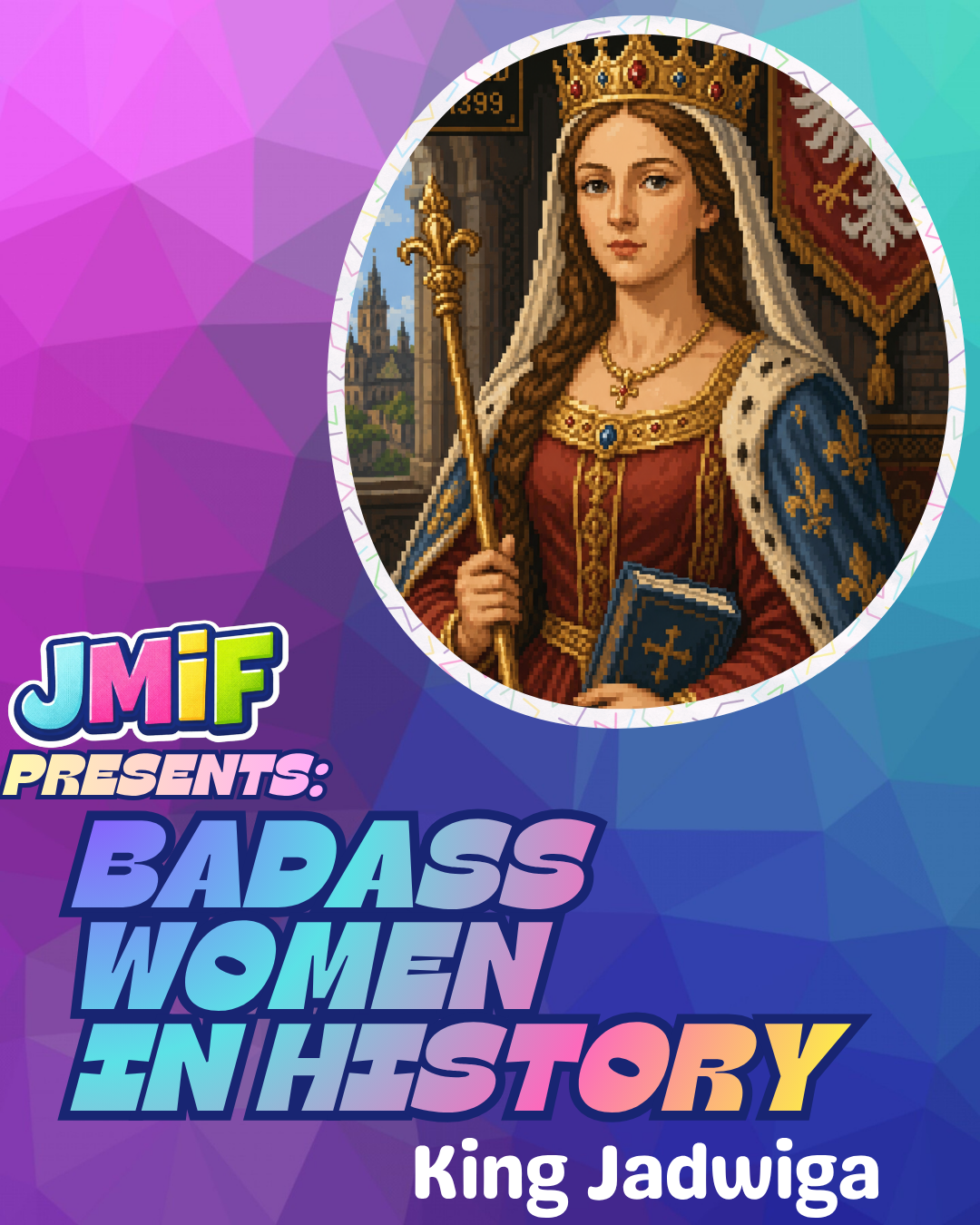
The Little Girl Who Refused to Be “Queen”
Bad-Ass Women in History — Jadwiga of Poland | 1377 – 1399
King • Diplomat • Scholar-Queen
She was crowned king because “queen” was too small.
Jadwiga inherited a throne as a child and still changed the map of Europe. She brokered power, backed learning, served the poor, and proved a young woman could rule without asking history’s permission.
Poland • c. 1377–1399 • Bad-Ass Women in History
They Crowned a Little Girl “King”
At around ten years old, Jadwiga was crowned not Queen but King of Poland, a deliberate legal trick to make a child a sovereign in her own right. What she did with that crown in just fifteen years reshaped the map of Europe. What was done to her along the way is the part the saint’s halo tends to hide.
Badass Women in History • A JMIF Original Series
In October 1384, in the cathedral on Wawel Hill in Kraków, a girl of about ten was crowned. The detail that should stop you is the title they gave her. Not Queen. King. Rex, in the Latin, the masculine word for a sovereign monarch.
This was not a clerical slip or a quirk of translation. It was a deliberate, calculated legal maneuver. The men arranging all of this needed Jadwiga to be understood as a ruler in her own right, a true monarch with sovereign authority, not a queen consort who merely sat beside a king and borrowed his power. The female title carried the wrong implications. So they reached for the male one and crowned a little girl King of Poland. In a deeply patriarchal medieval world, the system bent its own language rather than admit a woman could hold real power under a female name, which tells you something about both the limits and the strange possibilities of her position.
Here is the tension that makes Jadwiga one of the most genuinely complicated subjects in this whole series, and I’m going to be honest about it from the start rather than save it for the end. She is, today, a canonized Catholic saint, raised to the altars in 1997. The official story is one of a holy young queen who sacrificed her own happiness for the good of her people and her faith. And there is real truth in that. But she was also a child, used as a diplomatic instrument by powerful men, married off at a tender age to a stranger three times her age for reasons of state. Both of those things are true at once. She was a genuine ruler who accomplished astonishing things, and she was a girl who had enormous decisions made for her before she was old enough to fully consent to any of them. Let’s try to hold the whole woman, halo and all, and see what’s actually there.
A Pawn on a Very Large Board
Jadwiga was born in 1373 or 1374, in Buda, in Hungary, the youngest daughter of Louis the Great, who was king of both Hungary and Poland, and his wife Elizabeth of Bosnia. She was royalty of the highest order, a member of a great European dynasty, and from the moment of her birth she was less a person than an asset, a valuable game piece on the chessboard of medieval dynastic politics.
This is the wall, and it’s a particular kind of wall: not poverty or obscurity, but the gilded cage of being a high-value royal daughter. Her entire childhood was arranged around her usefulness to others. While she was still tiny, she was betrothed to Wilhelm of Habsburg, a prince of Austria, and by some accounts she spent time being raised in Austria as part of that arrangement. The two children apparently grew fond of one another. That was the plan: Jadwiga would marry her Austrian prince and serve her family’s interests through that union. Nobody asked the little girl what she wanted, because in that world it would not have occurred to anyone that it mattered.
Then her father died in 1382, and the careful plan came apart. Louis had no surviving son. His elder daughter Mary was lined up for Hungary. And the Polish nobility, the powerful magnates who effectively controlled who wore the Polish crown, made a fateful decision. They did not want their country tied to Hungary anymore, and they did not want a foreign king who would rule from somewhere else. They wanted a monarch who lived among them, whom they could shape. So they chose Jadwiga, a child, and summoned her to Poland to be their sovereign.
And so, at around ten years old, she was crowned King of Poland. Read that scene honestly. A little girl, taken from the life and the betrothed she knew, brought to a foreign court, and set on a throne by a council of grown men who had very specific plans for her. The grand title was real, but so was the reality underneath it: she was, at that moment, a child being positioned for the magnates’ next move. And their next move was going to be enormous.
The Marriage That Made an Empire
The magnates had a far bigger prize in mind than ending the union with Hungary. To Poland’s east lay Lithuania, the last great pagan power in Europe, a vast realm ruled by a grand duke named Jogaila. Lithuania was under constant assault from the Teutonic Knights, a crusading military order that used the Lithuanians’ paganism as a permanent excuse for holy war, conquest, and plunder. Both Poland and Lithuania had reason to fear the Knights. And someone, on the Polish side, saw a way to solve several problems with a single marriage.
The deal, set down in the Union of Krewo in 1385, was breathtaking in scope. Jogaila would marry Jadwiga. In exchange, he would convert to Roman Catholicism, bring his entire pagan people into the Christian fold, unite his Lithuanian lands with the Polish crown, recover territory Poland had lost, and stand with Poland against the Teutonic Order. In one stroke, the marriage would create a combined Polish-Lithuanian power large enough to reshape the balance of all of central and eastern Europe, and it would pull the rug out from under the Teutonic Knights by removing their justification for crusade, because you cannot wage holy war against pagans who have just become Christians.
There was just the matter of the bride. Jadwiga was a young girl, betrothed to and fond of her Austrian prince Wilhelm, who actually traveled to Kraków to try to make good on their union. And the man the magnates wanted her to marry instead, Jogaila, was a grown man, by most accounts roughly three times her age, a stranger, a foreigner, and, until the ink dried, a pagan. The Polish lords blocked Wilhelm, sent him packing, and arranged the marriage to Jogaila. In 1386 Jogaila was baptized, taking the Christian name Władysław, married Jadwiga, and was crowned king alongside her.
The sacrifice, and the harder truth under it
Here is where the saintly legend and the historical reality have to be held together, carefully, because this is the moral heart of her story.
The pious version, the one told at her canonization and in centuries of Polish devotion, is genuinely moving. In it, Jadwiga agonizes over the marriage, prays long and hard for guidance, and then freely chooses to give up her own happiness, her Austrian prince, her personal wishes, for a greater good: the conversion of a whole pagan nation, peace, the security of her kingdom, the salvation of souls. In this telling she is not a victim but a heroine of self-sacrifice, a young woman who consciously laid down her own desires for her people. That is the saint.
The harder truth, the one a clear-eyed modern reader cannot simply ignore, is that we are talking about a girl of roughly eleven or twelve, whose marriage was engineered by powerful men for reasons of state, to a man decades her senior, after her existing engagement was forcibly broken. Whatever prayers she said, the structural reality is that a child was used as the instrument of a geopolitical strategy she did not design. To pretend that was a fully free adult choice is to flatter the story and erase the girl.
So which is it? Honestly, it is both, and refusing to collapse it into one is the only fair thing to do. It is entirely possible, even likely, that Jadwiga both was used as a dynastic pawn and came to genuinely embrace the purpose she’d been handed, to find real meaning and even a kind of agency in the role of a queen who could Christianize a nation and secure a realm. People, including children thrust into impossible positions, do find ways to author themselves inside situations they did not choose. The saint’s halo is not simply a lie. But it is a story told by an institution with a deep stake in one interpretation, and the honest reader keeps one eye on the eleven-year-old underneath it. Both deserve to be seen.
What She Actually Did With the Crown
Now for the part that should retire, permanently, any idea that Jadwiga was merely a passive bride. Because in a reign of only about fifteen years, ended by her death at twenty-five, this woman did things that mark her as a real and capable ruler, not a figurehead.
She led military and diplomatic campaigns herself. Astonishingly, while still in her early-to-mid teens, she personally led an expedition to recover the region of Galicia, also called Red Ruthenia, for the Polish crown, territory that had slipped under Hungarian control. By several accounts she rode into the disputed lands and persuaded their inhabitants to accept Polish sovereignty, settling a long-running conflict. Sit with that image: a teenage girl leading a campaign of statecraft and persuasion to expand and secure her kingdom’s borders. That is not the behavior of a chess piece. That is a player.
She was a diplomat and a peacemaker. She mediated in the bitter quarrels among her husband’s relatives, and crucially she conducted negotiations with the Teutonic Order, the predatory crusading state on the kingdom’s flank. Her diplomacy with the Knights is credited with buying precious time and stability for the young union at a dangerous moment. While she lived, by the assessment of serious historians, she remained the leading personality in the realm, the more commanding presence of the two co-rulers, even alongside her grand-duke husband.
And she made what may be her most lasting mark of all: she rescued a university. The academy at Kraków, founded decades earlier by King Casimir the Great, had fallen into decline. Jadwiga threw her support behind its restoration, secured permission to add a faculty of theology, and, in her will, bequeathed her personal jewels to fund its renewal. The institution was reborn shortly after her death and eventually took the name of her husband’s dynasty: the Jagiellonian University. It became the intellectual heart of Poland and one of the great universities of central Europe, and it is thriving to this day, more than six centuries later. A woman who died at twenty-five funded, with her own jewelry, an institution that has been educating people continuously ever since. Among its later students, generations on, would be Copernicus.
Beyond the Marble Saint
It would be easy to let the canonization do all the characterization here, to leave her as a serene figure of piety and charity. And the piety was, by every account, real; she was genuinely devout, attended Mass daily, and was remembered as a protector of the poor, a sponsor of hospitals and schools, a woman regarded almost as a spiritual mother to the kingdom’s most vulnerable. She even ordered religious hymns sung in Polish, the everyday language of the people, rather than only in Latin, a small but telling instinct toward making faith accessible to ordinary subjects rather than keeping it locked up in the clergy’s tongue.
But there are glimpses of a more complicated, more human person under the halo, and they’re worth honoring too. This was a woman who had been raised to be useful and who learned to be effective, who could lead a border campaign and stare down crusader-knights across a negotiating table. That is not pure gentle saintliness; that is competence, nerve, and political skill. And it is worth being honest about the limits of her power too: when rebellious nobles in Hungary murdered her own mother, Jadwiga, by the record, did not or could not act in response. She operated inside hard constraints, sometimes able to move boldly, sometimes boxed in. The fully rounded Jadwiga is neither a helpless victim nor a flawless saint, but a sharp, capable young ruler doing real work inside a cage of dynastic obligation, and occasionally rattling its bars hard enough to reshape a continent.
What It Cost Her
The cost, in the end, was everything, and it came in the most brutally ordinary way a medieval woman could pay it.
After more than a decade of marriage that had, for a long time, produced no child, Jadwiga finally became pregnant. In the summer of 1399 she gave birth to a daughter, baptized Elizabeth Bonifacia. The infant lived only a few weeks. And Jadwiga, weakened by the birth, died just days after her baby, on July 17, 1399, of what we would now recognize as postpartum complications. She was about twenty-five years old. Mother and daughter were buried together in Wawel Cathedral.
Think about the full arc of that life. Taken from her home and her betrothed as a child. Crowned with a borrowed masculine title at ten. Married off to a stranger for reasons of state at eleven or twelve. Made to carry, for fifteen years, the weight of a kingdom and a continent-spanning union. And then killed, at twenty-five, by the one role the medieval world valued most in a queen and pressured her hardest to fulfill: bearing an heir. The thing she was ultimately for, dynastically, is the thing that killed her. There is a grim, unsentimental irony in that which no halo can quite cover. She gave, quite literally, her whole life and her body to the role assigned to her, and got twenty-five years.
The Making of a Saint
Now to the legacy, and here Jadwiga offers something unusual for this series: a legend that is not so much a distortion as an official, institutional canonization, in the most literal sense.
The Polish people venerated her as a holy figure almost immediately after her death; her cult began to grow within years, and locally she was treated as a saint for centuries. But the formal, capital-C Canonization came startlingly late, in 1997, nearly six hundred years after she died, when Pope John Paul II declared her a saint. And the circumstances are worth examining honestly, not cynically. John Paul II was Polish, the most consequential Pole of the twentieth century, a pope whose support had helped crack open the communist grip on his homeland. He canonized Jadwiga in Kraków, on Polish soil, in what was the first canonization Mass ever held in Poland. In his homily he praised her as the only woman on the throne of Poland, young and beautiful and clever, who could have had anything and instead chose the good of her people.
Notice what’s happening there. A Polish pope, in a moment heavy with national meaning for a country emerging from communism, elevates a medieval Polish ruler into an official saint and a symbol of Polish identity, Christian devotion, and a unified Christian Europe. None of that makes her unworthy of veneration, and I want to be respectful: for millions of believers her sainthood is a matter of genuine faith, and her piety and charity were real. But it would be naive to pretend the canonization was a purely timeless spiritual verdict untouched by history. Saints are made by institutions, in particular moments, for reasons that braid the holy together with the national and the political. Jadwiga the saint is a real and beloved figure. She is also, partly, a figure shaped by what twentieth-century Poland needed her to be, which is its own fascinating layer rather than a knock against her.
The gap between legacy and reality here is not the usual one of erasure. Jadwiga is gloriously remembered. The gap is subtler: the marble saint can quietly crowd out the actual person, the capable teenage ruler and the used child both, leaving only the serene icon. Recovering the human being, in all her contradiction, is the work.
The Long Tail, and the Line to Now
So what did Jadwiga actually change? Here the answer is genuinely enormous, arguably out of all proportion to her short life.
The marriage and union she anchored set in motion one of the great state-building projects of European history. The Polish-Lithuanian connection that began with her wedding grew, over the following centuries, into the Polish-Lithuanian Commonwealth, for a long stretch one of the largest and most powerful states in all of Europe, a multi-ethnic, multi-confessional realm that shaped the entire eastern half of the continent until the late eighteenth century. The Christianization of Lithuania that her marriage required permanently redrew the religious and cultural map of the region. And the university she rescued with her jewels became, and remains, one of the intellectual engines of Polish civilization. Few rulers who reigned for fifty years changed as much as this woman changed in fifteen, dead at twenty-five.
The lines to now run in a couple of directions, and they pull against each other in a way that’s honest rather than tidy. The first is the uncomfortable one. Jadwiga’s story is, at its foundation, a story of a child married off for political advantage, and that is not a safely closed chapter of history. Child marriage and the use of girls as instruments of family and political strategy are still realities in much of the world today. The medieval grandeur can make us forget that the mechanism at the center of this celebrated tale is one we would, in the present, rightly call a violation. Holding the admiration and that discomfort together, rather than letting the crown and the halo wash the discomfort away, is part of telling her truthfully.
The second line is more affirming, and just as real. Within the cage she was placed in, Jadwiga found ways to act, to lead, to build, to leave the world materially changed. She is a striking case of a person who was handed almost no real choices and still managed to author a meaningful legacy out of the role forced on her, founding a university that has outlived empires, securing borders, brokering peace. There is something quietly powerful in that for anyone who has ever had to make something worthwhile out of a situation they did not choose. She did not get to pick her life. She picked, as much as she was able, what to do inside it.
They crowned a little girl King because they needed a sovereign and would rather rewrite the language of power than leave the throne to a woman under her own name. They married her off as a child to bind a continent together. They turned her, centuries later, into a saint for reasons both holy and national. Through all of it, an actual person was doing actual work: leading campaigns in her teens, funding a university with her jewels, dying at twenty-five for a role she never chose. Refusing to let either the pawn or the saint swallow the whole of her, and insisting on the capable, constrained, consequential young woman in between, is how she earns her place among the Badass Women in History. Not because she was a flawless holy queen, but because she was a real girl handed an impossible job who reshaped Europe before she was old enough to have lived a full life at all.
More Resources to Learn About This Subject From
A note on sources. Jadwiga is unusually well documented for a medieval figure, but much of the writing about her is devotional, shaped by her sainthood, so the trick is reading the piety and the politics alongside the evidence. A few things genuinely wobble: her exact birth date, her precise age at coronation and marriage (somewhere around ten and eleven respectively), and how much of the saintly self-sacrifice narrative reflects her actual inner life versus later hagiography. Where I leaned on the legend, I tried to flag it as legend. To go deeper, start here.
- Jadwiga (Britannica) — a sober overview that credits her real political leadership while keeping the dates and the dynastic machinery straight.
- Union of Krewo (background) — the 1385 agreement that turned her marriage into a continent-altering political deal; essential for understanding what was really being negotiated over her.
- Faces of Jadwiga (Kraków Travel) — strong on her concrete achievements, especially the teenage Ruthenia campaign and the founding of the Jagiellonian University with her jewels.
- For the saint’s side of the story, read about her 1997 canonization by John Paul II and the centuries-old Polish cult around her, then read it critically, noticing where devotion and national feeling shape the portrait. Holding the saint and the historical girl side by side is the whole exercise.
If you take one thing from her: be wary of any story that’s purely beautiful. The crown and the halo are both real, but there was a girl underneath them who deserves to be seen whole.
Leave a Reply