
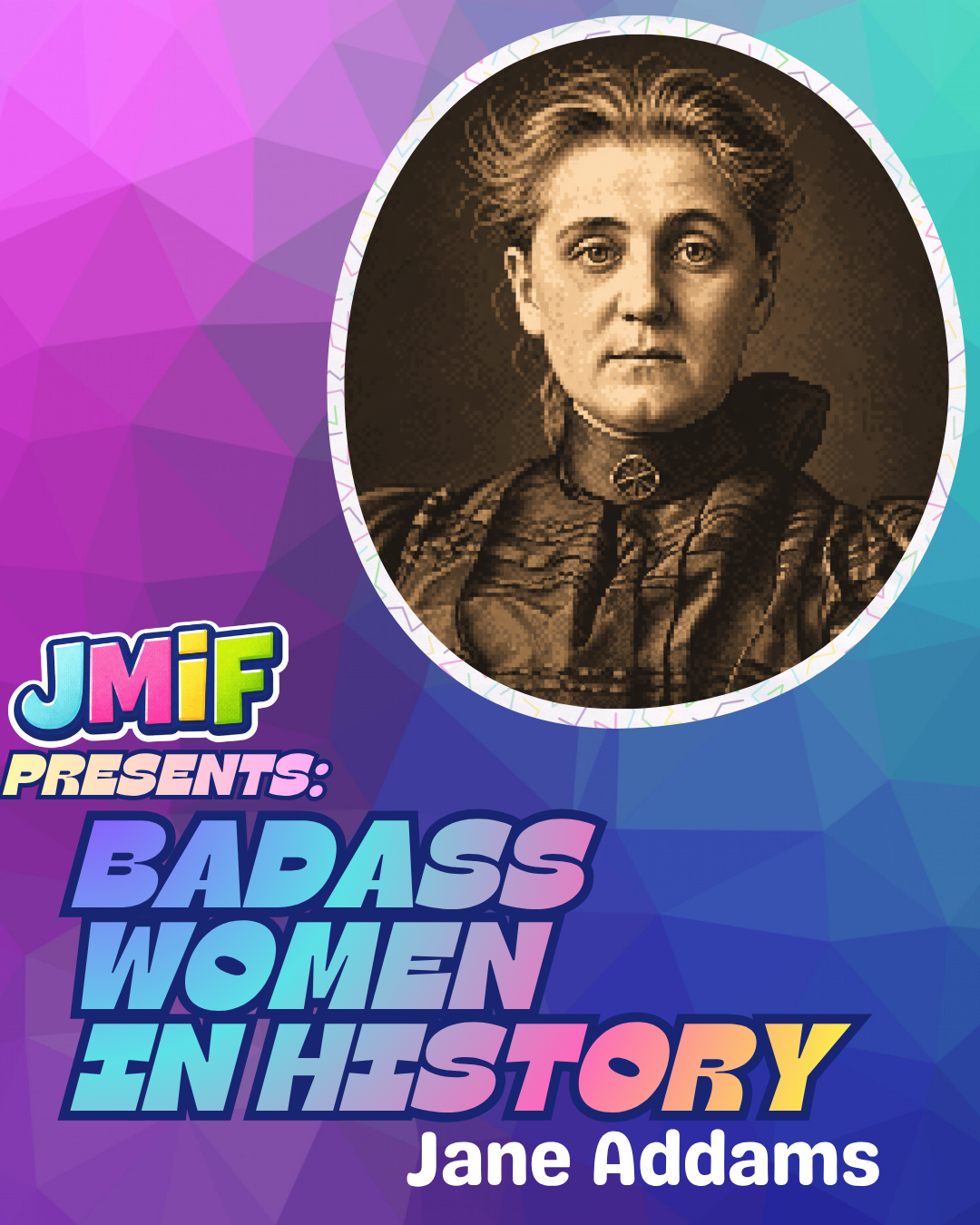

Jane Addams, Ellen Gates Starr, and the Hull House Women Who Made Social Reform Everyone’s Problem
Some people inherit a mansion and throw parties.
Jane Addams and Ellen Gates Starr got access to one and built one of the most influential social reform laboratories in American history.
Which is the polite way of saying: two Illinois women looked at industrial Chicago — the poverty, child labor, tenement housing, sickness, political neglect, and decided, “Absolutely not. We live here now.”
That place was Hull House.
Founded in 1889 on Chicago’s Near West Side, Hull House became a settlement house: part neighborhood center, part school, part childcare provider, part arts hub, part organizing space, part research lab, and part political pressure cooker. It served immigrant and working-class families in a neighborhood packed with Italian, Irish, German, Greek, Bohemian, Russian, and Polish Jewish residents trying to survive the city’s industrial grind.
But Hull House was never just charity. Please. We are not doing the lace-glove version of history today.
Hull House insisted poverty was not a personal failure. It insisted immigrants deserved dignity. It insisted children belonged in school, not factories. It insisted labor conditions were a public concern. It insisted women — even women without elected office, voting rights, or permission from the patriarchy’s dusty little clipboard — could collect data, expose abuse, shape policy, and change the law.
And while Jane Addams is deservedly the most famous name attached to Hull House, the real story is bigger, messier, and much more interesting. Hull House became a powerhouse because Addams and Starr built the door, then women like Florence Kelley, Julia Lathrop, Alice Hamilton, and Alzina Stevens stormed through it with clipboards, case files, medical research, labor organizing, and no patience for nonsense.
If you love women who turned grief into infrastructure, read about Lydia Moss Bradley. For more women who refused to shrink themselves, explore Zaha Hadid and Gwendolyn Lizarraga in the Badass Women in History archive.
Now, back to Chicago. Because Hull House was not born in a vacuum. It was born in smoke.
The City Was Booming. People Were Breaking.
Late 19th-century Chicago was doing what America loves to do: growing fast, bragging loudly, and making vulnerable people pay the invoice.
Factories expanded. Railroads moved goods. Meatpacking, manufacturing, and sweatshop labor fueled wealth. Immigrants arrived in huge numbers, often crowded into unsafe housing with low wages, poor sanitation, and few public supports. People often soften this history with words like “urbanization” and “industrialization,” as if those were weather patterns. Nope. Those conditions were produced, tolerated, and profitable.
Addams, born in Cedarville, Illinois, in 1860, came from privilege but had no interest in becoming a decorative daughter of comfort. Starr, born in Laona, Illinois, in 1859, had been Addams’s classmate at Rockford Female Seminary and worked for years as a teacher. During a trip to Europe, the two visited Toynbee Hall in London, a settlement house where educated residents lived among working-class neighbors and offered educational and social support.
They came home with an idea that was simple and wildly radical: instead of treating poor people as distant objects of pity, they would live in the neighborhood, learn from residents, and build programs around what people actually needed.
Imagine that. Listening to communities before designing services for them. Revolutionary then. Still apparently revolutionary now.
Hull House Opens Its Doors
In 1889, Addams and Starr opened Hull House in a mansion at 800 South Halsted Street. Their early goals were modest: art, literature, education, connection. Starr especially believed beauty was a public good, not a luxury item reserved for people with inherited silverware and opinions about “good breeding.”
That matters.
People do not stop needing beauty because they are poor. Children do not stop needing imagination because their parents work long hours.
Hull House offered kindergarten, daycare, English lessons, citizenship classes, lectures, libraries, music, theater, public baths, playgrounds, meeting space for labor groups, and clubs for children and adults. As the settlement expanded, it became a 13-building complex and one of the most important reform centers in the country.
Then came the women who turned it from a neighborhood center into a policy machine.
Florence Kelley Brought the Receipts
If Jane Addams was the public conscience of Hull House and Ellen Gates Starr helped shape its cultural soul, Florence Kelley was the woman walking into sweatshops with a notebook and a look that said, “Lie to me. I dare you.”
Kelley moved into Hull House in 1891 and investigated sweatshops, tenement labor, child labor, women’s working conditions, wages, hours, and the brutal gap between industrial profit and human cost. Her work was not abstract. She documented children working in overcrowded apartments and unsafe workplaces.
In 1893, Illinois passed a Factory Inspection Act that prohibited the employment of children under 14 and limited working hours for women and children. Governor John Peter Altgeld appointed Kelley as Illinois’s first chief factory inspector, with Alzina Stevens as her assistant.
A woman, in the 1890s, had authority to inspect factories and enforce labor protections in an economy where factory owners were used to doing whatever they wanted. Naturally, business interests fought it.
The Illinois Manufacturers’ Association helped get the law overturned in 1895. Because the system rarely says, “Wow, you caught us exploiting children. Our bad.”
But Kelley did not disappear. She became a national leader in consumer advocacy, child labor reform, and workplace protections. Hull House gave her a base, a network, and a living laboratory for reform. She used all three.
Julia Lathrop Made Child Welfare a Public Responsibility
Julia Lathrop arrived at Hull House in 1890 with administrative brilliance, investigative discipline, and a deep commitment to children who had been treated as disposable by courts, institutions, and public agencies.
Before modern juvenile justice reform, children could be jailed with adults. Let that sit for a second. A child could be treated as a miniature criminal rather than a young person shaped by poverty, neglect, disability, trauma, or lack of support.
Hull House reformers were deeply involved in the movement that led to the first juvenile court in the United States, opened in Chicago in 1899. Lathrop served on the first Juvenile Court Committee, and Hull House resident Alzina Stevens became the court’s first probation officer.
In 1912, President William Howard Taft appointed Lathrop as the first chief of the newly created U.S. Children’s Bureau. She was the first woman to head a federal bureau in the United States. From there, she helped move child welfare into national policy, studying infant mortality, maternal mortality, child labor, juvenile delinquency, birth registration, mothers’ pensions, and the conditions facing dependent and disabled children.
Translation: she helped make the government pay attention to children as human beings with rights, needs, and public value. Radical concept.
Alice Hamilton and Alzina Stevens Made Harm Visible
Alice Hamilton, a physician and Hull House resident, helped build the field of occupational medicine in the United States. Living at Hull House gave her a close-up view of industrial labor’s human cost, and she studied the effects of lead, carbon monoxide, mercury, and other industrial poisons on workers.
While some reformers focused on wages and hours, Hamilton focused on the body: lungs, nerves, blood, fatigue, illness, injury. In other words, she studied what capitalism leaves behind in people’s bones.
Her work made it harder for employers and governments to pretend occupational disease was just bad luck or personal weakness. She later became the first woman appointed to the faculty at Harvard Medical School, though not with equal privileges to male faculty. The audacity is almost impressive. Almost.
And then there was Alzina Stevens, who deserves far more attention than she usually gets.
Born in Maine in 1849, Stevens worked in textile mills as a child and suffered a serious industrial injury when she was young. She became a labor leader, journalist, editor, suffragist, and reformer. By the time she came to Hull House, she was not theorizing about child labor from the outside. She knew what it meant to be a working child in an economy that treated young bodies as cheap machinery.
As Florence Kelley’s assistant factory inspector, Stevens helped enforce Illinois labor protections and brought a working-class perspective into reform spaces that could have become elite women speaking for the poor rather than with them. That distinction matters.
Hull House Was Not Charity. It Was Infrastructure.
The lazy version of Hull House history says nice women helped poor immigrants.
The accurate version says Hull House became a social reform engine because women built infrastructure where government had failed, then used that infrastructure to force government to do its job.
They provided childcare so mothers could work, classes because education was survival, cultural programming because dignity includes beauty, and research because documented patterns are harder to ignore.
Was it perfect? No.
Settlement houses carried class privilege and assimilationist assumptions. We do not need to pretend otherwise. History is more useful when we let it be complicated.
But Hull House at its best was about proximity, accountability, and action. It created alternative routes into public life for women shut out of formal political power. They became researchers, organizers, administrators, inspectors, physicians, advocates, and policy architects.
They turned “women’s work” into public policy.
And that is exactly why the system should have been nervous.
Jane Addams received the Nobel Peace Prize in 1931, the first American woman to do so. Ellen Gates Starr continued her work in labor, art, and social reform. Florence Kelley shaped national fights over child labor and consumer protections. Julia Lathrop transformed child welfare at the federal level. Alice Hamilton helped make occupational health a serious field. Alzina Stevens connected labor activism to juvenile justice with the force of someone who knew exactly what exploitation cost.
Together, they made Hull House more than a building.
They made it a threat.
A threat to employers who profited from child labor, politicians who preferred poverty invisible, courts that treated children like disposable adults, and every comfortable person who wanted charity without justice.
Hull House was not badass because it was sweet. It was badass because it was strategic. It took the supposedly feminine virtues — care, teaching, homemaking, neighborliness, child welfare, cleanliness, moral concern — and weaponized them against systems of exploitation.
It said: Fine. If you think women belong in the home, we will expand the definition of home until it includes the neighborhood, workplace, courtroom, legislature, school, hospital, and federal government. Icon behavior, honestly.
May we all be so annoying.
Learn More / Sources
Websites
- “About Jane Addams and Hull-House Settlement,” Jane Addams Hull-House Museum, https://www.hullhousemuseum.org/about-jane-addams, accessed 2026.
- “Hull-House,” National Park Service, https://www.nps.gov/places/hull-house.htm, 2021.
- “Hull House,” Social Welfare History Project, Virginia Commonwealth University Libraries, https://socialwelfare.library.vcu.edu/settlement-houses/hull-house/, 2011.
Book
- “Twenty Years at Hull-House,” Jane Addams, Macmillan, 1910.
Video / Show
- “Chicago Stories: Jane Addams,” WTTW / PBS, https://www.wttw.com/chicago-stories/jane-addams, 2023.
Notes on contested or complicated history
- Some sources describe Hull House as the first settlement house in the United States. That claim is contested because other U.S. settlement efforts, including the Neighborhood Guild/University Settlement in New York, predated Hull House. A safer phrasing is that Hull House was Chicago’s first settlement house and one of the most influential settlement houses in U.S. history.
- Hull House was groundbreaking, but settlement work also carried class and assimilation tensions. Many residents sincerely worked with immigrant communities, but some reform efforts reflected middle-class assumptions about how working-class and immigrant families “should” live.
- Jane Addams is often centered in public memory, which is understandable given her leadership and fame, but Hull House’s impact was collective. Ellen Gates Starr, Florence Kelley, Julia Lathrop, Alice Hamilton, Alzina Stevens, and many others were essential to its power.
Leave a Reply