
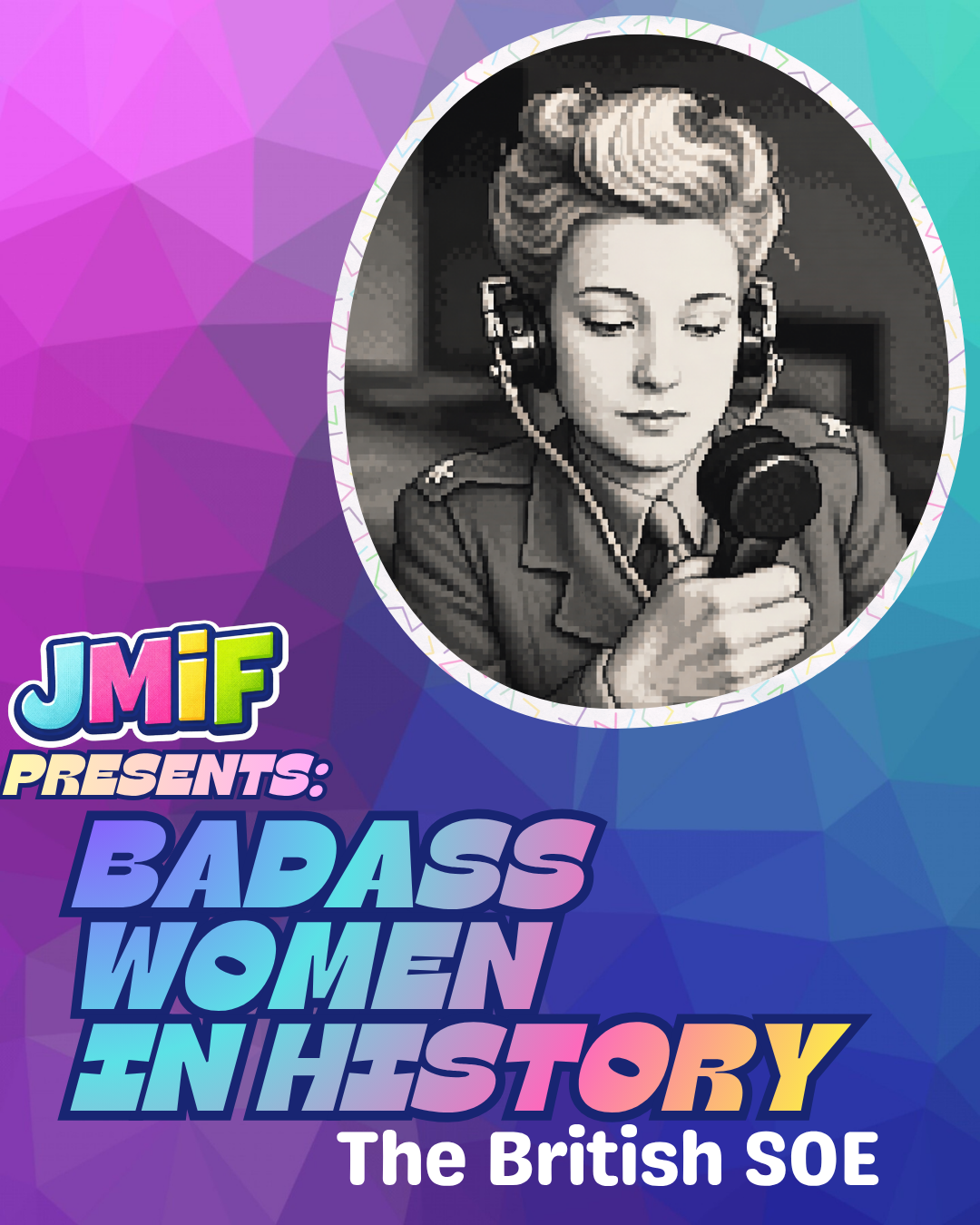
They were recruited because the enemy couldn’t even imagine them.

The Women of Britain’s Special Operations Executive: Invisible on Purpose
In occupied France, a man of military age walking down a street was a problem. He was a candidate for labor conscription, for a document check, for arrest on a slow afternoon. He was, structurally, suspicious.
A woman pushing a bicycle with a basket on the front was furniture.
That is why Britain sent women into France. Not principle. Not progress. The Special Operations Executive worked out that the Nazi regime’s contempt for women was a hole in its security architecture, and it drove a truck through it.
Read that again, because it is the whole thing. These women were selected for the war’s most lethal work precisely because the enemy could not conceive of them as dangerous.
And then, after the war, neither could Britain.
“Set Europe Ablaze”
In July 1940, with the continent gone and invasion expected, Churchill instructed Hugh Dalton to build an organization for sabotage and subversion behind enemy lines. Dalton recorded the phrase in his diary: set Europe ablaze.
The SOE’s F Section ran agents into France. Historians generally count thirty-nine women sent in. Roughly a third did not come back.
Seven of them are the reason this series exists, and each will get her own entry. This is the room they walked into.
Virginia Hall, Who the Gestapo Never Identified
She wanted the American Foreign Service. The State Department turned her down repeatedly, and after a hunting accident in Turkey cost her a leg below the knee, told her plainly that a one-legged woman had no future in government.
She named the wooden prosthetic Cuthbert.
In 1941 she went into Lyon for the SOE under cover as a reporter for the New York Post, and she built the Heckler network out of people no military officer would have recruited: a brothel keeper who ran safe houses and reported on German officers, a doctor who hid wounded agents in a psychiatric asylum, shopkeepers who served as dead drops.
Now here is the detail that gets lost in every retelling, including some of the good ones.
The Gestapo hunted her ferociously. Their internal communications reportedly called her the most dangerous of all Allied spies and ordered that she be found and destroyed. They plastered occupied France with wanted posters.
The posters carried a sketch. Not a photograph. They had her described secondhand by double agents.
They never learned her name. They never even worked out her nationality. Klaus Barbie is said to have raged about a limping Canadian, which she was not.
She was hunted across a country by the most efficient secret police in Europe, and they did not know who she was. In November 1942, with Vichy France about to be occupied outright, she walked out of the country over the Pyrenees. Roughly fifty miles. Two or three days. Snow. On the wooden leg.
The SOE would not send her back, so she joined the American OSS and went back anyway.
The Other Six
Krystyna Skarbek, a Polish countess and champion skier, walked into British intelligence in 1939 with an unsolicited plan to ski into occupied Poland. In August 1944, with her network commander hours from execution, she walked into a Gestapo office in Digne, claimed to be General Montgomery’s niece, spent three hours explaining to a frightened man exactly how his war was going to end, and walked out with the prisoners.
Noor Inayat Khan, a Sufi nobleman’s daughter, a children’s author and a pacifist, took the most lethal job in the field: wireless operator. Direction-finding vans could triangulate a transmitter in minutes. When her Paris network collapsed in mass arrests within days of her arrival, London ordered her home. She refused. For roughly four months she was the last radio link between London and the resistance in Paris, alone, carrying her set across the city in what looked like a music case.
Nancy Wake, the White Mouse, with five million francs on her head, commanded thousands of maquis in the Auvergne and won them over by outshooting and outmarching them. When her codes were destroyed, she rode a bicycle roughly five hundred kilometres through German checkpoints and back in about seventy-one hours.
Violette Szabo, twenty-three, widowed by El Alamein, was cornered at a roadblock near Salon-la-Tour in June 1944 with a Sten gun and an injured ankle.
Odette Sansom (later Hallowes) was arrested in 1943 and convinced her interrogators that Peter Churchill was the Prime Minister’s nephew, that she was married to him, and that she, not he, ran the network. She made herself valuable enough to be worth keeping alive, and him too.
Pearl Witherington was, her instructors said, the best shot the SOE had ever seen.
She never carried a gun in France.

The Claim I Am Not Going to Make
You will read, in a great many places, that the women of the SOE consistently outperformed the men. That their networks had better security. That the data proves it.
There is no data.
There is no comparative study of network longevity by the gender of the organizer. Nobody was keeping that spreadsheet, and the sample sizes are tiny, and half the relevant files stayed classified for decades. When you see a tidy table on this subject with a column labeled something like “core security innovation,” somebody made that up.
I want it to be true. It is the sort of thing that ought to be true. The men frequently did arrive with military reflexes that got people killed, and Virginia Hall genuinely did build a network out of civilians when the doctrine said not to, and it genuinely did outlast the ones built to doctrine.
But a series about people whose credit was invented away has no business inventing credit. So here is what the record actually shows, and it is enough.
The Medal She Sent Back
Pearl Witherington’s network organizer, Maurice Southgate, was arrested by the Gestapo in May 1944. Rather than wait for London to send a man, she split the circuit and took command of the Wrestler sector: roughly two thousand maquis in the Indre.
In June 1944, her fighters and the neighboring network cut the Paris to Bordeaux railway more than eight hundred times, hobbling German reinforcement of Normandy. The Germans put a million francs on her head. The SOE’s official historian later called the network highly successful and Witherington herself incomparable.
After the war she was recommended for the Military Cross.
Women were ineligible for the Military Cross.
So the War Office sent her a Member of the Order of the British Empire, in the civil division. The one for exemplary office work.
She sent it back, with a note observing that there had been nothing remotely civil about what she did, and that she had not sat behind a desk all day.
They eventually gave her a military MBE. She got a CBE in 2004. And in April 2006, at ninety-two, after a sixty-year wait, she was finally given her parachute wings, which she valued above both. She had made three training jumps and one operational. The men made four training jumps and one operational, and wings required five.
She did the war. They docked her a jump.
September 1944
Here is the thing I did not know before I wrote this, and it reorganized my understanding of the whole story.
In early September 1944, near Issoudun, more than nineteen thousand German troops under General Botho Elster were surrounded and beaten by French maquis. Witherington’s Wrestler network had spent months making that possible.
Elster refused to surrender to the maquis. Irregulars. Terrorists, in the German framing. He negotiated instead with an American general, Robert Macon, so that he could hand his sword to a regular army.
The maquis who had defeated him were not invited to the surrender ceremony. Neither ceremony. Not at Issoudun on September 11, not at Beaugency bridge on September 16.
The erasure did not begin after the war. It began before the war ended, at the moment of victory, in front of everyone.
What Happened to Them
Virginia Hall received the Distinguished Service Cross in 1945, the only civilian woman to be awarded it in the war. Truman wanted to give it to her at the White House. She declined, because publicity would end her usefulness. She went to the CIA, which put her at a desk and referred to her as the gung-ho lady left over from the OSS days. She retired at the mandatory age of sixty, to a farm.
Krystyna Skarbek, stateless because Poland was now Soviet, was given a small payment and left to it. She worked as a stewardess on ocean liners and a shop clerk. She kept her medals in a suitcase in a rented room. In 1952 she was stabbed to death in a London hotel by a man she had rejected.
Noor Inayat Khan was executed at Dachau in September 1944. Violette Szabo was executed at Ravensbrück in early 1945, aged twenty-three. Odette Hallowes survived a year of solitary confinement and spent the rest of her life advocating for veterans.
Nancy Wake, asked in old age whether she had been frightened, said she had been too busy being angry.
They were recruited because a woman with a shopping basket is invisible.
They were forgotten for exactly the same reason.
Related: Josephine Baker, who smuggled intelligence for the French Resistance and waited sixteen years for her medal. And the Women of ENIAC, recruited for work the men found beneath them.
Learn More
Websites
- WANTED: The Limping Lady, Smithsonian Magazine, https://www.smithsonianmag.com/history/wanted-the-limping-lady-146541513/, 2007
- Pearl Witherington, Spartacus Educational, https://spartacus-educational.com/SOEwitherington.htm, n.d.
- World War II’s “Most Dangerous” Allied Spy Was a Woman With a Wooden Leg, HISTORY, https://www.history.com/articles/female-allied-spy-world-war-2-wooden-leg, 2025
Book
- A Woman of No Importance: The Untold Story of the American Spy Who Helped Win World War II, Sonia Purnell, Viking, 2019. The essential Virginia Hall biography. For the institutional record, M. R. D. Foot’s SOE in France (HMSO, 1966) remains the official history and is where most of the reliable numbers come from.
Video / Show
- Carve Her Name with Pride, dir. Lewis Gilbert, https://www.imdb.com/title/tt0051495/, 1958. The Violette Szabo film, and also the origin of a good deal of the Szabo mythology. Watch it knowing that.
A Note on Contested and Widely Oversimplified Claims
The biggest change from the earlier draft: the comparative claim has been cut. No comparative dataset exists showing that women-led SOE networks had higher security integrity than male-led ones. Nobody compiled it. Sample sizes are small, records were classified for decades, and confounders are everywhere. Any table presenting per-agent “core security innovations” as findings is analysis dressed as evidence. The qualitative argument (Hall’s civilian recruitment outlasted doctrine-built networks) is defensible. The quantitative one is not, and a series about invented credit cannot invent credit.
Virginia Hall. The Gestapo phrase “the most dangerous of all Allied spies” comes from internal communications about an unidentified woman with a limp. They had a sketch from double agents, never a photograph, never her name, never her nationality. The Klaus Barbie quote about a “limping Canadian” is reported secondhand and cannot be sourced to a document. Barbie took charge in Lyon around November 1942, roughly when Hall fled, so the personal-nemesis framing is partly retrospective. Her exchange with London about Cuthbert (“if Cuthbert is troublesome, have him eliminated”) is charming and near-unsourceable. Most importantly, the SOE refused to send her back; her second and arguably greater tour was with the American OSS, and she received the Distinguished Service Cross in 1945, declining a White House presentation from Truman. She joined the CIA in 1951.
Pearl Witherington was recommended for the Military Cross, not the DSO. Her Wrestler network numbered roughly 2,000 maquis, not 1,500 growing to 3,500. The exact wording of her refusal varies across sources; the substance (“I had done nothing civil”) is consistent.
Violette Szabo was executed at Ravensbrück in early 1945, usually dated 5 February, not January. Her last stand (holding a detachment for half an hour, firing until ammunition was exhausted, spitting at her captors) rests substantially on Jacques Dufour’s account and was heavily amplified by the 1958 film. Historians differ on the details. Her courage is not in dispute. The choreography is.
Noor Inayat Khan was executed at Dachau on 13 September 1944. That her final word was “Liberté” comes from a single secondhand account and is not securely established. Who betrayed her is genuinely disputed; Renée Garry is the usual name, with Henri Déricourt also implicated. The “six-week life expectancy” for wireless operators is a standard figure whose provenance is murky.
Her surname was Odette Hallowes, not Hallows. Her account of torture at Fresnes (toenails, a hot iron) comes from her own testimony and has been questioned by some historians, though her 1946 George Cross stands and she was the first living woman to receive it. Her cover story to the Germans was that she was married to Peter Churchill and that he was the Prime Minister’s nephew. The marriage claim is the load-bearing half and is usually dropped.
Krystyna Skarbek was murdered in 1952 by Dennis Muldowney, a ship’s steward, in a Kensington hotel. “Churchill’s favourite spy” is a persistent line with no support. The Digne rescue and the grenade story come substantially from her own and Francis Cammaerts’s accounts.
Nancy Wake’s bicycle ride is usually given as around 500 km (roughly 310 miles) in about 71 hours; “over two hundred miles” understates it. Her killing of an SS sentry with a bare-handed blow comes from her own memoir. The five-million-franc bounty is standard but, like most such figures, hard to document.
“Thirty-nine women, thirteen dead” is the commonly cited F Section figure, deriving from Foot. Counts vary depending on whether you include other SOE sections, women who were arrested but survived, and agents recruited in-country. Treat it as an order of magnitude.
On motive. The blog leads with cold pragmatism, which is accurate about the institution. It is worth noting that individuals inside it, notably F Section’s recruiting officer Selwyn Jepson, argued for women agents against internal opposition. Institutions and the people inside them are not the same thing.
Leave a Reply