
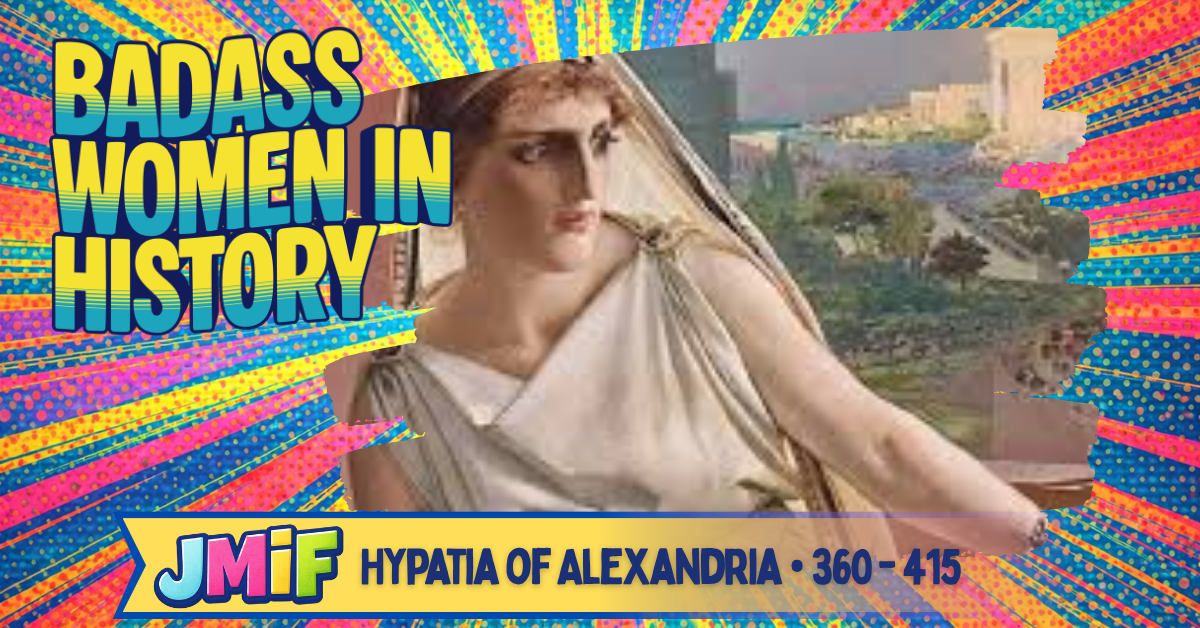
Bad-Ass Women in History — Hypatia of Alexandria, c. 360–415 CE
Philosopher • Mathematician • Astronomer • The Symbol They Made of Her
They dragged her from her chariot in March 415 CE. They killed her in a church. They burned her body at Cinaron. The man they believed ordered it was made a saint. She became the symbol of everything — which meant she became no one in particular.
Alexandria, Egypt • c. 360–415 CE • Bad-Ass Women in History
Introduction
She was the most prominent intellectual in the ancient world’s most important city. She lectured in public, advised the Roman prefect, and taught students of every faith. She was not killed for being a woman of science. She was killed for being in the way. History turned her into a martyr. She was something more interesting: a philosopher doing politics in a city on the edge of catastrophe.
The most detailed account we have was written within living memory of the event by Socrates Scholasticus, a Christian church historian who did not admire the men responsible and did not pretend otherwise. He wrote it down because he found it shameful.
Primary Source — Eyewitness Era Socrates Scholasticus, Ecclesiastical History, Book VII.15 — c. 439 CE
“There was a woman at Alexandria named Hypatia, daughter of the philosopher Theon, who made such attainments in literature and science, as to far surpass all the philosophers of her own time. Having succeeded to the school of Plato and Plotinus, she explained the principles of philosophy to her auditors, many of whom came from a distance to receive her instructions.”
“For as she had frequent interviews with Orestes, it was calumniously reported among the Christian populace, that it was she who prevented Orestes from being reconciled to the bishop. Some of them therefore, hurried away by a fierce and bigoted zeal, whose ringleader was a reader named Peter, waylaid her returning home, and dragging her from her carriage, they took her to the church called Caesareum, where they completely stripped her, and then murdered her with tiles.”
“After tearing her body in pieces, they took her mangled limbs to a place called Cinaron, and there burnt them. This affair brought not the least opprobrium, not only upon Cyril, but also upon the whole Alexandrian church. And surely nothing can be farther from the spirit of Christianity than the allowance of massacres, fights, and transactions of that sort.”
Written c. 24 years after Hypatia’s death. Socrates Scholasticus was a Christian, not a pagan apologist. His condemnation of Cyril is the more remarkable for it. The Suda encyclopedia, the pagan historian Damascius, and the Coptic bishop John of Nikiû also describe the event, with varying details and obvious ideological inflections.
She was dragged from her carriage, stripped naked in a church, killed with roof tiles — tegulae, the ceramic tiles of the building — her body dismembered and burned at a place called Cinaron. The specificity of the violence matters: it was not a random riot that caught her by accident. It was a targeted execution in a specific location by a named leader named Peter, who was a lector of the church and therefore a functionary of the ecclesiastical hierarchy whose bishop had been publicly feuding with the woman they killed.
She was approximately fifty-five years old. She had been the most respected intellectual in Alexandria for decades. Her students included bishops, government officials, and philosophers from across the Roman world. She had never, as far as the record shows, done anything to anyone except teach mathematics and philosophy and advise the city’s governor on matters of civil administration. This is what got her killed. Not what she believed. What she was.
I — Against the Grain
A Woman Wearing the Philosopher’s Cloak in a City Tearing Itself Apart
Hypatia’s father was Theon of Alexandria, a mathematician and astronomer associated with the city’s great tradition of learning — he wrote commentaries on Euclid and Ptolemy that were standard texts for centuries. He taught his daughter mathematics, astronomy, and philosophy from childhood, and she exceeded him. By the time she was a mature scholar, she had produced her own commentaries on Diophantus’s Arithmetica and Apollonius’s Conics, worked with her father on editions of Ptolemy’s Almagest, constructed astrolabes and hydrometers for her students, and — most unusually — taken the teaching position of head of the Neoplatonist school in Alexandria.
She wore the tribon — the philosopher’s cloak — and lectured in public, in the streets. This was radical not primarily because she was a woman but because it was the philosopher’s assertion of public intellectual authority: the philosopher’s cloak said, I speak here as a figure of rational wisdom, not as a private individual. She had the same authority as the male philosophers who wore it. She exercised it in the same streets. The city, by all accounts, accepted this without notable objection. Pagans, Christians, and Jews came to her lectures alike. City officials sought her advice. Her students wrote to her with the kind of affectionate reverence reserved for the genuinely extraordinary teacher.
Her student Synesius of Cyrene became a Christian bishop. He wrote to her from his diocese in what is now Libya — letters full of philosophical questions and the ordinary concerns of an intellectual man with too much administrative responsibility. One of his letters, written in 413 CE, two years before her death, says: “You always have power, and you can bring about good by using that power.” He was asking her to use her influence with the Roman prefect on behalf of people caught in the city’s civil strife. She had that kind of power. That is precisely why she was killed.
II — Motivation Beyond the Mythology
She Was Not Fighting Science Against Religion. She Was Doing Philosophy.
The Enlightenment account of Hypatia — crystallized by Edward Gibbon in The History of the Decline and Fall of the Roman Empire, popularized by Carl Sagan in Cosmos, dramatized most recently in the 2009 film Agora with Rachel Weisz — positions her as a martyr for rational inquiry against religious fanaticism, a proto-scientist murdered by Christianity for daring to pursue knowledge. This is a compelling narrative. It is also a simplification that tells us more about the Enlightenment’s needs than about Hypatia’s actual project.
She was a Neoplatonist. Neoplatonism was not secular humanism. It was a deeply spiritual philosophy — rooted in Plotinus’s interpretation of Plato, organized around the concept of “the One” as a transcendent divine principle, convinced that the pursuit of mathematical and philosophical truth was itself a form of spiritual ascent toward union with the divine. She was not fighting for atheism. She was not fighting against spirituality. She was doing philosophy in the tradition she had inherited, which happened to be a different tradition from the one currently consolidating political power in Alexandria.
She was also doing politics. This is the part the symbol-story tends to leave out. She was the primary intellectual adviser to Orestes, the Roman prefect — the representative of the imperial government in Alexandria. She was a key figure in the faction that was, essentially, trying to maintain the authority of civil governance against the claims of ecclesiastical authority to exercise power over civic life. She was not naive about this. She was choosing a side in an escalating power struggle and making herself useful to that side, because she believed, as the Neoplatonist tradition held, that the philosopher had a responsibility to bring reason to political life.
She was not killed for being a woman of learning. She was killed for being the most powerful person standing between Bishop Cyril and the consolidation of his control over Alexandria. The fact that she was also a woman, and a philosopher, and a pagan made the smear campaign that preceded her murder more effective. But the motive was power. It is always power.
III — The Support System
Her Father, Her Students, Her Prefect — and the City That Could Not Hold
Theon of Alexandria gave her everything the ancient world could give a daughter: education, access to texts, mathematical training, the example of a serious scholarly life conducted seriously. He was the last known member of the Mouseion — the institution associated with the Library of Alexandria — and whatever remained of that tradition of organized scholarship, he passed to her. She surpassed him within his own lifetime and, by the accounts of those who knew both of them, knew she had.
Orestes — Roman prefect, recent Christian convert, political moderate — was her friend and her most important ally in the city’s power structure. He admired her, consulted her, included her in his circle. He was also, in the end, unable to protect her. When the parabalani — the paramilitary force of Christian monks under Cyril’s authority — attacked him in the street and one of them, Ammonius, struck him with a stone, Orestes had Ammonius tortured to death. Cyril declared the monk a martyr. Prominent Alexandrian Christians intervened and told Cyril to stop; Cyril backed down. Then, from a losing position, he turned to the weapon he had left: the smear campaign against the person who had Orestes’ ear. Orestes could not protect her from a rumor that had infected the street. He could not protect her from the mob that acted on it.
Alexandria, 412–415 CE — A City in Collapse
Understanding Hypatia requires understanding what Alexandria was in the final years of her life — not the Alexandria of the great Library at its height, but a city fracturing under overlapping pressures that none of its inhabitants could fully see or manage.
In 412 CE, Cyril became bishop after a violent contest with a rival candidate, the parabalani overrunning supporters of the other side. His first acts as bishop included the persecution of the Novations — a rival Christian sect — and the expulsion of Alexandria’s Jewish population, a community that had existed there since the founding of the city under Alexander the Great. He seized their property and converted their synagogues to churches.
Orestes, the Roman prefect, was infuriated and wrote to the emperor to complain. A feud began. Five hundred Nitrian monks came into the city in Cyril’s support and attacked Orestes in the street. One of them wounded the prefect with a stone. Orestes had the attacker tortured to death; Cyril declared the tortured man a martyr. Hypatia was the most prominent person in Orestes’ circle who was not already compromised by involvement in earlier stages of the conflict. She had maintained neutrality and an impeccable reputation precisely by staying above specific factional battles — until Cyril decided her neutrality was itself an obstacle to his power.
The parabalani — nominally a charitable institution for caring for the sick and dying — had been the instrument of Cyril’s most brutal acts. They were, functionally, a private army. They were also, after the murder of Hypatia, stripped of their authority and placed under the civil prefect by imperial edict. Too late for her. Effective for the moment.
The city Hypatia lived in was not the golden age of Alexandrian learning. It was a Roman provincial capital in the grip of religious conflict, political fragmentation, and the specific violence of institutions competing for ultimate authority. She was trying to hold a space of rational civil discourse in a city that was running out of room for it.
IV — What It Cost Her
Her Work, Her Body, Her Name — and Then Her Story
Almost none of her writing has survived under her name alone. She is thought to have produced a commentary on Diophantus’s Arithmetica that preserved portions of that text — meaning that what we know of Diophantus we know partly because of her. She worked with her father on editions of Ptolemy’s Almagest and Euclid’s Elements. She may have written commentaries on Apollonius’s Conics. But the direct attribution is uncertain for much of it, because she was a woman and her contributions were not systematically distinguished from her father’s in the documentary record, and because the destruction that followed her death was comprehensive.
Socrates Scholasticus notes that after her murder, whatever remained of the university where she and her father taught was sacked. There was a mass exodus of intellectuals and artists from Alexandria. The pagan philosophical tradition of the city — which had been the intellectual center of the ancient Mediterranean for centuries — did not survive the consolidation of Cyril’s power in any robust form. The burning at Cinaron was not just the burning of a body. It was the effective end of a world.
She never married. By choice, apparently — the ancient sources note this as a deliberate decision, consistent with the Neoplatonist philosopher’s commitment to the life of the mind. She had followers who seem to have adored her, students who traveled from distant provinces to hear her lecture, a city that loved her almost universally — until a rumor, spread deliberately by men who needed her gone, turned part of that city into the instrument of her death. What it cost her was everything. What it cost the world that killed her was the last fifty years of the Alexandrian intellectual tradition at full strength.
V — The Gap
The Philosopher, the Symbol — and the Saint Who Ordered the Killing
This is the part that requires being stated plainly.
The Historical Record, Stated Plainly Cyril of Alexandria — Bishop, 412–444 CE — Later Canonized Doctor of the Church
Bishop Cyril of Alexandria — the man who conducted the smear campaign against Hypatia that the ancient sources directly link to her murder, who commanded the parabalani that killed her, who expelled Alexandria’s Jewish population and seized their property, who declared the monk tortured to death for attacking the Roman governor a martyr — was later declared a saint by the Catholic and Eastern Orthodox churches. He was named a Doctor of the Church by Pope Leo XIII in 1882. His feast day is June 27th in the Western church and June 9th in the Eastern church.
His theological contributions — his work on Christology, the nature of Christ, the relationship between the divine and human in Jesus — were real and significant, and his writing on the Incarnation has shaped Christian doctrine for sixteen centuries. His historical conduct was also real: the expulsion of the Jews, the murder of Hypatia, the paramilitary violence. The Catholic and Orthodox churches have never formally addressed the contradiction. The theologian and the man who almost certainly ordered a philosopher’s murder are the same person. Both things are in the historical record. One of them is on the feast day calendar.
This is not an argument against Christianity. It is a statement of what the historical record contains. Socrates Scholasticus — a Christian historian — found it shameful in 439 CE. He was right.
The gap between how Hypatia has been remembered and how she actually lived runs through the Enlightenment’s adoption of her as their patron martyr. Edward Gibbon made her death a symbol of Christianity’s destruction of classical learning in the eighteenth century. Carl Sagan, in 1980, described her in Cosmos as “the last great mind of Alexandria” — which is poetically powerful and historically imprecise; the Alexandrian school continued in some form for another century after her death. The 2009 film Agora depicted her as essentially a proto-modern scientist making anachronistic arguments about heliocentrism. All of these are more about the needs of the people telling the story than about the woman who lived it.
The most honest version of Hypatia is also the most interesting one: she was not fighting for secular humanism. She was not a proto-feminist who refused to be defined by her gender. She was not naive about politics. She was a specific person in a specific city in a specific conflict, doing specific work, making specific choices — and she was outmaneuvered by a man with a mob at his disposal. The symbol is useful. The specific person is more interesting.
VI — Contemporaries & Context
The Last Years of a World That Had Been Everything
Alexandria in 415 CE was still, technically, the second city of the Roman Empire — after Constantinople, which had been founded less than a century before. But the world had shifted. The intellectual tradition of the Mouseion, the great Library, the centuries of concentrated scholarship that had made Alexandria the place where Euclid wrote his Elements and Eratosthenes calculated the circumference of the earth and Hero built his automata — that tradition was fraying. The scholars who remained were doing the essential work of preservation and commentary, not the expansive original work of earlier centuries.
Augustine of Hippo was alive. Jerome had translated the Bible into Latin. The Council of Nicaea had happened ninety years earlier, and the doctrinal arguments it had tried to settle were still running. The Roman Empire, which had been officially Christian since Constantine in the previous century, was doing what empires do with new official religions: using the institutional church as a tool of governance, which made the church into a tool of power, which made the church into something that could be directed at political enemies. Hypatia was a political enemy. The tool was directed at her.
The Neoplatonist school continued after her — Proclus in Athens, Damascius who wrote about her with obvious grief and admiration. But they continued on the intellectual margins. What Hypatia had represented — the philosopher as a public figure with genuine civil authority, welcomed into the highest levels of governance, operating in the same political space as bishops and prefects — that version of the philosopher was ending. The world that made it possible was ending. She was, in a very precise sense, the last person to hold that particular position in Alexandria. Not because the men who killed her were right. Because they had the weapons and the mob and the impunity, and those things, in history, tend to be decisive.
VII — The Long Tail
What She Left Behind — and What Was Taken
Her work — the mathematics she preserved, the commentaries she produced — survived in pieces, attributed sometimes to her father, sometimes to no one, absorbed into the tradition she was part of without a clear individual credit line. This is also a direct line: the work of women being absorbed into the record without attribution is not a Roman-era phenomenon. It runs through every field and every century up to the recent past, and the work of historians trying to recover those attributions is ongoing and incomplete.
Raphael painted the School of Athens in 1509, placing all the great philosophers of antiquity together on a vast staircase. There is a white-robed figure in the foreground who many scholars believe is Hypatia. Raphael included her in the company of Plato and Aristotle and Euclid and Pythagoras. He couldn’t name her directly — the figure is officially unnamed, and including a pagan woman too explicitly in this kind of commissioned work would have been politically fraught. She’s there, in the painting. She’s in the philosophical tradition. She was always there. The name just required extra effort to keep visible.
What the killing of Hypatia did not do was end the argument. The Neoplatonist tradition persisted for another century. Students kept studying. Copies of Diophantus survived. The mathematics she helped preserve is still in use. The stars she charted are still there. What ended, in Alexandria, in 415, was the specific version of the world in which the philosopher could stand in the street in the philosopher’s cloak and advise the governor and be, broadly, safe. That world did not come back. What replaced it had different rules about who was permitted to speak with authority on public questions, and those rules were enforced, when necessary, the same way they had been enforced in March 415 CE.
VIII — A Direct Line to Now
The Oldest Argument Is Still Running. So Is the Smear Campaign.
The argument that killed Hypatia was not, at its root, about science versus religion. It was about who gets to exercise power in a shared civic space — who has the authority to advise the governor, who has the authority to define the terms of civil order, who has the authority to tell a city what it should and should not value. Cyril’s claim was that this authority belonged to the bishop. Hypatia’s position — not articulated as a political manifesto but enacted through her teaching and her advising and her public presence — was that it belonged to reason, to whoever could best argue for the public good, regardless of institutional affiliation. She was arguing for a space of civil discourse above the factional violence of the moment.
This argument is not over.
The smear campaign preceded the murder. Cyril’s people spread the rumor that she was a witch, that she was using magic to influence Orestes, that her philosophical practice was demonic. The seventh-century bishop John of Nikiû described her as devoted “at all times to magic, astrolabes, and instruments of music” — the astrolabes and instruments of music being straightforwardly what she taught, the magic being the accusation that rendered the technical expertise sinister.
This is the mechanism: you cannot attack a well-respected person directly, so you attack the frame. You make the expertise into evidence of deviance. You make the influence into evidence of corruption. You make the woman into a witch. Then the mob does the rest.
The mechanism runs from Alexandria in 415 to Salem in 1692 to whatever corner of the internet is currently calling a woman dangerous for being correct about something inconvenient. The technology changes. The accusation doesn’t.
The most learned person in Alexandria was killed with roof tiles in a church in the middle of Lent. The man responsible was made a saint. She was made a symbol. The symbol is useful. But she was a specific woman in a specific city who wore the philosopher’s cloak because she had earned it, who lectured in public because that was where philosophy belonged, who advised the governor because someone with a good argument should, who was killed because a powerful man found her inconvenient and had a mob available.
Every piece of that sentence is still happening somewhere.
The stars she charted are still there. The mathematics she preserved is still being used. Her name still requires being said out loud, deliberately, in the company of the people who shaped what we know — because history has a habit of making room for everyone except the women who helped build it.
Closing
Bad-Ass Women in History
These women weren’t exceptions to history — they were history fighting back against the version of itself that wanted to erase them.
She wore the philosopher’s cloak. She lectured in the streets. She advised the prefect. They killed her in a church with roof tiles and made her killer a saint. She was turned into a symbol. She deserves to be a person.
Next in the series: She’s already waiting. History, as usual, tried to look past her.
Leave a Reply