
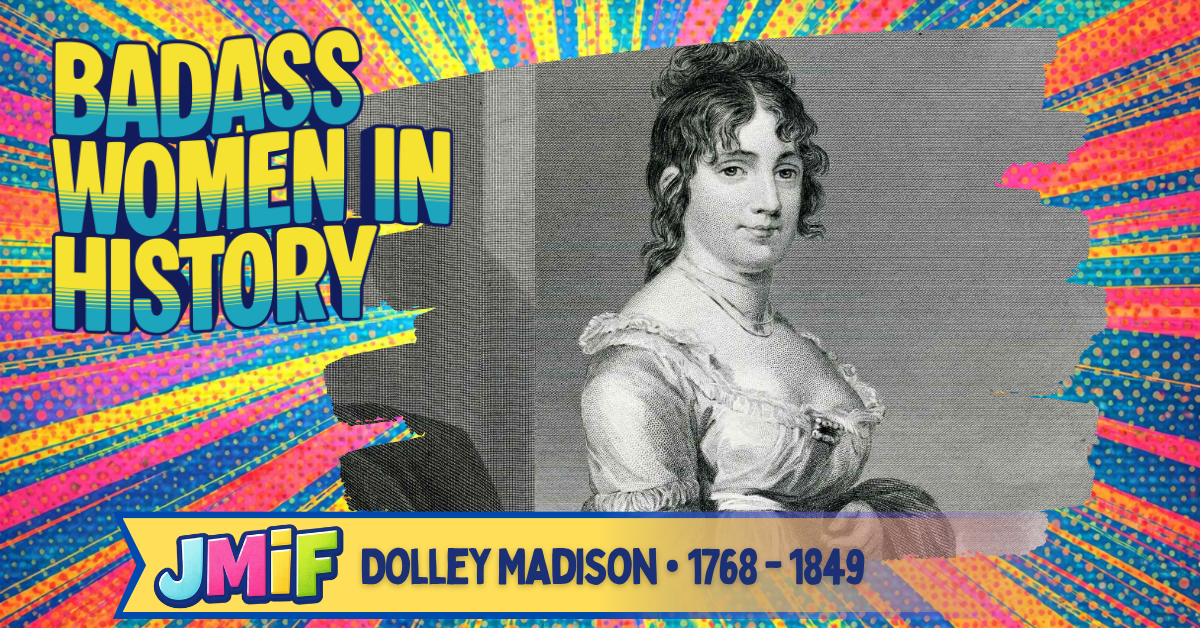
Bad-Ass Women in History — Dolley Madison, 1768–1849
Held No Office • Cast No Vote • Ran the Room Anyway
She held no office, cast no vote, and signed nothing into law. For half a century she was the closest thing the American Republic had to a social heartbeat — and the real story involves a burning city, a contested portrait, and an enslaved man who told it differently.
Guilford County, NC • 1768–1849 • Bad-Ass Women in History
Introduction
The letter exists. Dolley Madison wrote it herself, on the afternoon of August 23 and into the morning of August 24, 1814, to her sister Lucy, and she wrote it while the British army marched on Washington and the city unraveled around her. She described what she could see from the window of the President’s House with her spyglass. She described what she was doing: ordering the Cabinet papers packed into trunks and linen bags, watching the panic ripple through the streets, eating dinner at a table that had been set for forty guests while cannon fire sounded in the distance. She described, in her own words, what happened next.
She sent the letter. It survived. It has been quoted in every biography of her since, and it begins — because Dolley Madison understood, with a politician’s instinct wrapped in silk, that the record mattered — with a line that positions her not as a frightened woman but as a woman making decisions under fire: “Dear Sister, my husband left me yesterday morning to join General Winder…” She knew the letter would be read. She probably knew it would be preserved. She was a woman who had spent twenty years understanding, in precise practical terms, that whoever controlled the first draft of a story controlled something durable.
The portrait of George Washington — Gilbert Stuart’s full-length canvas, seven feet tall, too large to remove from its frame without tools — she had ordered taken down and removed before she left. The state papers, she had ordered packed. The table, still set for those forty guests, she left behind. Then she fled.
The British arrived hours later. Admiral George Cockburn reportedly helped himself to James Madison’s wine and toasted “Jemmy’s health” before ordering the house torched. The President’s House burned through the night. What survived, primarily, were the stone exterior walls and, somewhere in a farmer’s cart headed for the countryside, the portrait of the first president.
This is the story that made her famous. It is not the whole story. It is not even the most interesting part of the story. It is, however, the part that fits cleanly into the shape of a legend, which is why it’s the part that survived.
Dorothea Payne was born in Guilford County, North Carolina, in May of 1768, into a Quaker family of modest means and serious convictions. No dancing. No music. No fashionable dress. No theater. No jewelry. No colors more vivid than what God had arranged for the fields. She grew up in this silence, in Virginia, and by all available evidence she was suppressing something quite considerable from a very young age. When she finally got out — and she did get out, though not in the direction anyone expected — the result was a woman in a purple velvet turban with peacock feathers, hosting two hundred politicians in the President’s House every Wednesday, and managing the social architecture of the early American republic with a precision that no one in that republic wanted to classify as what it actually was.
Which was, plainly, political genius.
I — Before the Myth
A Quaker Girl Who Wanted Everything
The American republic in 1801 — when James Madison became Secretary of State and Dolley arrived in Washington as his wife — was a republic built entirely on the assumption that politics was a male enterprise. Women could not vote. Women could not hold office. Women could not speak on the congressional floor. The Constitution, which her husband had largely written, contained exactly zero provisions for women’s participation in the government it created. The men who assembled in Philadelphia in 1787 appear not to have found this omission remarkable.
The one space where women had always existed at the margins of political life was hospitality. The dinner table. The reception. The drawing room. These were occasions when men who despised each other in public were required, by social convention, to occupy the same space and perform a minimum of civility. In Europe, this had been the terrain of organized female political influence for centuries — salonnières like Marie Thérèse Rodet Geoffrin had shaped Enlightenment discourse from their drawing rooms. In the new American republic, this tradition was viewed with deep suspicion. It smelled too much of the European aristocracy the revolution had supposedly discarded.
What Dolley Madison did — slowly, methodically, with a gift that looked like instinct but was actually the result of decades of careful attention — was make hospitality a legitimate instrument of democratic governance. Not courtly favor. Not aristocratic patronage. Something specifically American: a political salon where Federalists and Democratic-Republicans could sit at the same table and be required, by her presence and her rules, to behave like citizens of the same republic before returning to their project of destroying each other. She called her Wednesday evening receptions “squeezes.” They were not casual. Every element — the seating, the food, the wine, the guest list, the conversational pairing — was managed with the precision of a military campaign. The chaos was curated.
The work she did — which was, at its core, the work of making it possible for democratic institutions to function in an environment of personal enmity — was classified as “entertaining.” Therefore, officially, not quite real. She performed this unreality every Wednesday for eight years and most of Washington would have collapsed without it.
Her name did not appear in the Congressional Record. She held no title beyond “wife.” She drew no salary. She was not subject to confirmation hearings, could not be removed from office, could not be voted out. This made her, in a certain structural sense, more powerful than any elected official in the building. She was permanent. She was indispensable. And she was formally invisible, which suited the men around her for precisely as long as they needed her tables set and their enemies made manageable.
The Wednesday “Squeeze” — How It Actually Worked
Between 1809 and 1817, Dolley Madison’s Wednesday evening levées were the central node of Washington’s political social life. They were open — in theory, any citizen with reasonable dress and behavior could attend. In practice, the guest list was curated with extraordinary care, and the room, which could hold upward of two hundred people, was stage-managed by its hostess with a hostess’s complete command of the space.
She memorized names. Hundreds of them. Legislators, diplomats, military officers, their wives, their rivals. She greeted everyone by name, without hesitation, across decades of acquaintance. This was not small talk. This was information gathering, relationship maintenance, and political signal-sending, all performed simultaneously while wearing a turban.
She bridged political factions deliberately. She is documented seating known enemies near each other in contexts that made open hostility socially costly. She made civility the price of admission to the most important room in the capital.
She made the White House a symbol of the republic’s continuity and hospitality during a period when the republic was alarmingly new, genuinely fragile, and not obviously going to survive. The physical space — the house she furnished, the table she set — was doing ideological work.
After James Madison’s presidency ended, the woman who replaced her — Elizabeth Monroe — deliberately withdrew from public entertaining. Washington society experienced this as a catastrophe. Which is the most revealing possible testament to what Dolley’s work had actually been.
II — Against the Grain
The Republic Had No Room for Her. She Made One.
She didn’t escape her circumstances. She leveraged them — which is a harder thing to do, and a less comfortable thing to celebrate, and the truth.
The received history flattens Dolley Madison into a figure of perfect wifely selflessness: charming, tireless, gracious, devoted. She hosted because James needed her to. She saved the portrait because America needed it saved. She kept the parties going because someone had to. In this version, she is a support structure for other people’s significance, remarkable primarily for her willingness to be remarkable in service of her husband.
The record is more interesting than this.
The historical evidence suggests — with some consistency — that Dolley Madison genuinely liked power. Liked being at the center of things. Liked being known, sought after, the person everyone wanted to talk to and be approved by. This is not a criticism. It is a more honest accounting. The woman who returned to Washington in 1837, a full year after James Madison’s death, and proceeded to run her own independent social scene for another decade until her own death in 1849 — that woman was not fulfilling a duty. She was doing what she loved, in the place she loved doing it, and she would have done it with or without a president’s name attached to hers.
There is also this context, which the marble-statue version tends to leave out: she had experienced the alternative. Her first husband, John Todd, a Quaker lawyer, died in the yellow fever epidemic that swept Philadelphia in the autumn of 1793. In a single terrible week, she lost her husband and one of her two small sons to the same disease. She was twenty-five years old, a widow with one surviving child, and essentially no income, in a city that had just killed half the people she knew. When Aaron Burr — yes, that Aaron Burr — introduced her to James Madison seventeen months later, James was a 43-year-old bachelor with intellectual depth, political consequence, and what appears to have been an entirely earnest and total affection for her. She did not hesitate.
The decision to leave the Quaker community — with its plain dress, its silence, its prohibition on dancing and music and color and every pleasure she had apparently been suppressing since childhood — was not a sacrifice. It was an escape, and she knew it. She bought her first fashionable dress almost immediately. She started hosting. She discovered she was very, very good at it, and that the goodness was inseparable from wanting it. That combination — competence and desire, locked together — is what makes a genius. It is also what the histories tend to edit down to simple devotion, because devotion is tidier and requires less explaining.
III — The Support System
Who Set the Chairs and Who Cleared the Plates
Aaron Burr introduced her to James Madison. This is documented. The man who would kill Alexander Hamilton, who would be tried for treason for attempting to carve a private western empire, was in 1794 a U.S. Senator from New York doing a favor for a widow he knew. His role in her life ended at the introduction. She appears to have assessed his character accurately and maintained appropriate distance thereafter. But she owed him, at minimum, the meeting that changed the direction of everything.
James Madison was, by all accounts, a genuinely unusual partner for the period. He was seventeen years older, considerably shorter — five feet four inches, described by contemporaries as “no bigger than half a piece of soap” — and prone to recurring illness. He was brilliant on the page and uncomfortable in rooms. He needed her in the social arena far more than she needed him there. He appears to have known this and appreciated it without resentment, which was not the universal experience of political wives of the era. He let her operate. He did not require her to be invisible or small. For a man of his time and class, this was a form of genuine support that should not be understated.
But here is the part that requires honest accounting — the part that the commemorative plates and the school names and the ice cream brand consistently decline to address:
The household that made her social machine run was operated in significant part by enslaved people. At the President’s House, between twelve and fifteen enslaved men, women, and children worked at any given time — cooking, serving, cleaning, maintaining the physical infrastructure of elegant hospitality. At Montpelier, the Madisons’ Virginia plantation, over one hundred enslaved people labored to support the life that made the levées possible: the food, the wine, the linen, the silver, the tobacco income that funded the whole enterprise. The table that Washington ate from was set, in the most literal sense, by people who were legally defined as property and who had no voice in any of the decisions being made around it.
Among them was a man named Paul Jennings. He arrived at the President’s House in 1809, when he was ten years old, as James Madison’s personal attendant. He would remain in the Madison household’s orbit for decades. He would, eventually, write a memoir. We will come back to Paul Jennings.
There was also a woman named Sukey — Dolley’s personal enslaved maid and body servant, who traveled everywhere with her, who dressed her, who managed the intimate daily machinery of her mistress’s appearance and presentation. The relationship was close, as such relationships often were, in the way that proximity and enforced intimacy create something that looks like closeness from one direction and is something else entirely from the other.
In August of 1814, during the chaos of the British invasion, Sukey attempted to escape. Dolley caught up with her and brought her back. The support system that made Dolley Madison possible included a woman who was actively trying to leave it. This is in the historical record. It appears in very few of the commemorative accounts.
IV — The Burning and What It Cost
August 24, 1814 — and the Bill That Came After
Here is the famous letter.
Primary Source — August 23–24, 1814 Dolley Madison to her sister, Lucy Payne Todd Washington
“Dear Sister, my husband left me yesterday morning to join General Winder. He inquired anxiously whether I had courage or firmness to remain in the President’s house until his return on the morrow, or succeeding day, and on my assurance that I had no fear but for him, and the success of our army, he left, beseeching me to take care of myself, and of the Cabinet papers, public and private.”
“I have pressed as many Cabinet papers into trunks as to fill one carriage; our private property must be sacrificed, as it is impossible to procure wagons for its transportation. I am accordingly ready; I have had it in my power to send off great quantities of silver and plate; also the velvet curtains… Two messengers, covered with dust, come to bid me fly; but here I mean to wait for him… At this late hour a wagon has been procured, and I have had it filled with plate and the most valuable portable articles belonging to the house.”
“Our kind friend, Mr. Carroll, has come to hasten my departure, and in a very bad humor with me, because I insist on waiting until the large picture of General Washington is secured, and it requires to be unscrewed from the wall. This process was found too tedious for these perilous moments; I have ordered the frame to be broken, and the canvas taken out.”
— Dolley Madison, August 24, 1814. Written from the President’s House as the British army approached Washington, D.C.
This is the heroic version, and it is true as far as it goes. The papers were saved. The portrait was saved. She left before the British arrived. The house burned.
Now here is another account.
Paul Jennings, who was fifteen years old and standing in that house on that day, wrote his own memoir in 1865 — fifty-one years later, after he had purchased his own freedom, after he had become a figure of some standing in Washington. He remembered it differently. He wrote that the portrait of Washington was not removed by Dolley Madison at all, but by a gardener named Magraw and the White House doorman — that Mrs. Madison had already departed or was in the immediate process of departing, and that her famous letter attributed to herself an action performed by others.
The Other Account — 1865 Paul Jennings: A Colored Man’s Reminiscences of James Madison
Paul Jennings published what is widely considered the first White House memoir in 1865. He was enslaved at the President’s House from the age of ten, serving as James Madison’s personal attendant. His account of August 24, 1814 contradicts several points of Dolley Madison’s famous letter. He attributed the removal of the Washington portrait to the doorman and the gardener. He noted that much of the prepared food and wine was eaten by arriving soldiers before it could be removed. He described the scene with the specificity of a man who was present, had nothing to protect, and was writing half a century later with no incentive to flatter anyone.
Jennings was eventually able to purchase his freedom through the assistance of Massachusetts Senator Daniel Webster. He worked as a Senate aide for decades. He lived to see the end of the Civil War and wrote it all down. His memoir is twelve pages long. It contains more unvarnished accounting of life in the Madison household than anything Dolley Madison ever wrote, and it is read by a fraction of the people who read her letter.
Both accounts have supporters among historians. Both have elements of selectivity. The letter is a primary source written on the day, by a woman who was under pressure, who understood that the letter would circulate, who had every incentive to position herself as the decisive actor. The memoir is a primary source written fifty years later by a man who was a child at the time, who had every reason to correct the historical record and no particular reason to be kind to the woman who had brought back Sukey when Sukey tried to run. The portrait was saved by someone. The papers were saved. The house was lost. The question of credit has never been fully resolved. It probably never will be.
What happened after the war is the part of the cost that goes least discussed.
Dolley Madison’s son from her first marriage, John Payne Todd, was a charming and total catastrophe. A gambler, a drinker, the kind of handsome man who goes through other people’s money with the easy confidence of someone who has never once been held accountable. She bailed him out of debtors’ prison at least once that we know of. She sold property. She covered debts in secret, to protect him from James’s knowledge and, increasingly, to protect her own peace of mind. When James Madison died in 1836 — the last surviving Founding Father, the last living link to the Constitutional Convention — he left the estate in serious debt. Payne Todd’s gambling. The broader collapse of Virginia tobacco agriculture. The math that had been deferred for years coming due all at once.
The enslaved people of Montpelier — more than one hundred men, women, and children — were eventually sold to settle the debts. Dolley authorized the sale. She was in a materially desperate position; the debts were real and the options were few. It is also documented that she had expressed, in private letters, genuine fond feeling for particular enslaved people. Both of these things are true, and they live in the same woman, and there is no resolution available that makes one of them disappear.
Congress eventually purchased the remainder of James Madison’s papers — his meticulous notes from the Constitutional Convention, the closest thing to a transcript that document possesses — specifically to provide her with income. It was a polite subsidy from a republic that had used her work for forty years and left her broke. She received it with the precise, dignified gratitude of a woman unaccustomed to needing anything from anyone.
V — The Gap
The Portrait She Saved and the Memoir She Didn’t Write
The Dolley Madison who appears in the commemorative record — on plates, in school names, in ice cream branding, on the cover of children’s books — is warm, charming, patriotic, selfless. She saved the portrait. She held the republic together with her bare hands and her Wednesday parties. She is the Mother of Washington Society, beloved without complication or qualification. She is, above all, safe.
The gap between that version and the one who actually lived is instructive in a specific way: the sanitization was useful. A culture that needed its Founding Fathers to be infallible needed its Founding Mothers to be saintly. She was the first First Lady whose role was visible enough to require mythologizing, which meant she was the first to have the myth applied to her with real force. She also cooperated with this, actively and skillfully. She understood the value of the image. She had been managing her image since 1794. She was extraordinarily good at it.
The version of her that was handed to history is the version she largely wrote, and the version she largely wrote leaves out the enslaved people, papers over the portrait dispute, minimizes the Payne Todd catastrophe, and presents the poverty of her final years as dignified retirement rather than the consequence of mismanagement, exploitation, and a son who spent forty years treating his mother’s resources as a personal line of credit.
The most honest version of Dolley Madison’s legacy is also the most interesting one: she understood that the record was being written in real time, she understood who would write it if she didn’t — and so she wrote it. That is a form of power. It is also a form of erasure.
Paul Jennings published his memoir in 1865 and it was twelve pages long and almost no one read it for a hundred years. It has since been republished, annotated, and studied by historians working to recover the full texture of life in the early White House. It is available now in full text online. It takes about fifteen minutes to read. It is the most important fifteen minutes you can spend with the Madison story — not because it discredits Dolley Madison, but because it gives the house its other inhabitants, who were there every day of those eight years and who have been, for most of two centuries, standing just outside the frame of the famous letter.
VI — Contemporaries & Context
The Room She Ran and the People Who Needed Her to Run It
She came after Abigail Adams, who was the more explicitly intellectual First Lady — the “remember the ladies” Abigail Adams, who wrote candidly to her husband about women’s political exclusion and whose correspondence is a monument of early American feminist thinking. Abigail operated through letters; Dolley operated through rooms. These are different tools, and they reveal different things about what was possible. Abigail wrote her arguments. Dolley enacted them in practice, and practice moves people differently than argument does.
She came before Elizabeth Monroe, who deliberately rejected the social model Dolley had built. Elizabeth Monroe largely withdrew from public entertaining after 1817, which Washington society experienced as a near-catastrophe. Diplomatic wives were furious. Congressional members complained. The whole apparatus of political sociability ground to an awkward halt, because it turned out to be non-transferable — it worked because of Dolley specifically, because of her twenty-five years of relationship maintenance and name memorization and strategic seating, and it could not simply be delegated to the next person who moved into the house.
The men who orbited her: Thomas Jefferson, who was a widower and who asked her, before James’s presidency began, to serve as his official White House hostess for state dinners — which she did, as the Secretary of State’s wife, because Jefferson understood the work required doing and he couldn’t do it himself. Henry Clay, who was a loyal Dolley partisan for decades and who knew which side of that particular alliance served him better. Daniel Webster, who loved her and who would later, quietly, help Paul Jennings purchase his freedom — a gesture that connects, in a slightly vertiginous way, the most public and the least visible figures in the Madison story.
And Aaron Burr, the original matchmaker, who by the time she was hosting her Wednesday levées had become the man who shot Hamilton and stood trial for treason and retreated into a self-imposed exile of disgrace. She maintained a cordial public distance. Whatever she privately thought of him, the historical record declines to say. She was, among her other gifts, extraordinarily disciplined about what she left in writing.
VII — The Long Tail
What She Actually Changed — and What She Didn’t
Here is what she built, in concrete terms. She built the template for the American First Ladyship — not as passive decoration but as an active cultural and political institution with independent public significance. Every person who has occupied that role since has worked within the framework she established: the White House as a symbol of national hospitality and continuity, the President’s spouse as a figure who performs specific ideological labor that has value to the state and is officially classified as personal. She invented the job description. She did it without a job title. She did it without pay.
She demonstrated, through forty years of practice, that soft power was real power — which sounds obvious now and was quietly radical in 1809. She is the reason Washington has a social circuit at all. She is the reason “the Washington dinner party” is a concept with political valence rather than just an occasion for food. She is the reason we talk about the First Lady as an institution rather than just a biographical detail, because she made it one.
What she did not change — what she could not change, operating entirely within the existing system — was the classification of her work as something less than political. The hostess versus the politician. The social genius versus the statesman. This distinction has haunted every woman who has tried to exercise influence through the social and domestic channels that were, for most of American history, the only channels available. When we debate today about which work “counts” — which meetings are substantive and which are “just” dinners, which labor is visible on a résumé and which disappears into the air — we are still having the argument that Dolley Madison lived in public for fifty years and never got a clean answer to.
VIII — A Direct Line to Now
Every Political Spouse Lives in Her Shadow
In 2016, when Michelle Obama’s “when they go low, we go high” became the most quoted line of an American political season, nobody said out loud what was structurally obvious: that the role she was performing — moral anchor, social architect, emotional register of a presidency — was exactly the role Dolley Madison had invented in 1809 and that no one had yet figured out how to formally account for. The labor is the same. The classification is the same. The invisibility of the classification is the same.
The debt that remains unpaid: Paul Jennings, who stood in that house and helped save what was saved and saw what he saw, died in 1874, at approximately seventy-five years of age, having lived through slavery, the Civil War, and Emancipation. His memoir was republished in 1987 with an introduction. It was republished again, more widely, in 2009. The National Park Service now includes him in its interpretation of Montpelier. A historical marker in Washington was placed in his honor. His name is on a display at the White House Visitor Center. This is progress. It is also, in the scale of two centuries, the kind of progress that arrives late enough to make you wonder what we are still postponing.
Sukey’s full name is not known to history. She appears in the record as “Sukey” and as “my maid” and as “the servant” and once in a letter as a woman Dolley described as dear to her. She attempted to leave in August of 1814. She was brought back. What happened to her after the Montpelier enslaved people were sold in the 1840s is not documented in any source that has survived. She is not on a historical marker. She is not in the White House Visitor Center display. She is in this article because leaving her out would be a continuation of the same erasure that has been happening since 1814.
The tablecloth is still set. Forty places. The question of who runs the room, whose labor is counted, whose name goes on the record and whose gets absorbed into “entertaining” — that question is still being negotiated, and in at least one of those directions, the woman who invented the template is still being thanked for her graciousness rather than credited for her work.
She set the table. She ran the room. She held the republic together through dinner parties and Wednesday squeezes and a letter she wrote to her sister while a city burned. She did it in a purple velvet turban because she had spent twenty-five years suppressing herself in plain linen and she was done with that. She did it with enslaved hands and in debt and with a son who cost her everything and with a political system that took everything she produced and filed it under “entertaining.”
She died in Washington, in 1849, in the city she had made, surrounded by the people who loved her, eighty-one years old and completely, stubbornly, irreducibly herself.
That is not nothing. That is, in fact, almost everything. The rest is the part we still owe.
Closing
Bad-Ass Women in History
These women weren’t exceptions to history — they were history fighting back against the version of itself that wanted to erase them.
She set the table. She ran the room. She held a republic together with dinner parties and stubbornness, and history filed it under “entertaining.”
Next in the series: She’s already waiting. History, as usual, tried to look past her.
Leave a Reply