
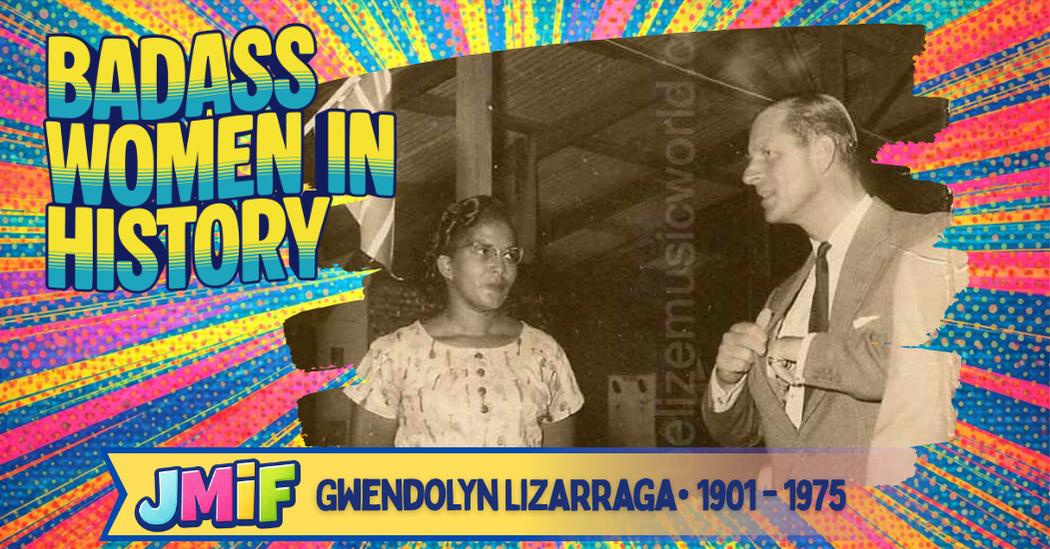
Bad-Ass Women in History — Gwendolyn Lizarraga | 1901 – 1975
Organizer • Minister • Women’s Rights Pioneer
She walked into the swamp and mapped power for women.
Gwendolyn “Madam Liz” Lizarraga fought for women’s wages, land, education, and political voice in Belize. When officials said there was no land, she helped women claim it anyway. Then she became the first woman elected to the House.
Belize • 1901–1975 • Bad-Ass Women in History
When the colonial government said there was no money to build a school for poor kids, Gwendolyn Lizarraga didn’t write a petition. She gathered a crew of women, walked into the mangrove swamp, and started clearing the land herself. She wore pants, carried a gun, ran a timber empire, and then became the first woman ever elected to govern Belize.
Badass Women in History • A JMIF Original Series
Let’s open with the swamp, because if any single image earns this woman her place in this series, it’s the swamp.
In a poor, working-class neighborhood of Belize City, children were being shut out of school. The reason given was the usual one: there was no money to prepare the site and put up a building. The land that was available was mangrove swamp, tangled and waterlogged and useless until somebody cleared it, and nobody was going to pay to do that for poor kids.
So Gwendolyn Lizarraga, a successful businesswoman who absolutely did not need to be standing in a swamp, gathered a group of women, picked up two-person handsaws, and started clearing the mangroves themselves. By hand. In the muck. Not as a photo op, but as the actual labor of building a school out of nothing. The sight of these women sawing their way through a swamp was apparently striking enough that workers from the Public Works Department eventually came and joined them. And the schools got built. Two of them. One was later renamed Gwen Lizarraga High School, which means that today there are Belizean kids getting an education inside a legacy that started with their namesake standing knee-deep in mud with a saw in her hands.
That is who Madam Liz was. Not a woman who asked the system politely to do better, but a woman who, when the system shrugged, picked up a tool and did it herself, and dared everyone watching to keep sitting on their hands. Most of the world has never heard her name. Let’s fix that.
The Woman Who Wore Pants and Carried a Gun
She was born Gwendolyn Margaret Smith in 1901, in Maskall, a village in what was then the British colony of British Honduras, the country we now call Belize. Her parents were Sidney Smith and Guadalupe Baeza, and that pairing of names tells you something about Belize itself, a place where Creole, Mestizo, Maya, and other roots braided together into something distinct from anywhere else in the Caribbean or Central America. She got a decent schooling for the time and place, attending several primary schools and then St. Catherine’s Academy. In 1926 she married a police photographer, Victor Manuel Lizarraga, and they went on to have five children.
On paper, that’s a conventional enough start. What she did with it was not conventional at all.
Lizarraga went into business, and not a genteel, acceptable-for-a-lady business. She ran a chicle and mahogany operation. Chicle is the sap once used to make chewing gum, and mahogany was Belize’s great colonial timber export, so this was the hard, masculine, frontier heart of the Belizean economy, the world of forest camps, heavy labor, and big foreign buyers. And Lizarraga operated in it on her own terms. By the accounts that survive, she drove a Land Rover, wore pants, carried a gun, and smoked cigarettes, every one of which was a small act of defiance against what a woman of her era was supposed to be. She dealt directly and without flinching with massive companies, including the chewing-gum giant Wrigley’s, and she did it with an authority that did not invite anyone to talk down to her.
Picture the full scene. Early-to-mid twentieth century, a British colony, a deeply conventional society about gender, and here is a woman in trousers with a firearm and a cigarette, running a timber-and-chicle business and staring down multinational corporations across a negotiating table. She was, in the most literal sense, refusing to stay in the box built for her, and she was doing it years before she ever entered politics. The politics, when it came, was not a departure from her character. It was the same woman, pointed at a bigger target.
What She Was Up Against
To understand why Lizarraga matters, you have to understand the two overlapping cages she was operating inside, because she was pushing against both at once.
The first cage was colonialism. Belize was a British colony, and like colonies everywhere, it was run for the benefit of the mother country and a small local elite, not for the ordinary people. By the late 1940s, that arrangement was cracking. In 1949, the British colonial governor devalued the local dollar against the wishes of the legislature, a move that protected big transnational interests while making life more expensive for ordinary workers. It was a clarifying insult. It united labor, nationalists, and the middle class in fury, and out of that fury came an organized independence movement and, in 1950, the People’s United Party, the PUP, the anti-colonial party that would dominate Belizean politics for decades and eventually lead the country to independence. Lizarraga threw in with this nationalist movement. She was not just fighting for women; she was fighting to get her whole country out from under Britain.
The second cage was the one built specifically for women, and it had a particularly clever lock. For a long stretch of Belizean history, the right to vote was tied to property: only property owners could vote. Now layer that on top of a world where women were systematically kept from owning property in their own names, and you see the trap. You can’t vote unless you own property, and you can’t readily own property because you’re a woman, so the property requirement quietly does the work of disenfranchising women without ever having to say “women can’t vote” out loud. It’s the kind of indirect, deniable barrier that is harder to fight precisely because it doesn’t announce itself.
I want to be careful and honest about the timeline here, because the sources don’t all line up cleanly and I’d rather tell you that than fake a tidy version. The expansion of voting rights in Belize came in stages through the 1950s, with universal adult suffrage broadening the electorate, and accounts differ on the exact dates and details. What is consistent and well-established is the specific barrier Lizarraga personally smashed: 1961 was the first year women were allowed to run as candidates in the country’s national elections. Being able to vote is one thing. Being allowed to stand for office yourself, to hold the power rather than just choose who does, is another, and that door did not open until 1961. Lizarraga walked through it the instant it did.
Building the Machine
Here is where Lizarraga shows she was not just a force of personality but a genuine organizer, which is the difference between a colorful character and a historical mover.
In February 1959, she founded the United Women’s Group, the women’s arm of the PUP. That is a strategist’s move, and an important one. She understood that for women to have real political power, they could not just be individual exceptions; they needed an organized base inside the party that actually held power. She built women a permanent seat at the table of the movement that was going to run the country. The United Women’s Group still exists. She didn’t just win a moment; she built an institution that outlived her by generations.
And her organizing was always tied to concrete, material help for ordinary people, which is why the swamp story is so perfectly her. She was relentlessly practical. She advocated fiercely for women to be able to acquire their own house lots, understanding, given that old property-and-voting trap, exactly how much power a woman owning her own land actually represented. She surveyed land herself to create parcels for women. She championed equal pay and the protection of women laborers. She worked as a probation officer in social development. Her feminism was not abstract theory delivered from a podium; it was schools, housing, land titles, and paychecks, the unglamorous infrastructure of a dignified life.
Why did she do it? It would be easy to make her a pure selfless servant of the people, and there’s real truth in that, but it would also flatten her. Lizarraga was, by every description, ambitious, outspoken, and authoritative, a woman who clearly enjoyed power and was very good at wielding it. She liked being the one who got things done and was not shy about it. And that’s not a knock. The combination of genuine care for the poor and a healthy personal drive to be the one in charge is exactly what makes an effective politician. She wanted to help people and she wanted to win, and she saw no reason those should be in conflict. Naming the ambition makes her more real, not less admirable.
First Through the Door
In 1961, the first election in which Belizean women could run, Lizarraga ran for the Pickstock division in Belize City. She did not squeak in. She won it with sixty-nine percent of the vote. More than two out of every three voters in her division looked at the ballot, saw the first woman ever permitted to run for national office in their country, and chose her decisively. That is not a token victory or a sympathy seat. That is a landslide.
With that win she became the first woman elected to the national legislature of British Honduras. And the government promptly made her the first female cabinet minister in the country’s history, handing her the portfolio of Education, Housing, and Social Services, which, when you think about what she’d already been doing with handsaws and land surveys, was less an appointment than an official recognition of work she was already doing anyway. The voters re-elected her in 1965 and again in 1969, and she held that ministerial role across those terms. This was not a one-time fluke. She was a durable, repeatedly-chosen political force.
And she used the power. As minister, she drove the creation of Belize’s junior secondary schools, expanding real educational opportunity for Belizean young people, including the schools that grew from that swamp. In 1969 she led a project to build low-cost housing in several Belize City neighborhoods, turning her long-held conviction about ordinary people owning their own homes into actual roofs over actual heads. She backed bringing the regional Caribbean Examinations Council into Belize, plugging Belizean students into a wider world of accreditation and opportunity. Brick by brick, lot by lot, she built the things she’d spent her life arguing for.
She didn’t bend, even to her own side
One detail worth holding up, because it shows her spine was about principle and not just party loyalty. Lizarraga was, by one account from her own party’s history, the only politician who made no secret of her opposition to granting a casino concession in Belize. Set aside whether you agree with her on casinos; the point is the posture. Here was a powerful figure willing to stand alone, publicly, against something she thought was wrong, even when staying quiet would have been the smoother political play. The woman who wore the gun and faced down Wrigley’s was not going to suddenly start going along to get along once she had a cabinet seat. The defiance was not a costume. It was load-bearing.
Not the Only Pathfinder
As always in this series, honesty requires widening the lens, because the lone-heroine version erases the very women we’re trying to recover.
Lizarraga rose inside a whole nationalist movement full of consequential people, most famously George Price, the towering figure who led the PUP and is generally regarded as the father of Belizean independence. She was a major player in a team sport, and the eventual independence of Belize in 1981 was the work of many hands across many years. She didn’t free Belize single-handedly, and the story shouldn’t pretend she did.
She also wasn’t the only remarkable Belizean woman of her era. Belize honors a set of women sometimes called the Pathfinders, and Lizarraga’s name appears alongside others like Vivian Seay, Dr. Bernice Hulse, and Sadie Vernon, women who broke their own barriers in nursing, public health, and civic life. Several of them could carry articles of their own. Lizarraga was the one who broke specifically into elected political power, but she was part of a generation of Belizean women who were collectively prying open a colonial, male-run society. The first woman through the political door was standing on the shoulders, and walking alongside, plenty of others. That doesn’t shrink her. It places her, which is more interesting and more true.
What It Cost, and How She’s Remembered
Lizarraga’s costs were not the dramatic violence some women in this series faced, and I won’t inflate them into something they weren’t. But they were real in their own register. She spent her life as the first and only woman in room after room, absorbing the particular grind of having to be twice as formidable to be taken half as seriously, of being the woman in pants and a gun in a world that would have much preferred her in an apron. She carried a business, five children, a political career, and a movement, all at once, with no template to follow because she was the template. She served until 1974, not seeking reelection, and died the following year, in 1975, at seventy-three. Her son Adolfo succeeded her in her own seat, which is its own quiet testament to what she’d built.
Within Belize, she is genuinely honored. There’s the high school that bears her name. There are streets, ceremonies, tributes during Women’s Month, a place in the national pantheon of Pathfinders. Belizeans know Madam Liz. The gap, the erasure this series keeps bumping into, is not so much within Belize as beyond it. Outside her own small country, Gwendolyn Lizarraga is almost completely unknown. The global story of twentieth-century women breaking into political power is told through a handful of large, wealthy nations, and the women who did the same hard work in small, formerly colonized countries are left out of it almost entirely. A woman this vivid, this consequential, this quotable, and most of the world has no idea she existed. That’s the debt.
The Long Tail, and the Line to Now
So what did Gwendolyn Lizarraga actually change?
Concretely, a great deal, and much of it is still standing. There are schools that exist because of her, including ones literally built on land she helped clear. There are families in homes because of the housing she championed. There is a women’s political organization she founded that still operates inside one of Belize’s major parties. And there is the simple, enormous fact that she was the first: the first woman elected to govern her country, the first in the cabinet, the proof of concept that a Belizean woman could hold real political power and wield it well. Every Belizean woman who has since served in the House or the cabinet is walking through a door Madam Liz was the first to kick open, in heels or in trousers as she pleased.
The line to now runs in two directions. The first is about the nature of effective change. Lizarraga is a master class in a particular kind of power: not the power of grand speeches alone, but the power of a person who combines vision with the willingness to pick up the actual saw. We tend to romanticize reformers as orators and martyrs. Lizarraga reminds us that a huge amount of real change is just somebody refusing to accept “there’s no money for that” as a final answer, and going and doing the muddy, practical work themselves until the thing exists. In an age full of people who are very good at talking about problems, she’s a patron saint of the ones who go build the school.
The second is the quieter argument about whose stories get told. Lizarraga did everything the celebrated suffragists and pioneering women politicians of the big nations did, broke the same barriers, against arguably longer odds, with the added weight of colonialism stacked on top of sexism, and she did it with more personal flair than almost any of them. And she’s a footnote, known mostly to her own compatriots. The fact that you can be a gun-toting, swamp-clearing, multinational-staring-down, country-governing trailblazer and still be essentially invisible to the wider world, simply because your country is small and was once a colony, tells you something uncomfortable about how history decides who’s worth remembering. This series exists to argue with that decision.
She wore the pants and carried the gun before it was allowed. She ran the timber business and faced down Wrigley’s. When they said poor children couldn’t have a school, she waded into a swamp with a handsaw and built one. And when her country finally, grudgingly, let a woman run for office, she didn’t just win, she won in a landslide and then spent her power building houses and schools and a permanent place for women in Belizean politics. They could not keep Madam Liz in the box. She sawed her way out of it, and held the door open behind her. If that is not a Badass Woman in History, then nobody in this whole series qualifies, and the only real mystery is why it took the rest of the world so long to look her way.
More Resources to Learn About This Subject From
A note on sources. Lizarraga is well documented within Belize and thinly covered everywhere else, so the good material lives in Belizean outlets, party histories, and archives. The one thing to read carefully is the voting-rights timeline: accounts differ on the exact dates that suffrage expanded versus when women could run for office, and I’ve tried to flag that rather than smooth it into a neat but shaky claim. The firsts she personally achieved, though, are solid. To dig deeper, start here.
- Gwendolyn Margaret Lizarraga (Belize City Eco Museum) — a Belizean source with the fullest account of her life, including the chess club and her folklore work.
- Gwendolyn Lizarraga (Infinite Women) — strong on the swamp-clearing schools story, the business, and the gun-and-pants details.
- Gwen Liz Is Remembered for Women’s Month (Channel 5 Belize) — a Belizean news piece on how she’s honored today, and on her work for poor and working women.
- The Nationalist Movement and the PUP (background) — for the bigger story of Belizean independence and the party Lizarraga rose within, including George Price and the 1950 founding.
If you take one thing from her: when somebody tells you it can’t be done because there’s no money and no easy path, the most powerful answer in the world is sometimes to just go pick up the saw.
Leave a Reply