
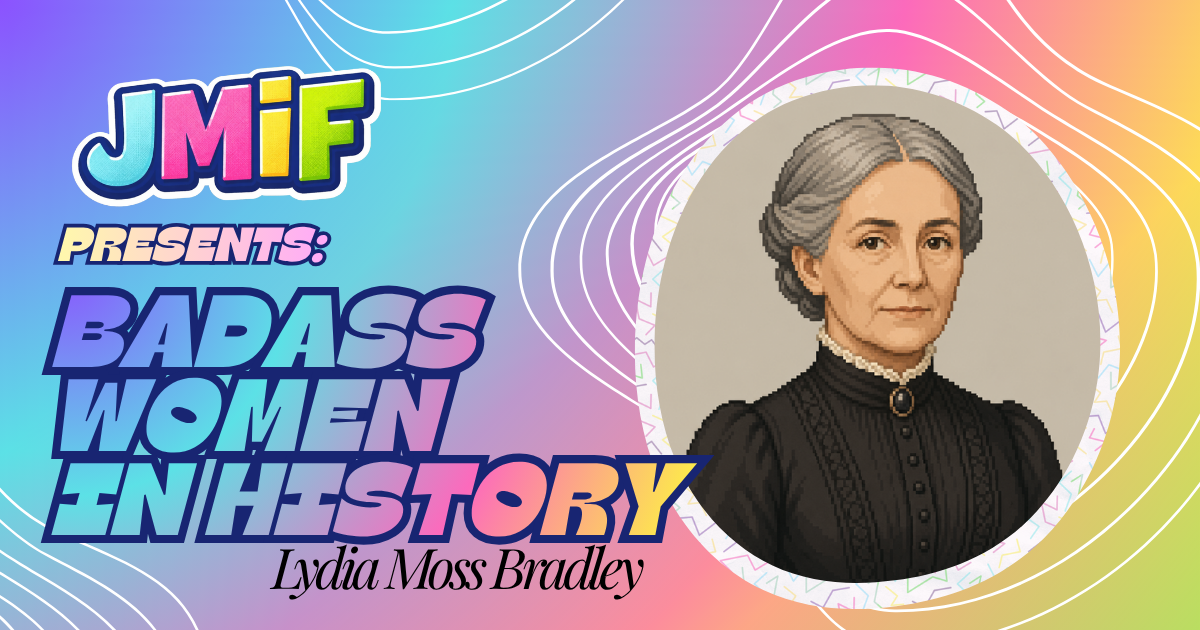
Bad-Ass Women in History — Lydia Moss Bradley | 1816–1908
Pioneer • Financier • Founder
By the time she was fifty-one, Lydia Moss Bradley had buried her husband and all six of her children. No survivors, no heirs, no family business to hand off. What she had instead was roughly half a million Gilded Age dollars, a frontier town that was about to become a real city, and forty more years to figure out what any of it was for. She spent them turning a riverbank into Peoria, and turning grief into a university that’s still standing about two miles from where I’m typing this.
Most people who pass her statue on the Bradley University campus know her as a name on a building. She was a lot more interesting than that, and the story of how she got there says as much about frontier Illinois, and what its early fortunes were actually built on, as it does about her.
It All Began With a Move to Peoria, Illinois
It’s 1837, in the middle of Indiana farm country. Twenty-year-old Lydia Moss just married Tobias Bradley, and they did what every couple does: they started a family. Ten years later, they packed up their toddler daughter and moved to Peoria, Illinois, using money from selling Lydia’s own Indiana land to buy property along the Illinois River. That detail matters more than it sounds, because from the very start, this was Lydia’s capital too, not just her husband’s, and the Peoria fortune that was coming was built on land she financed.
Over the next two decades, Tobias would prosper in real estate, banking, and a distillery he ran with Lydia’s brother. Those two decades were not without tragedy. In the same timeframe, the Bradley’s lost every child they had. Six births, six deaths, the last and longest-lived, Laura, dying at fourteen in 1864. Three years later, Tobias was killed in a carriage accident. This was not such a great time for Lydia.
So picture 1867. Lydia Moss Bradley is fifty-one years old. She has no husband, no children, no grandchildren, and a fortune worth around half a million bucks, in a country where married women had barely begun to win the legal right to own property, let alone run a fortune, and where a widow of her standing was generally expected to retreat into quiet, managed irrelevance until she died. The plan she and Tobias had vaguely discussed, building some kind of lasting memorial to their children, was still just a conversation. Nothing was written down. Nothing was funded. She was, suddenly, completely alone, and completely in charge.

Instead of Giving Up, She Stood Up
Lydia Moss Bradley did not give up. She did not retreat. Instead, she rose to the occasion.
For the next three decades, Lydia Moss Bradley personally managed and grew her estate, investing heavily and shrewdly in Peoria real estate as the city boomed around her. In 1875, she joined the board of the First National Bank of Peoria, very likely becoming the first woman in the country to sit on the board of a national bank; and she stayed on that board for the better part of thirty years. Under her direct management, the Bradley estate didn’t simply survive. It nearly quadrupled.
And she didn’t sit on it, either. She gave away land for what became Peoria’s first public park system, donated the ground for what’s now OSF Saint Francis Medical Center, and built a home for elderly women with nowhere else to go. But the big idea, the one she and Tobias had only talked about, took her years to get right. Advisors initially pushed an orphanage. Lydia studied other institutions, traveled, thought it through, and decided what the city actually needed was a practical school, a place where ordinary young people could learn real, usable skills for the ever-evolving modern world.
So in 1897, Bradley Polytechnic Institute opened its doors on twenty-eight acres, with a two-million-dollar endowment behind it, the buildings named Bradley Hall and Horology Hall. It was chartered as, in plain terms, a memorial: to Tobias, and to Rebecca, Tobias Jr., Mary, William, Clarissa, and Laura – the six children whose names mostly don’t appear on anything else, anywhere. The school is Bradley University now, and is still operating, still educating thousands of students each year; a living institution built by a woman with no living descendants as the only monument her family was ever going to get.

This Was Far From a Simple Pathway
Here’s the part that the campus tours tend to skip, and it’s worth sitting in, because it doesn’t have a tidy answer.
When Lydia and Tobias Bradley bought their land along the Illinois River in 1847, that land was cheap and available to incoming settlers for a very specific reason. Just fourteen years earlier, in 1833, the Treaty of Chicago had stripped the Potawatomi of the last of their lands in Illinois, the final step in a removal process that had been grinding through the region for years, and Peoria itself had seen its earlier indigenous villages burned out decades before that, during the conflicts of the 1810s. The frontier that Bradley arrived on wasn’t empty; it had been emptied, recently, and that’s a big part of why a young couple with modest savings from Indiana could walk in and start buying up the riverfront that would become the foundation of that fortune.
And that fortune itself wasn’t just clean real estate and banking. A meaningful piece of the early Bradley money came from Moss-Bradley & Company, a distillery that Tobias ran with Lydia’s brother William, in a town that would go on to become one of the most famous whiskey-producing cities in America, gleaning the moniker of the Whiskey Capital of the World.
None of this makes Lydia Moss Bradley a villain. None of it even makes her unusual. It makes her completely typical of how nineteenth-century Midwestern fortunes got built, which is exactly the point. The hospitals, parks, and university that bear her name and her generosity, the institutions modern-day Peoria literally could not imagine itself without, were funded by an estate whose foundation sits on recently cleared Native Land and a whiskey business. Both halves of that sentence are true. The philanthropy was real, transformative, and lasting. So was the land it was built on top of, and the liquor that helped pay for the buildings she put it into. This series doesn’t pretend that’s a contradiction with a clean resolution, because it isn’t one. It’s just the actual ground that a lot of Great American Philanthropy stories are built on, Peoria included, and it’s worth knowing the full story any time you hear a story.

Lydia Moss Bradley Did Pay Dearly
The cost Lydia Moss Bradley paid isn’t subtle. She buried a husband and six child ren, the last at fourteen, and then lived another forty-four years essentially alone, with no descendants of her own at all. In between, she made one more attempt at partnership: in 1869 she married a second husband, Edward Clark, having drafted what’s widely considered the first prenuptial agreement by an American woman, a sharp, deliberate piece of self-protection a century before such contracts were common. The marriage didn’t work. They divorced in 1873. The prenup did exactly what she designed it to do, and she went back to managing her own fortune, alone, for good.
She didn’t do any of it in a vacuum, though. Her brother William was a business partner from the earliest Peoria years through the distillery and beyond. Tobias’s three decades of real estate and banking groundwork gave her the base she later quadrupled. And when it came time to actually design the school, she leaned on outside expertise, including advice that steered her away from the orphanage idea and toward the practical-education model that became Bradley Polytechnic. The myth of the lone widow building a university from nothing isn’t quite right. The truth, a woman with real partners and real advisors making the final call herself and putting up her own fortune to fund it, is more interesting anyway.
The Gap, and Why It Matters Here
What changed because of her is not abstract. Bradley University is still open, still enrolling thousands of students, two miles from a downtown Peoria that owes a meaningful chunk of its civic infrastructure, parks, a hospital, a children’s aid society, to one woman’s forty-year second act. That’s a concrete, walkable, still-functioning legacy, which is rarer than it sounds.
But here’s the gap. Peoria has an entire mythology built around its industrialists and inventors, the men whose names sit on factories and foundations and get trotted out whenever the city tells its own “innovation” story. Lydia Moss Bradley quadrupled a fortune through her own financial management, sat on a national bank board for a quarter century when that was essentially unheard of for a woman, and personally decided what kind of institution Peoria needed and then built it. That’s not just charity. That’s the same kind of vision, capital, and risk-taking this blog’s Illinovation series usually hangs on men with their names on smokestacks. She just gets remembered as a sad rich widow who “gave her money to a school.” She didn’t give it. She built it, with her own hands on the ledger for thirty years first.
If you’re ever standing on Bradley’s campus, here’s the thing worth remembering: every building around you is a woman’s answer to the worst thing that can happen to a person, and her answer wasn’t to disappear. It was to spend the rest of her life making sure something outlasted the loss. That’s the whole lesson. Grief doesn’t have to be the end of your story. Sometimes it’s just the foundation.
More Resources to Learn About This Subject From
- Lydia Moss Bradley (Wikipedia) — the cleanest timeline of the marriages, the children’s deaths, and the bank board milestone.
- Her World Became Peoria (Peoria Magazine) — the richest local account of the Bradley family’s rise and what Lydia did after Tobias’s death.
- Forgotten Angel (Bradley University) — the university’s own biography, useful for the founding story of Bradley Polytechnic itself.
- Lydia Moss Bradley (History of American Women) — for the prenuptial agreement and the 1873 divorce, details that get smoothed over elsewhere.
Want to Stay Connected?
- Blog: https://www.jmif.blog
- Medium: https://medium.com/@JeffyMakesItFun
- LinkedIn: https://www.linkedin.com/company/jeffymakesitfun
- Facebook: https://www.facebook.com/jeffymakesitfun
- Instagram: @jeffymakesitfun
- X: @jeffymakesitfun
- BlueSky: https://bsky.app/profile/jeffymakesitfun.bsky.social
- ThingsBook: https://www.thbk.me/@technicallyjeffrey

Leave a Reply