
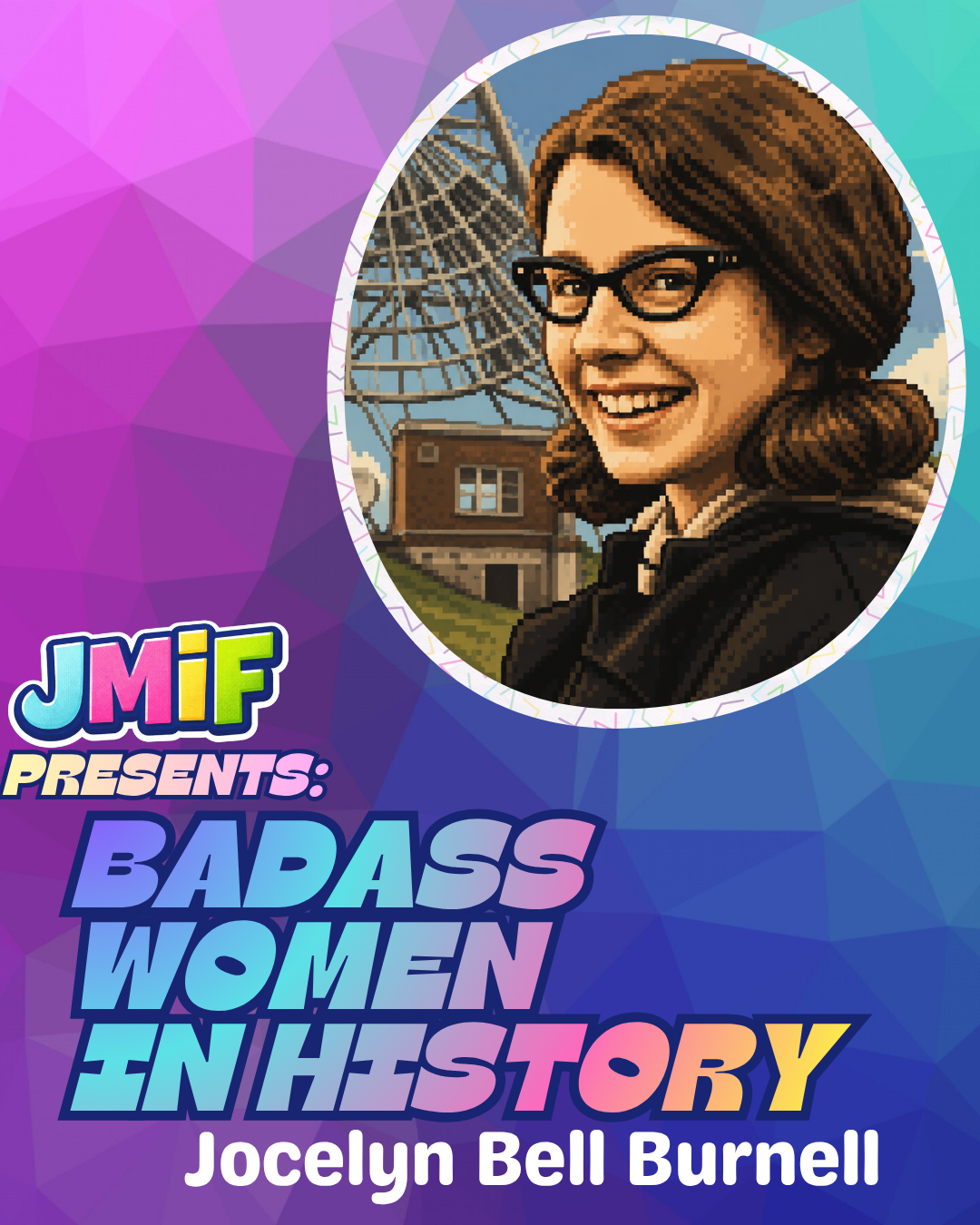
Jocelyn Bell Burnell: The Nobel She Didn’t Win, and Says She Didn’t Deserve

Picture ninety-six feet of paper. Every single night, another ninety-six feet.
That is what a chart recorder spat out at the Mullard Radio Astronomy Observatory outside Cambridge in 1967, and a twenty-four-year-old graduate student named Jocelyn Bell read all of it. By eye. By hand. Miles of squiggling ink, hunting for the flicker of quasars.
And somewhere in that endless ribbon, she found about a quarter inch of something wrong.
It was not a quasar. It was not interference from a passing car or a badly earthed thermostat. It was, she said, a bit of scruff. Fuzz. A smudge in the wrong shape, in the wrong place, and it kept coming back to the same patch of sky.
She could have ignored it. Ninety-six feet a night. Nobody would ever have known. She was, by her own account, quietly certain that Cambridge had made a mistake admitting her and would eventually throw her out.
She did not ignore it. That decision is why we know neutron stars exist.
The Girl They Sent to Cookery Class
Jocelyn Bell was born in Northern Ireland in 1943. Her father was one of the architects of the Armagh Planetarium, and he brought home astronomy books, and that was that.
At her school, when the students were sorted for their subjects, the boys went to the science laboratory. The girls were sent to learn cookery and needlework. Her parents, along with two other families, complained. She was allowed into the science room.
She failed the eleven-plus, the exam that decided which British children were considered worth educating. She got sent to boarding school in England and did fine, which tells you rather a lot about the eleven-plus.
At the University of Glasgow, she was the only woman in an honours physics class of about fifty. There was a tradition at that university. When a woman walked into the lecture theatre, the men whistled, stamped their feet, and catcalled as loudly as they could.
She faced that alone. For two years.
She has said that she assumed she would fail out of Cambridge, so she decided to work as hard as she possibly could, so that when they threw her out she would have nothing to regret.
That is what imposter syndrome does to a person who happens to also be right about everything.
She Built the Telescope
This detail gets skipped and it should not.
The Cambridge array was not handed to her finished. She spent two years constructing it: driving in posts, hanging wire, connecting antennas across roughly four and a half acres of field, in a build involving thousands of dipoles and something like a hundred and twenty miles of cable.
She helped build the instrument. Then she ran the instrument. Then she analyzed everything the instrument produced.
Then, on a night in late November 1967, she trained the recorder on her bit of scruff at high speed and watched it resolve into a string of pulses, arriving one after another with a regularity of about one and a third seconds. Metronomic. Absurd. Nothing natural was supposed to do that.
They half-joked that it might be a signal from another civilization and labeled it LGM-1. Little Green Men.
Then she found a second one, in a different part of the sky, on a different period. Two independent alien civilizations, both broadcasting at Cambridge, was not a hypothesis. It was a new kind of object.
Spinning neutron stars. City-sized, sun-massed, whipping around fast enough to sweep a beam of radio waves past Earth like a lighthouse. Pulsars. One of the great astronomical discoveries of the century, and later the foundation for some of the most rigorous tests general relativity has ever survived.
She was twenty-four. She was still not sure they were going to let her stay.
The Press Conference
The paper announcing the discovery appeared in Nature in February 1968. Five authors. Antony Hewish, her supervisor, first. Bell, second.
Then came the reporters.
She has described the pattern, and it is so precise it is almost funny, in the way a bruise is almost funny. The journalists talked physics with her supervisor. Then they turned to her and asked how many boyfriends she had. What color her hair was. Her bust, waist, and hip measurements.
She has said that however hard she worked at being a scientist, the press was always going to run her as a young woman.
They photographed her standing on things. Arms raised, please. Smile.
Sound familiar? Zaha Hadid spent thirty years being asked about her temper instead of her buildings.
1974
The Nobel Prize in Physics went to Antony Hewish and Martin Ryle. The Swedish Academy credited Hewish with a decisive role in the discovery of pulsars.
Bell Burnell was not on the list.
Sir Fred Hoyle, one of the most eminent and least tactful astronomers alive, publicly went off about it. Hewish, later, explained the omission by saying the question was who inspired and conceived the project, and decided what to do.
She had built the telescope, run it, spotted the anomaly he had initially suspected was terrestrial noise, and chased it down.
And this is the point in the essay where you expect me to bring the hammer down. So here is the hammer, and it is pointing at me.
She Says They Got It Right
In 1977, Jocelyn Bell Burnell explained, publicly and at length, that she thought her exclusion was correct.
Her argument, in her own words and paraphrased here: disputes between a supervisor and a student are nearly impossible to resolve cleanly. The supervisor carries final responsibility when a project fails, and we all know it. So he should also carry the credit when it succeeds. And it would, she said, demean the Nobel Prizes to award them to research students, except in exceptional cases, and this was not one of them.
She has never really walked that back. She has said she suspects she has done better without the Nobel than she would have done with it. She once had to reassure a fellow female physicist, a Nobel laureate, who was frightened Bell Burnell would be angry with her.
Now. There is a popular move here, and I want to name it before anybody makes it. The move is to suggest that she has internalized her own oppression. That this is a kind of Stockholm syndrome of the disenfranchised. That she cannot see clearly what was done to her, and we, from here, in the good light of the present, can.
I do not think we should do that. It is a remarkably convenient argument, because it lets us take a living woman’s stated position on her own life and reclassify it as a symptom. She is one of the most rigorous scientists of her generation. She has had sixty years to reconsider. She has not.
But hold two things at once, because this is the whole trick of reading history honestly.
She is defending a rule. The rule is: credit flows to the supervisor, not the student. And the rule is not neutral, because of who gets to be a supervisor and who gets to be a student, and in 1967 the answer to the first question was almost never a woman.
She can be entirely right that the rule was applied to her correctly. The rule can still be a machine for moving recognition upward, away from the people whose hands are on the instrument. Both of those are true. The second one does not require her to feel wounded, and she does not, and she does not owe anyone the wound.
Erasure does not always look like theft. Sometimes it looks like a perfectly reasonable convention, followed correctly, by decent people, every single time, for a century. (The women of ENIAC were officially classified as “operators.” Also a perfectly reasonable convention.)
What She Did With Three Million Dollars
In 2018, fifty years late, the Breakthrough Prize committee gave her a Special Breakthrough Prize in Fundamental Physics. Three million dollars. Previous recipients of the special prize include Stephen Hawking and the entire LIGO collaboration.
She kept none of it.
Every cent went to the Institute of Physics to establish a graduate scholarship fund for the people least likely to make it through a physics PhD: women, ethnic minority students, students with refugee status, students who cannot afford to finish. She said she wanted to counter the unconscious bias that still runs through physics research.
In 2021 she won the Copley Medal, the oldest scientific prize in the world, older than the Nobel by well over a century. She was only the second woman ever to receive it, after Dorothy Hodgkin in 1976. It came with twenty-five thousand pounds.
She gave that away too. Same fund.
She has been president of the Royal Astronomical Society, president of the Institute of Physics, and the first woman ever to serve as president of the Royal Society of Edinburgh. She is a Dame. She is a Quaker. She spent years working part-time while raising her son, in a field that punishes anyone who steps off the treadmill, and she came back anyway.
The Point
The story we like to tell is that a woman was robbed.
The story she tells is that a convention was followed, that it cost her a medal, and that she has spent the fifty years since making sure the convention costs the next woman less.
She did not get the door opened for her. She went and built a different door, out of three million dollars, and left it standing open behind her.
I would still have given her the Nobel. She would still tell me I was wrong. I think I can live with that, and I think that tension, the refusal to be tidy, is the most interesting thing about her by a considerable margin.
Somewhere out there a neutron star is spinning, keeping better time than any clock we have ever built, because a twenty-four-year-old with impostor syndrome refused to skip a quarter inch of paper.
Learn More
Websites
- Special Breakthrough Prize in Fundamental Physics Awarded to Jocelyn Bell Burnell, Breakthrough Prize Foundation, https://breakthroughprize.org/News/45, 2018
- Dame Jocelyn Bell Burnell awarded Copley Medal and donates gift to scholarship fund, Institute of Physics, https://www.iop.org/about/news/bell-burnell-awarded-copley-medal-donates-gift, 2021
- “However hard I tried to be a scientist, the press were always going to feature me as a young woman”, Anouk Waller-Sargent, Varsity, https://www.varsity.co.uk/science/26663, 2024
Book
- Black Hole Blues and Other Songs from Outer Space, Janna Levin, Knopf, 2016 (contains extended interviews with Bell Burnell on the Nobel and her own view of it). For the primary literature, the discovery paper is Hewish, Bell, Pilkington, Scott & Collins, “Observation of a Rapidly Pulsating Radio Source,” Nature 217, 1968.
Video / Show
- Beautiful Minds: Jocelyn Bell Burnell, dir. Jacqui Farnham, BBC Four, https://www.bbc.co.uk/programmes/b00tt2b6, 2010
A Note on Contested and Widely Oversimplified Claims
The subject disagrees with the popular framing of her own story, and she is alive to say so. Bell Burnell stated in 1977, and has broadly maintained since, that her exclusion from the Nobel was appropriate: demarcation disputes between supervisor and student are unresolvable, the supervisor bears responsibility for failure and should therefore receive credit for success, and awarding Nobels to research students would demean the prize. Some writers, including Maria Popova in The Marginalian, have raised the possibility that this reflects internalized marginalization. That reading is worth naming and worth resisting. It converts a living scientist’s considered position into a symptom, and she has had almost sixty years to revise it.
“Hewish dismissed her discovery and then stole the credit” is the popular version and it is shakier than it sounds. Accounts agree that Hewish’s first instinct was terrestrial interference, which was a reasonable first instinct. Sources disagree sharply on how quickly he came around and how dismissive he was. Some popular accounts (and some illustrated anthologies) flatten this into outright theft. Bell Burnell’s own accounts are considerably more nuanced, and she named him first author on the Nature paper without objection. Hewish later framed his claim around who conceived the project. Judge that argument however you like, but the “he stole it” version is not what the record shows.
Dates for the discovery vary because there were several moments. She first noticed the anomalous “scruff” around August 1967, reported it that month, and resolved it into a pulse train on 28 November 1967. The paper appeared in Nature in February 1968. Different sources lead with different dates.
The telescope’s specifications are cited slightly differently everywhere. Roughly four and a half acres, on the order of two thousand dipole antennas, and approximately 120 miles of wire and cable. Treat the figures as well-attested approximations, not audited numbers. Similarly, the chart paper is usually given as 96 feet per night, occasionally as 100 feet or 30 metres.
The pulse period is generally given as 1.337 seconds, with the refined value around 1.3373 seconds. Some sources round to 1.33 or 1.32.
The Breakthrough Prize is sometimes dated 2019. It was announced in September 2018 and presented at the ceremony in November 2018, which honoured the 2019 laureates. Both dates appear in reputable sources, including the Institute of Physics.
The Copley Medal. She was the second woman to receive it, after Dorothy Hodgkin in 1976. The medal was first awarded in 1731, which does make it older than the Nobel by a wide margin.
Leave a Reply