
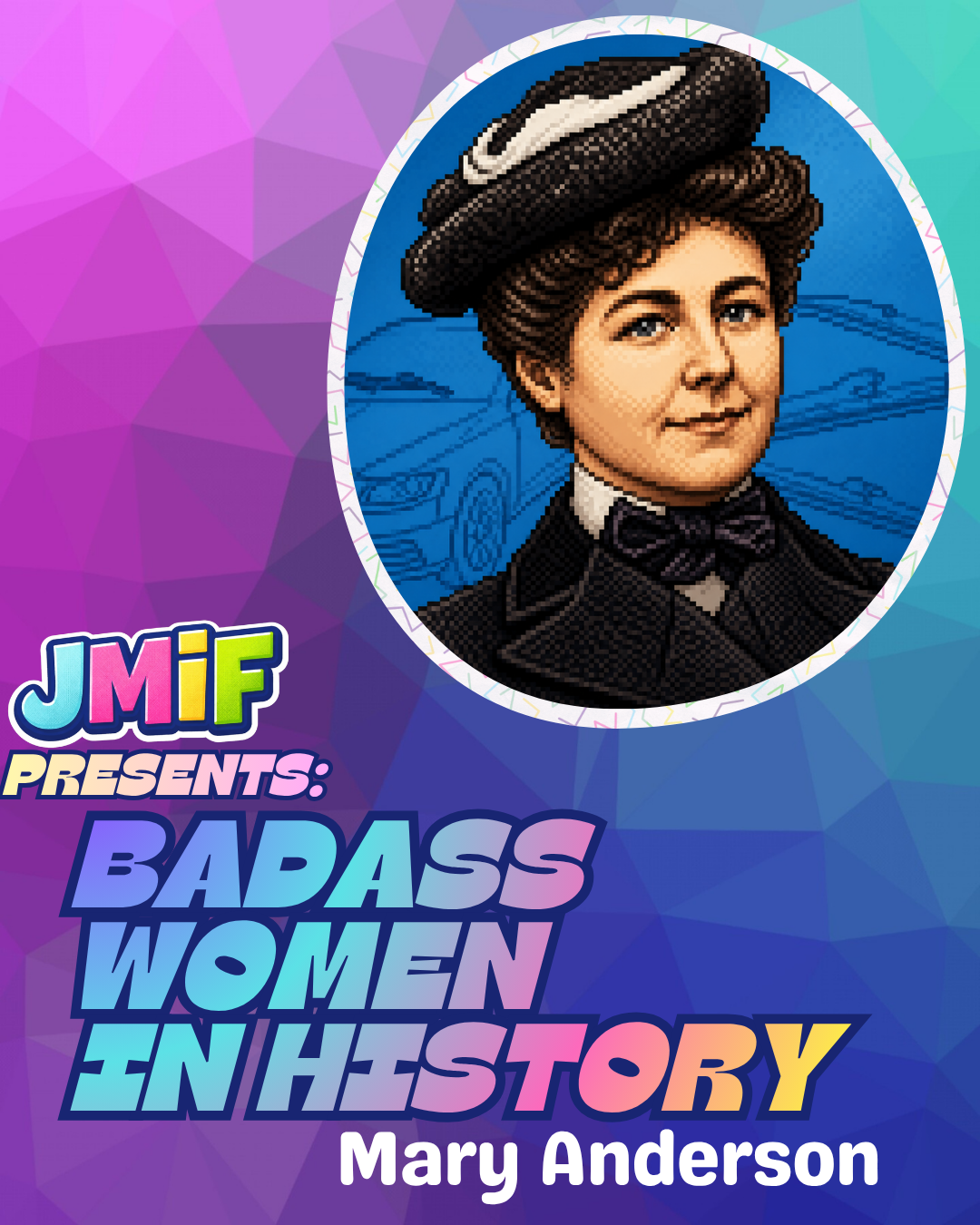

Mary Anderson: The Wiper, the Rejection Letter, and the Two Women Nobody Names
New York City, a winter day around 1902. Sleet.
A streetcar grinds down the avenue and every few blocks it stops, or the driver slides open a pane of the front window and sticks his head out into the freezing air, because he cannot see. Cold blasts through the car. Everyone shivers. Everyone accepts this. This is simply what winter is.
Sitting on that streetcar is a thirty-six-year-old woman from Alabama who has never designed a machine in her life.
And she looks at a grown man leaning his face into a sleet storm at fifteen miles an hour, and she thinks: this is a problem, and it is fixable.
That is the whole thing. That is the entire act of genius. Not the mechanism. The noticing.
Every single person on that streetcar saw exactly what Mary Anderson saw. She was the only one who refused to call it weather.

She Was Not an Engineer, and Nobody Ever Suggested She Should Be
Mary Elizabeth Anderson was born in Greene County, Alabama, in February 1866, ten months after the Civil War ended.
She was not a scientist. She was a businesswoman. In her twenties she moved to Birmingham and built the Fairmont Apartments. Then she went west, to Fresno, and spent five years running a cattle ranch and a vineyard, because apparently that is a thing you could just do in 1893 if you were sufficiently unbothered.
She came back to Alabama to care for an aunt. She never married. She was, by every indication, a woman who solved problems for a living and did not particularly need anyone’s permission.
Then she took a trip to New York, and got on the wrong streetcar at the right time.
Patent Number 743,801

She sketched the idea. She hired a designer to draw the mechanism properly, which is worth saying plainly, because it is how most inventors have always worked and nobody has ever docked Edison points for it.
The device: a lever inside the vehicle, connected to a spring-loaded arm carrying a rubber blade that swept across the outside of the windshield. A counterweight kept the blade pressed against the glass. The driver worked the lever from his seat, in the warm, with the window shut.
And here is the detail that makes me want to shake her hand: it was designed to be removed. You took it off in the spring. She thought about the whole year.
She filed on June 18, 1903. On November 10, 1903, the United States Patent Office granted Mary Anderson patent number 743,801, for a “window cleaning device for electric cars and other vehicles.”
She had seventeen years of protection. She had solved a problem that every driver on earth would eventually have.
She would not make one dollar.
The Letter
Here is the story as the internet tells it. Ready?
Men scoffed at her. They said the moving blade would distract the driver and cause accidents. They rejected her because she was a woman.
I have read that sentence, or a version of it, in a dozen places while writing this.
Now here is the artifact. It survives. Her great-great-niece, an Episcopal priest named Sara-Scott Wingo, still has it. It is a letter from the Canadian firm of Dinning and Eckenstein, responding to Anderson’s attempt to sell her patent.
It says, in essence: dear madam, we acknowledge your letter, and we regret to state that we do not consider it to be of such commercial value as would warrant our undertaking its sale.
That is it.
No mention of distraction. No mention of accidents. No mention, anywhere in that letter, that Mary Anderson was a woman.
I went looking for the source of the “distracting” claim. It appears everywhere and it is sourced nowhere. It has the texture of a detail somebody added later because the true story felt insufficiently villainous.
And I want to argue that the real story is worse, and it is the reason I could not let this one go.
Nobody had to say anything about her sex. Nobody had to conspire. A firm looked at a device for cars, in a year when there were almost no cars, and correctly concluded there was no market. Then a seventeen-year clock ran out.
Her patent expired in 1920.
Cadillac made windshield wipers standard equipment in 1922.
She missed it by two years. Not by sexism. By the calendar. That is what a rigged system actually looks like most of the time: not a slammed door, just a clock nobody offered to stop.

And Then There Were Three
Now the part that made me put down my coffee, because this series has taught me to always check who is standing outside the frame.
In 1917, a woman named Charlotte Bridgwood patented the first automatic, electrically powered windshield wiper. She called it the Electric Storm Windshield Cleaner. It used rollers instead of blades and ran off the car’s engine, meaning no lever, no hand, nothing to work. Just switch it on.
She was president of her own company, the Bridgwood Manufacturing Company. She was a former vaudeville actress who went by the stage name Lotta Lawrence. She was fifty-six years old.
She could not raise the money to manufacture at scale. Her patent expired in 1920.
The same year as Mary Anderson’s.
Two years later, Cadillac made automatic wipers standard.
Charlotte Bridgwood never earned a cent either. And Charlotte Bridgwood had a daughter.
Her name was Florence Lawrence, and she was, by most accounts, the first movie star in the history of cinema. She appeared in something like three hundred films. She was also a car obsessive, and she designed an “auto signaling arm,” a mechanical device that raised a flag from the rear bumper to show which way the car was about to turn.
She designed a mechanical brake signal too.
She never patented either one. She got no credit and no money for the turn signal or the brake light.
So: sit in your car. Switch on the wipers. Signal a left turn. Tap the brake.
You have just used inventions from three women, from one family and one Alabama businesswoman, and not one of them made a dollar from any of it.
What Actually Happened
Let me be scrupulous, because this series does not do the thing where we make the injustice bigger than it was.
Mary Anderson was not the only person thinking about this in 1903. Three window cleaning patents appeared that year. About three months after hers, Robert Douglass filed for a locomotive cab window cleaner. A few months after that, in England, James Henry Apjohn patented an apparatus for cleaning carriage and motor car windows. Anderson’s was first among them, and hers is the one recognized as the first operational windshield wiper. She is in the National Inventors Hall of Fame. That is a real claim and it holds.
But “she invented the windshield wiper and men stole it” is not what happened.
What happened is that a woman with no engineering training correctly identified a problem eighteen years before the market was ready to care, and the patent system gave her seventeen. What happened is that a second woman solved the same problem better, went broke trying to build it, and watched her patent lapse in the same calendar year. What happened is that a third woman, arguably the most famous person in America at the time, invented two things you touch every day and did not bother to file paperwork, and so simply vanished from the record.
No villain. No smoking gun. Just a system that will happily take everything you have and hand you nothing back, and which does not need to hate you personally in order to do it.
That is the shape of most of it. The dramatic theft is rare. The clock is constant.
If you want to see it happen to a living scientist, read about Peggy Lemaux, who spent thirty years engineering crops that never reached a single person.
The Point
Mary Anderson lived to be eighty-seven. She died in 1953 at her summer home in Tennessee, having watched, for thirty years, every car in America drive past with her idea bolted to the windshield.
There is no record of her being bitter about it. There is no record of her saying much about it at all.
She was inducted into the National Inventors Hall of Fame in 2011. She had been dead for fifty-eight years.
She was a real estate developer, a rancher, and a winemaker, and she looked at a man freezing his face off in a sleet storm and decided that was unacceptable. She was right. It only took the world nineteen years to agree, and by then the meter had run out.
Next time it rains, flip the little stalk. Somebody thought of that. She was on a streetcar, she was cold, and nobody had asked her to fix anything.
Related: Lydia Moss Bradley, another woman who built things in a century that did not expect her to. And the Women of ENIAC, a story about who stands outside the frame.
Learn More
Websites
- Alabama Woman Stuck In NYC Traffic In 1902 Invented The Windshield Wiper, NPR, https://www.npr.org/2017/07/25/536835744/alabama-woman-stuck-in-nyc-traffic-in-1902-invented-the-windshield-wiper, 2017 (contains the text of the actual rejection letter, held by Anderson’s great-great-niece)
- The Evolution of Wind Shield Wipers: A Patent History, IPWatchdog, https://ipwatchdog.com/2014/11/09/the-evolution-of-wind-shield-wipers-a-patent-history/, 2014
- US Patent 743,801: Window-Cleaning Device, Mary Anderson, https://www.datamp.org/patents/displayPatent.php?pn=743801&id=79964, 1903
Book
- Patently Female: From AZT to TV Dinners, Stories of Women Inventors and Their Breakthrough Ideas, Ethlie Ann Vare and Greg Ptacek, John Wiley & Sons, 2002
Video / Show
- Mary Anderson Patents the Windshield Wiper, HISTORY, https://www.history.com/this-day-in-history/november-10/mary-anderson-patents-windshield-wiper, 2025 (see the note below: no feature documentary about Anderson appears to exist)
A Note on Contested and Widely Oversimplified Claims
The “they said it would distract drivers” claim is unsourced and this post treats it as folklore. It appears in dozens of articles, always without citation. The one surviving primary artifact is the rejection letter from Dinning and Eckenstein, in the possession of Anderson’s great-great-niece Sara-Scott Wingo and read aloud on NPR, which states only that the firm did not consider the patent of sufficient commercial value to warrant handling its sale. It says nothing about distraction, accidents, or Anderson’s sex. If you find a primary source for the distraction claim, I would genuinely like to see it.
She hired a designer. Anderson conceived the device and had someone else render the mechanism for the patent application. This is unremarkable for the period and was true of many celebrated male inventors. It is included here for precision, not to diminish her.
“First windshield wiper” needs a qualifier. Three window-cleaning patents cluster in 1903. Anderson’s was granted first (November 10). Robert Douglass filed roughly three months later for a locomotive cab cleaner; James Henry Apjohn patented a comparable apparatus in England a few months after that. Anderson is credited with the first operational windshield wiper, which is the defensible claim, and is the one the National Inventors Hall of Fame recognizes.
Patent dates get mangled constantly. At least one USPTO-hosted document states her patent was awarded in September 1905, and several secondary sources say 1905. The grant date is November 10, 1903; the application was filed June 18, 1903.
“Wipers were standard by 1913” and “Cadillac standardized them in 1922” are both in circulation and are not the same claim. Manual wipers appeared on production cars during the 1910s. Cadillac is generally credited with making automatic wipers standard equipment in 1922. Sources routinely blend these into one sentence. The two-year gap this post highlights (1920 patent expiry, 1922 Cadillac standardization) refers to the automatic wiper.
Charlotte Bridgwood’s patent is hard to verify directly. IPWatchdog notes that they could not locate the official patent through Google Patents, though the USPTO and multiple sources report the 1917 grant for the Electric Storm Windshield Cleaner. Her design used rollers rather than blades and was never commercially successful. She died in 1929.
Florence Lawrence’s inventions were never patented, which is precisely why they are hard to document and easy to overstate. Contemporary and near-contemporary sources credit her with a mechanical auto signaling arm and a brake signal. Some modern listicles also credit her with the traffic light, which is not supportable.
On Anderson’s birthplace. Several sources describe her as born on Burton Hill Plantation in Greene County, Alabama, in 1866. Her family’s relationship to slavery before emancipation is not addressed in any source I could find, and this post does not assume an answer in either direction. If you pursue this entry further, that is the thread worth pulling.
No feature documentary about Mary Anderson appears to exist, which is itself telling. The video slot above points to HISTORY’s short-form coverage. Treat any listing claiming a dedicated film with suspicion until verified.
Leave a Reply