
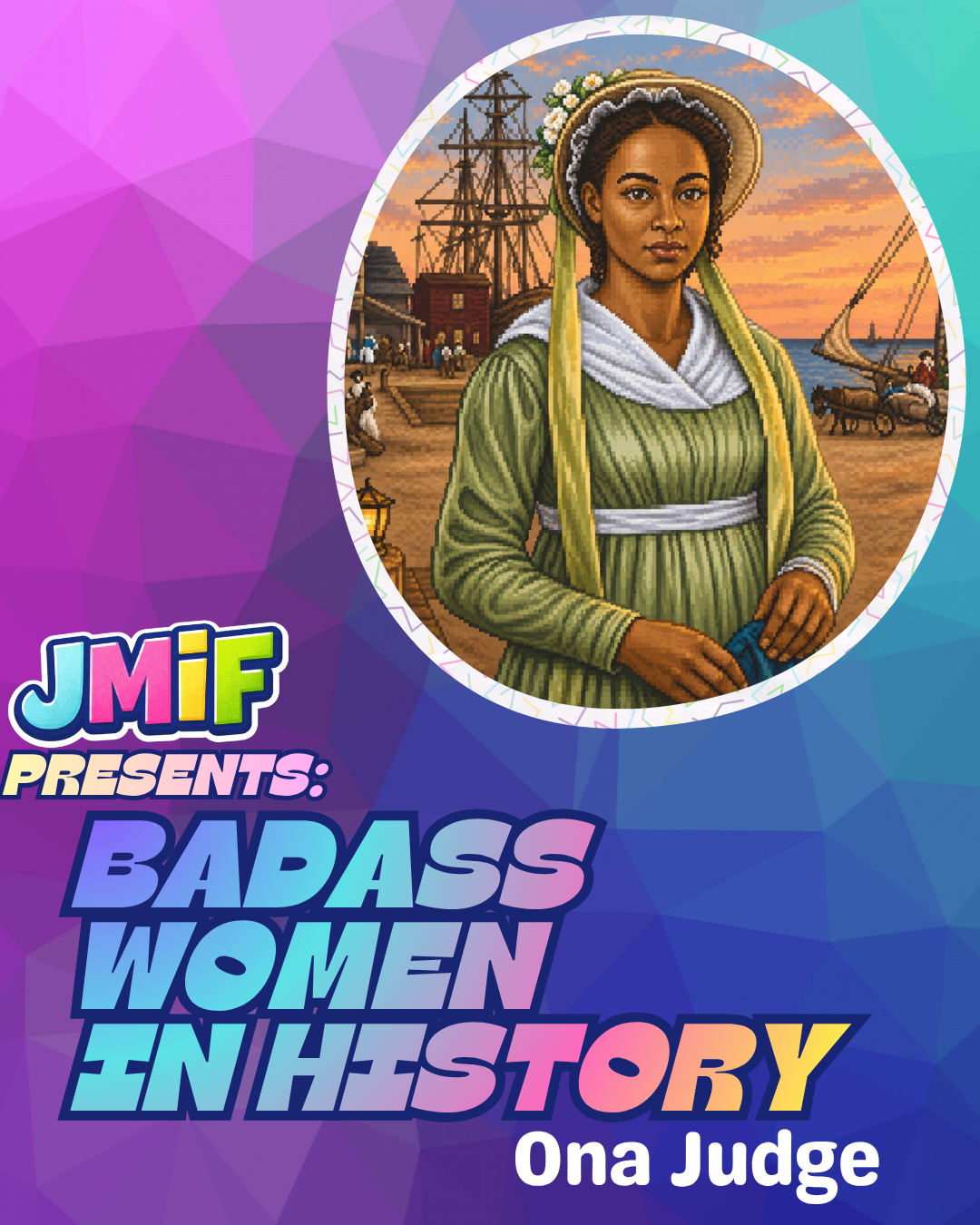
Ona Judge: The Woman Who Told George Washington No

On the evening of May 21, 1796, the President of the United States sat down to dinner.
Somewhere in the house, a twenty-two-year-old woman named Ona Judge was not sitting down to anything. She had already sent her belongings ahead, quietly, to friends in the free Black community of Philadelphia. She waited until the soup was served. Then she walked out the front door of the President’s House and did not come back.
She had been Martha Washington’s personal maid since she was about ten years old. She dressed the First Lady. She traveled with her. She was, by the Washingtons’ own account, treated well, which is a sentence that should make your teeth hurt, because “treated well” was being said about a person who was legally furniture.
Ona had just found out she was to be given away as a wedding gift.
The Six-Month Trick
Here is the part where I need you to be as angry as I am.
Pennsylvania passed a Gradual Abolition Act in 1780. Among other provisions, any enslaved person held in the state continuously for six months could claim their freedom.
George Washington, President of the United States, sitting in the nation’s capital, read that law and found the loophole. Every six months, before the clock ran out, he shuttled the people he enslaved out of Pennsylvania. Back to Mount Vernon. Or just across the river to New Jersey for a few days. Then back to Philadelphia, and the counter reset.
The man on the money did this. Deliberately, repeatedly, as a matter of household administration, for years. He was not unaware of the law. He was managing it.
And in 1793, as president, he signed the Fugitive Slave Act, which meant that anyone who escaped across a state line could legally be hunted down and dragged back.
Three years later he used that law on Ona.
“No Provocation”
The runaway advertisement went into a Philadelphia paper within days. Ten dollars for her return. It described her as slender, delicate, freckled, with very dark eyes and dense black hair. And it made a point of informing readers that there had been no suspicion of her leaving, and no provocation for it.
No provocation. She was being handed to Martha’s granddaughter Eliza, a young woman with a reputation among the household staff for a vicious temper, and shipped back to Virginia, where the odds of ever seeing freedom were effectively zero. She said it herself, plainly, decades later: she knew that if she went back to Virginia she would never get her liberty.
No provocation. Just a person, being informed she had been reassigned, like a chair.
Ona boarded a merchant ship called the Nancy, under Captain John Bowles, and spent four or five days sailing three hundred miles north to Portsmouth, New Hampshire, praying nobody recognized her. She was helped by free Black Philadelphians whose names, almost entirely, we do not have.
The Customs Collector
She was spotted in Portsmouth within months. A young white woman who knew the Washington family recognized her on the street. (Sources disagree about which one. Some say Senator John Langdon’s daughter Elizabeth. Some say Martha’s granddaughter Nelly Custis herself. Nobody has ever pinned it down.)
Word reached Washington. He did not go to a court. He used his administration. He reached out through his Treasury Secretary to Joseph Whipple, Portsmouth’s collector of customs, a man who owed his job to Washington, and asked him to get her on a boat.
Whipple found her. And Ona, twenty-three years old, with no lawyer, no money, no legal standing, and no rights whatsoever, negotiated with the President of the United States.
She said she would come back. On one condition: that the Washingtons guarantee her freedom after their deaths, so she could never again be sold or gifted to anyone. Otherwise, she said, she would rather die than return to slavery.
She also told Whipple that Washington’s story about her being seduced away by a Frenchman was a fabrication, and that her only motive had been a thirst for complete freedom. Her words, more or less, preserved in a customs officer’s letter because nobody thought to preserve them anywhere else.
Washington’s response was to be insulted. Freeing her, he wrote, would be rewarding unfaithfulness. He instructed Whipple to seize her by force, though quietly, please, and without starting a riot on the docks, because Portsmouth was full of abolitionists and this would look bad.
Whipple, an abolitionist himself, declined. He told the President to hire a lawyer.

“I Am Free Now”
Ona married a free Black sailor named Jack Staines in January 1797. They had a daughter, Eliza.
In August 1799, Washington, no longer president, sent Martha’s nephew Burwell Bassett Jr. to New Hampshire on the errand his customs collector had refused. Bassett knocked on Ona’s door. Her husband was at sea. Her baby was in her arms.
He tried charm. He tried promises, including a promise that she would be freed if she came back to Virginia. She had heard that one.
She told him: I am free now, and choose to remain so.
Bassett, a Virginia gentleman entirely unaccustomed to a Black woman saying no to him twice, went back to Senator Langdon’s house to regroup and, over dinner, announced his plan to take her by force. Langdon, whose family had freed the people they enslaved and hired them back for wages, quietly sent a warning. Possibly through a member of his own staff.
By morning Ona had hired a carriage, taken her baby, and gone eight miles inland to Greenland, New Hampshire, to the home of a free Black woman named Nancy Jack.
Bassett went home empty-handed. Washington died four months later. And after that, she said, the family never troubled her again.
Roll credits, right?
What It Cost
No. Sit back down.
Because when Ona ran, Martha Washington still needed a wedding gift for her granddaughter. So she gave her Ona’s younger sister, Delphy.
Delphy was not freed until 1807, when Eliza Custis Law and her husband manumitted her and her children. Eleven years. Ona’s freedom was purchased, in part, with her sister’s body, and Ona had no way to prevent that and almost certainly knew it.
And here is the other thing. Ona was never actually free.
She was a “dower slave,” legally part of the Custis estate rather than Washington’s personal property, which means that even the manumission clause in his will could not have reached her. She lived the rest of her life as a fugitive. Her children were, in the eyes of Virginia law, the property of the Custis estate from the moment they were born, and could have been seized at any time.
Her husband died in 1803. She buried both of her daughters. She spent her final decades in Greenland, still at Nancy Jack’s, classified by Rockingham County as a pauper.
She died in 1848. Fifty-two years a fugitive.
The historian Erica Armstrong Dunbar puts it in a sentence that has never once stopped bothering me: Ona was never free. She was simply never caught.
Why We Know Any of This
Almost everything Ona Judge said in her own voice survives because two abolitionist newspapers sent men to interview her in the 1840s, when she was in her seventies.
The Granite Freeman in 1845. The Liberator in 1847. Two white men, writing down a Black woman’s words, for a political purpose, half a century after the events, and then editing them.
That is our primary source. That is nearly all of it. Everything else we have comes from the paperwork of the people who were hunting her: Washington’s letters, Whipple’s letters, a runaway ad written by the household steward.
We know Ona Judge mostly through the correspondence of her pursuers. Think about how much of women’s history works exactly this way. The record survives because someone powerful was annoyed enough to write it down.
She taught herself to read after she got to New Hampshire. She told her interviewer she had never received any instruction of any kind in Washington’s house. She read the Bible she was never allowed.
The Point
Every May, Americans post about a man who could not tell a lie.
He told at least one. He told Joseph Whipple that a Frenchman had lured her away, because he could not construct, inside his own head, a version of Ona Judge who simply wanted to belong to herself.
She walked out during dinner. She negotiated with a president from a position of zero leverage and she did not fold. She said I am free now to a man who had come to put her in chains, and she said it while holding her baby.
She lost her sister to it. She lost her husband and her daughters. She died poor, in a borrowed house, still technically the property of a family in Virginia.
And she never went back.
Related: the Women of ENIAC, a story about the people standing just outside the frame of the photograph. And Gwendolyn Lizarraga, who also declined the role she was assigned.
Leave a Reply