
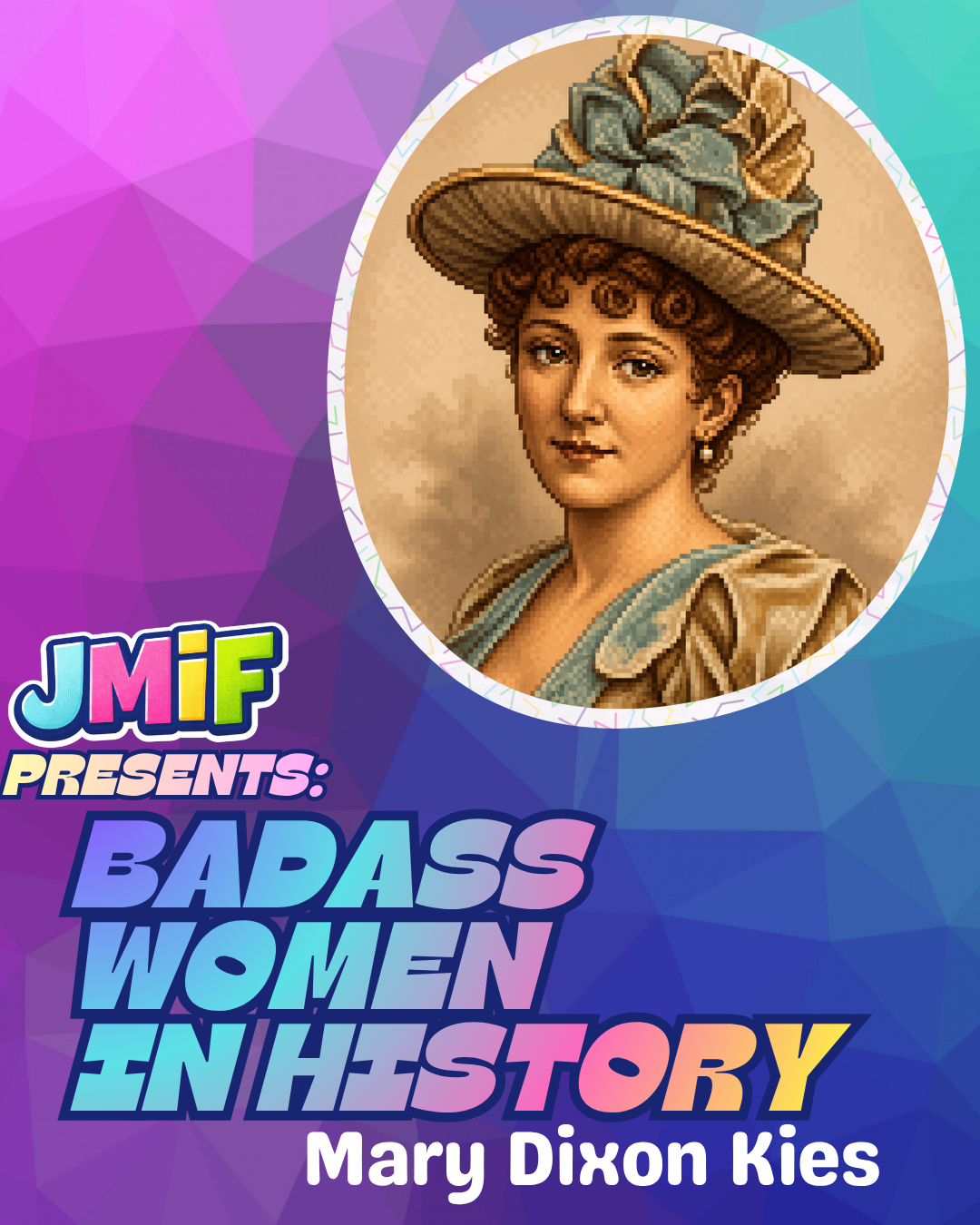
She dared to put her own name on the patent.

A Bonnet, a Patent, and a Whole Lot of Nerve
Imagine being a woman in 1809 and deciding that your idea deserved legal protection, public credit, and your name attached to it.
That sounds reasonable now. Bare minimum, honestly. But in the early United States, a woman claiming ownership over an invention was a quietly radical act. Married women were still tangled in coverture, the legal doctrine that treated a wife’s property and identity like bonus content attached to her husband. Women’s labor was everywhere, especially in homes, farms, shops, textile work, and local manufacturing. But women’s ownership? Women’s names? Women’s right to profit from their own technical brilliance?
Suddenly, the room got very quiet.
Then Mary Dixon Kies walked in with straw, silk, thread, and the kind of practical genius history keeps trying to misfile under “crafts.”
On May 5, 1809, Mary Kies of South Killingly, Connecticut, received a U.S. patent for a new method of weaving straw with silk or thread. The invention was used for women’s hats and bonnets, which sounds sweet and decorative until you remember that hats were not just accessories. They were an industry. They were labor. They were fashion. They were protection from sun and weather. They were money.
And Mary Kies wanted her cut of the credit.
For more women who refused to disappear from the paperwork, start with the Badass Women in History hub and cross-link this story with Lydia Moss Bradley, another woman who understood that control over property could become control over legacy.
The Woman Behind the First
Mary lived in a New England economy where women and girls braided straw at home, feeding a real hatmaking industry that somehow kept being treated as “women’s work” instead of “manufacturing.” Cute trick.
Mary Dixon was born on March 21, 1752, in Killingly, Connecticut. The details of her life are frustratingly thin, which is part of the problem and part of the point. We know she married, became Mary Kies, and lived in a world where women’s work was considered essential until the second it needed to be remembered.
This is the historical equivalent of asking women to make the whole meal, clean the kitchen, host the guests, and then pretending the recipe appeared from a cloud.
By the late 1700s and early 1800s, straw hats and bonnets were in demand. They were useful for working women who needed protection outdoors, and fashionable for women who wanted something pretty without waiting for elite European imports. Then international politics dropped a brick on the market.
The Napoleonic Wars disrupted trade. U.S. embargoes and tensions with Britain and France made imported goods harder to get. Suddenly, domestic manufacturing was not just patriotic rhetoric. It was necessary. American consumers still wanted hats. American workers still needed hats. The hat industry needed better, cheaper, sturdier ways to make them.
Mary Dixon Kies saw the opening.
The Invention Was Not “Just a Hat Thing”

Mary’s invention was a process for weaving straw with silk or thread. That might sound tiny if you are used to innovation being marketed with chrome, venture capital, and a man in a black turtleneck acting like he invented thinking.
But this was exactly the kind of practical improvement that powers real economies.
Straw was plentiful, but straw alone could be brittle. Silk or thread could strengthen and decorate the weave. The result was a more appealing and durable material for hats and bonnets. In other words, Mary improved the product, boosted the industry, and helped meet a market need during a trade crisis.
Very casual. Just economic strategy, textile engineering, consumer goods innovation, and women’s labor all braided together.
The National Inventors Hall of Fame notes that Kies’ technique was quickly adopted by New England hatmakers and widely used for about a decade. That is not trivia; that is market impact.
The Patent Act Opened the Door. Society Tried to Stand in Front of It.

The U.S. Patent Act of 1790 used broad language that allowed “any person or persons” to apply for patent protection. Technically, women could apply.
Technically, the door was open. Socially, economically, and legally, women were still being told to stay outside and maybe hold someone’s coat. Local property laws and coverture norms made it difficult for married women to own property independently. A patent was a form of property. A patent meant a woman could claim an idea as hers, attach value to it, and potentially profit from it.
That was not just paperwork. That was power.
Mary Kies applying in her own name directly challenged a culture that treated women’s work as useful but women’s ownership as inconvenient. It is why her name matters. Not Mrs. Somebody. Not attached to a husband’s identity. Mary Kies.
Now here comes the messy part, because history loves to make women’s milestones as complicated as possible.
Mary Dixon Kies is widely described as the first woman to receive a U.S. patent. More precisely, she is often identified as the first woman to apply for and receive a U.S. patent in her own name. That phrasing matters because the early patent record has some ambiguity.
Hannah Wilkinson Slater received a patent in 1793, but it was issued under the name “Mrs. Samuel Slater,” not her own full name. Hazel Irwin is also cited by some historians for an 1808 cheese press patent. Then there is Mary Kies in 1809, whose patent was issued in her own name and became the milestone most often taught as the first U.S. patent awarded to a woman.
And as if that were not enough archival chaos, the Patent Office fire of 1836 destroyed many early patent records, including Mary’s original patent documents.
The Lost Patent and the Very Familiar Pattern
The 1836 Patent Office fire is not just a plot twist. It is a metaphor with smoke damage.
Mary Kies did the thing. She applied. She received the patent. Her process was recognized. Her work fed an industry. Then the original document burned, and with it went details that might have helped historians understand exactly how her process worked and how it spread.
This is how erasure often happens. Not always with one mustache-twirling villain. Sometimes it is a fire, a missing file, a husband’s name, or the lazy choice to call women’s technical work “craft.”
Then, two hundred years later, people ask, “Where were all the women inventors?”
Babe, they were there. You misplaced the receipts.
For more “the system underestimated the medium and missed the genius” energy, cross-link to Zaha Hadid. Architecture, textiles, patents — different rooms, same stale gatekeeping air.
What Mary Changed
Mary Dixon Kies did not single-handedly end sexism in patents. Obviously. If she had, this blog series would be much shorter and I would have fewer reasons to yell politely into the internet.
But she did something historically important: she proved that a woman could use the patent system in her own name.
That proof mattered.
A first does not fix the door. A first shows the door is real.
Her invention also helps us rethink what innovation looks like. We are trained to imagine inventors as lone geniuses in workshops, usually men, preferably wild-haired, surrounded by gears, lightning, or dramatic equations. But invention is also a woman noticing that straw hats could be stronger, prettier, and more useful if woven differently. It is local knowledge. It is material intelligence. It is an improvement that makes work easier, products better, and economies more resilient.
That deserves respect.
Why Mary Dixon Kies Still Matters
Mary Dixon Kies matters because she reminds us that credit is not a luxury. It is infrastructure.
When women are denied credit, they are denied money, leverage, authority, legacy, and proof. They are denied the ability to point to their own work and say, “That was mine.” And when that happens across generations, we end up with a fake version of history where men appear to have invented the modern world by themselves while women apparently spent several centuries arranging flowers and fainting attractively.
Mary’s patent says otherwise.
It says women were building the economy. Women were solving technical problems. Women were watching markets and adapting to supply disruptions. Women were making goods people needed. Women were innovating in the space between domestic labor and industrial production, which is exactly where a ton of real life happens.
Her story deserves more than a trivia-card cameo. She belongs in conversations about women inventors, intellectual property, early American manufacturing, textile history, and the legal fight for women to own the products of their own minds.
And yes, she patented a bonnet process.
Good.
Let the bonnet be the warning label.
Because inside that bonnet is a woman who looked at a country barely old enough to have its paperwork in order, saw a legal system mostly built by and for men, and said: my idea, my name, my patent.
That is not small. That is a whole revolution braided in straw and silk.
Learn More / Sources
Websites
- Mary Dixon Kies, National Inventors Hall of Fame, https://www.invent.org/inductees/mary-dixon-kies, updated 2026
- First Woman to Receive US Patent – Today in History: May 5, Connecticut History, https://connecticuthistory.org/first-woman-to-receive-us-patent-today-in-history/, 2021
- Meet Mary Kies, America’s First Woman to Become a Patent Holder, Erin Blakemore / Smithsonian Magazine, https://www.smithsonianmag.com/smart-news/meet-mary-kies-americas-first-woman-become-patent-holder-180959008/, 2016
Book
- Feminine Ingenuity: Women and Invention in America, Anne L. Macdonald, https://worldcat.org/oclc/30537259, 1994
Video / Show
- Mary Dixon Kies, Introductions Necessary, https://introductionsnecessary.com/podcast/mary-dixon-kies/, 2024
Notes on contested / nuanced history
- Mary Dixon Kies is widely called the first woman to receive a U.S. patent, but the most precise phrasing is that she was the first woman to apply for and receive a U.S. patent in her own name.
- The USPTO notes ambiguity because Hannah Wilkinson Slater received a 1793 patent under “Mrs. Samuel Slater,” while Hazel Irwin is cited by some historians for an 1808 cheese press patent.
- Mary’s patent date is often listed as May 5, 1809, though some sources list May 15, 1809. The original patent record was destroyed in the 1836 Patent Office fire, which complicates exact documentation.
- Some details of Kies’ later life, including how much money she made from the invention, are less securely documented than the patent milestone itself. Treat claims that she “died penniless” with caution unless a stronger primary source is added.
Leave a Reply