
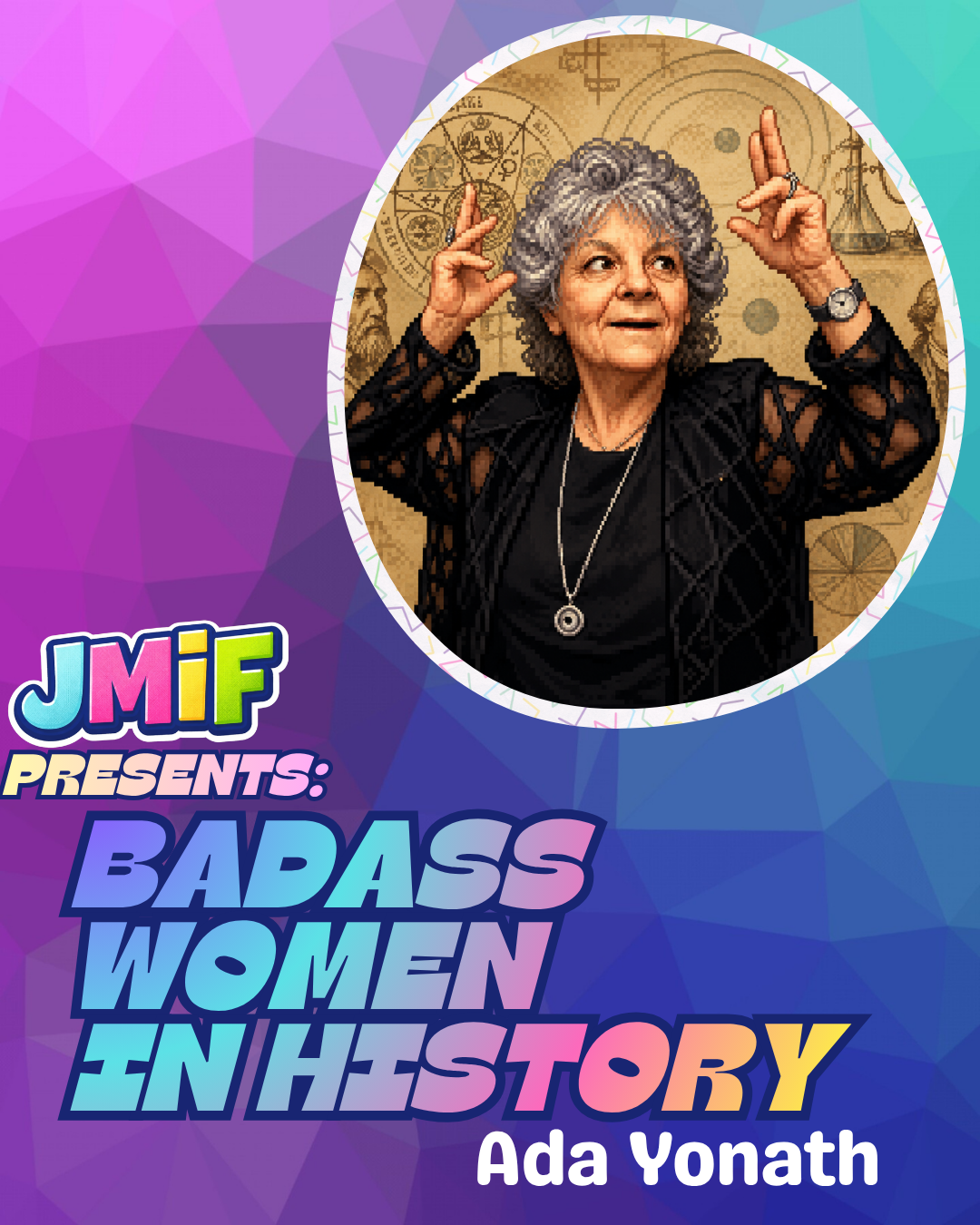

The Cell’s Tiny Factory Had a Security System. Ada Yonath Broke In.
History loves a genius after the prize ceremony.
Before the medal, before the applause, before the serious people in serious suits start saying they “always believed,” history often treats a woman with a wild idea like she wandered into the wrong room. Ada Yonath knew that room well.
She wanted to map the ribosome — the cellular machine that turns genetic instructions into proteins. In plain English: ribosomes are part of the reason DNA is not just a fancy biological recipe card sitting uselessly in the kitchen drawer. They help make life happen. Every cell depends on them. Bacteria depend on them. You depend on them.
Ada Yonath looked at this absurdly complex, floppy, unstable molecular beast and decided she was going to figure out what it looked like.
The scientific establishment responded with the usual playlist: impossible, ridiculous, dead end, not worth it, you will waste your life. Ah yes, the sacred peer-reviewed tradition of “girl, don’t.”
Ada did it anyway.
A Childhood Built on Questions, Scarcity, and Books
Ada Yonath was born in Jerusalem on June 22, 1939, when the city was still part of the British Mandate of Palestine. Her parents had emigrated from Poland, and the family struggled financially. Her father was a rabbi, but the family tried to make a living by running a grocery store. When he died, Ada was still young, and her family moved to Tel Aviv.
This was not the glossy “future Nobel laureate raised in a perfectly stocked science palace” version of genius. Her curiosity had to survive real limits.
She studied chemistry at the Hebrew University of Jerusalem, earned her master’s in biochemistry, and completed her PhD at the Weizmann Institute of Science. By 1970, she had established what Weizmann later described as Israel’s first biological crystallography laboratory for solving protein structures — and for almost a decade, the only one of its kind in the country.
That detail matters. She did not walk into a fully prepared empire of tools and applause. She built the room, then did the work inside it.
For another woman who turned “there is no place for you here” into “cool, I’ll build the place myself,” cross-link to Lydia Moss Bradley.
The Ribosome Problem, or: Why Everyone Thought She Was Delusional
The ribosome was not just difficult to study. It was a nightmare with a lab coat.
To see the structure of very small biological molecules, scientists often use X-ray crystallography: make crystals, hit them with X-rays, interpret the diffraction patterns, and infer the structure. Elegant? Yes. Easy? Absolutely not, especially when your target molecule is enormous, flexible, unstable, and apparently committed to being a diva.
By the 1970s, scientists knew ribosomes were essential, but getting a high-resolution, three-dimensional structure seemed fantasy-level ambitious. Other teams had tried. Other teams had backed away. The conventional wisdom was basically: absolutely not.
Ada Yonath heard “absolutely not” and apparently translated it as “needs better technique.”
Classic system nonsense: when men guess boldly, it gets called vision. When women diagnose the problem correctly, it gets called delusion until the data gets too loud to ignore.
For more “you called her impossible until she changed the field” energy, cross-link to Zaha Hadid. Buildings, molecules — same patriarchal migraine.
Polar Bears, Dead Sea Bacteria, and One Ridiculously Good Idea
Ada’s inspiration came from an unexpected place: hibernating bears.
She read that bears pack their ribosomes in an orderly way before hibernation, preserving them through long periods of inactivity. That gave her a wild but logical idea: maybe ribosomes could be packed into an ordered structure after all. Maybe nature had already done the thing scientists insisted could not be done.
So she looked for ribosomes from organisms that could survive extreme conditions — including bacteria from harsh environments like the Dead Sea, thermal springs, and even settings connected to atomic piles. These ribosomes were tougher. More stable. Better candidates for the brutal process of crystallization.
It worked, sort of. She and her collaborators produced early ribosome microcrystals in the early 1980s.
Did everyone immediately celebrate the breakthrough? Please. This is history, not a Disney Channel finale.
Ada later recalled that distinguished scientists responded to her plans with sarcasm and disbelief. She was called a dreamer, a village fool, a so-called scientist, and someone driven by fantasies.
Imagine being that wrong with your whole chest.
Cryo-Bio-Crystallography: When the Molecule Is Dramatic, Freeze It
One of Ada Yonath’s key contributions was helping develop cryo-bio-crystallography. The basic idea was to cool crystals to extremely low temperatures so they would not disintegrate so quickly under X-ray bombardment.
By using extreme cold, Ada’s team could reduce damage and get better data from fragile ribosomal crystals. This technique became widely used in structural biology — a quietly massive achievement that does not get enough public drama because nobody has figured out how to make “protecting crystals from radiation damage” trend.
And here is the hook in the middle of the story: Ada Yonath did not win because she had one perfect flash of genius. She won because she stayed with a problem long enough to change the conditions around it.
Less lightning bolt. More controlled burn.
The Ribosome Finally Gave Up Its Secrets
By the late 1990s, the work began breaking through. Ada’s group and other teams pushing the field forward started producing increasingly detailed maps of ribosomal structures.
In 2000 and 2001, the first complete three-dimensional structures of bacterial ribosomal subunits were published. These were not decorative scientific trophies. They were maps of one of life’s most fundamental machines.
Once scientists could see the ribosome at this level, they could understand how it reads genetic information and helps build proteins. They could also better understand how antibiotics work, because many antibiotics fight bacteria by targeting bacterial ribosomes. If you know the shape of the machine, you can understand how to jam it, protect it, or redesign tools that interact with it.
That matters even more in a world facing antibiotic resistance. Ada’s ribosome work helped explain how certain antibiotics bind to ribosomal sites, how resistance can develop, and how future drugs might be designed more intelligently.
The Nobel Prize, and the Part Where Chemistry Remembered Women Exist
In 2009, Ada Yonath received the Nobel Prize in Chemistry alongside Venkatraman Ramakrishnan and Thomas A. Steitz “for studies of the structure and function of the ribosome.”
She was the first woman in 45 years to receive the Nobel Prize in Chemistry, since Dorothy Crowfoot Hodgkin in 1964. She was only the fourth woman ever to receive the Chemistry Nobel at that point, after Marie Curie, Irène Joliot-Curie, and Dorothy Hodgkin.
A prize first awarded in 1901 had recognized only four women in Chemistry by 2009.
And no, that is not because women were lounging around for a century saying, “Ugh, molecules are hard.” Women were there. Women were working. Women were publishing, teaching, calculating, experimenting, building, and getting conveniently blurred into the background like history had applied a bad Instagram filter called Patriarchy Warm Beige.
Ada Yonath’s Nobel mattered because the science mattered. It also mattered because every girl who hears “you are not built for hard science” deserves a counterspell with a name attached: Ada Yonath.
The Badass Part Is Not Just the Prize. It Is the Refusal.
It would be easy to make this story all about the Nobel, but that would flatten her into a trophy case. Ada Yonath’s badassery is not that Stockholm eventually noticed.
It is that she kept going before they did.
She kept going when the field was underfunded. She kept going when colleagues mocked the idea. She kept going through fuzzy images, failed crystals, better crystals, technical dead ends, new methods, more ridicule, and decades of work that did not come with a guarantee.
There is a specific kind of courage required to spend your life on a question people have already decided is foolish. Not cute courage. The unglamorous kind. The kind where you keep showing up to the lab while everyone else is smugly waiting for your failure to confirm their worldview.
Ada’s story exposes a brutal truth about innovation: the future often sounds stupid to the people most invested in the present.
And when a woman says it first? Oh, then it sounds extra stupid.
Until it wins a Nobel.
Why Ada Yonath Still Matters
Today, Ada Yonath’s research continues through the Weizmann Institute, where her group’s work connects ribosome structure and function to human genetic diseases, antibiotic development, and questions about the origin of life.
That scope is deliciously huge: from tiny cellular machinery to the ancient origins of biology itself.
Her story also belongs inside a bigger Badass Women in History conversation. Pair her with Hypatia of Alexandria and Gwendolyn Lizarraga — women who made knowledge and power inconvenient.
Because Ada Yonath’s life says: sometimes unrealistic is just reality before the cowards have caught up.
Closing: The Ribosome Was Never the Only Thing She Cracked
Ada Yonath cracked the ribosome, yes.
But she also cracked a narrative.
The narrative that women belong at the edges of discovery. The narrative that “serious” science requires a certain kind of person, a certain kind of confidence, a certain kind of institutionally approved swagger. The narrative that if enough men call your idea impossible, the universe is required to agree.
The universe did not agree. The ribosome did not agree. Ada Yonath did not agree.
She belongs here as a builder of methods, a breaker of assumptions, a scientist who took one of biology’s most complicated machines and forced it into focus.
History loves to say women were ahead of their time. Cute phrase. Soft little pillow of a phrase. But sometimes the truth is sharper.
Ada Yonath was not ahead of her time.
Her time was behind her.
Learn More / Sources
Websites
- “Ada E. Yonath – Facts,” Nobel Prize Outreach, https://www.nobelprize.org/prizes/chemistry/2009/yonath/facts/, 2026
- “Ada E. Yonath – Biographical,” Nobel Prize Outreach, https://www.nobelprize.org/prizes/chemistry/2009/yonath/biographical/, 2026
- “Nobel Prize in Chemistry 2009,” Weizmann Wonder Wander / Weizmann Institute of Science, https://wis-wander.weizmann.ac.il/chemistry/nobel-prize-chemistry-2009, 2010
Book
- “Gene Machine: The Race to Decipher the Secrets of the Ribosome,” Venki Ramakrishnan, https://www.amazon.com/Gene-Machine-Decipher-Secrets-Ribosome/dp/0465093361, 2018
Video / Show
- “Nobel Prize Talks: Ada E. Yonath,” Nobel Prize Outreach, https://www.nobelprize.org/prizes/chemistry/2009/yonath/interview/, 2014
Notes on contested / nuanced history
- The broad facts of Yonath’s work and Nobel recognition are well established. The nuance is that ribosome structure was a highly competitive, international, team-based scientific race involving multiple labs.
- The Nobel Prize was shared with Venkatraman Ramakrishnan and Thomas A. Steitz, so avoid phrasing that implies Yonath alone solved the entire ribosome structure.
- Sources vary in how they describe priority, “firsts,” and exact credit for specific subunit structures. The safest wording is that Yonath pioneered ribosome crystallography, produced early ribosome crystals, developed crucial methods, and shared the 2009 Nobel for studies of ribosome structure and function.

Leave a Reply