
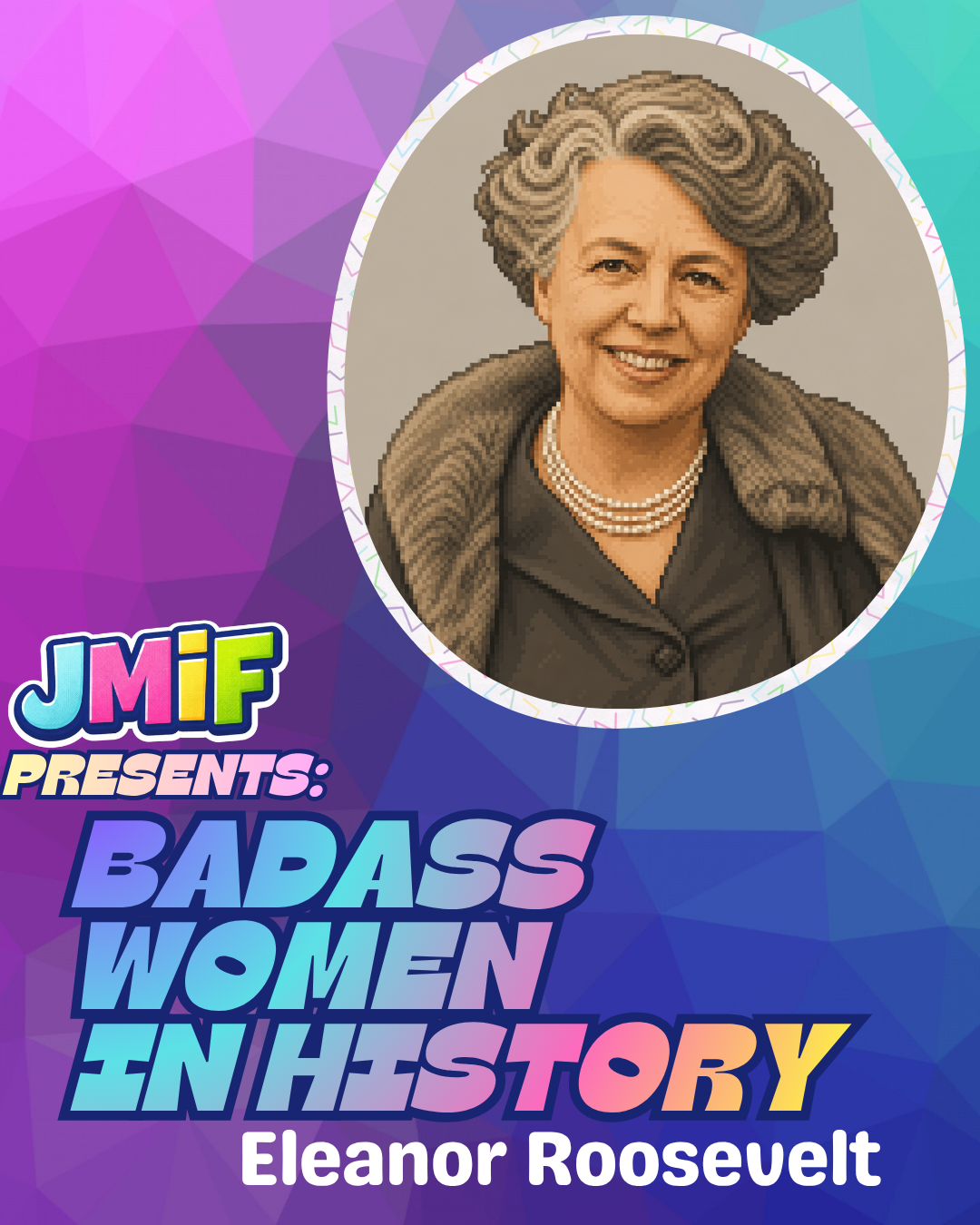

Eleanor Roosevelt: The First Lady Who Refused to Pour the Tea
In 1942, a twenty-five-year-old woman with 309 confirmed kills walked into the White House, and the First Lady of the United States looked at her, took her measure, and thought: I want to take you on a road trip.
Hold that image. We are coming back to it.
Because to understand how Eleanor Roosevelt ended up on a cross-country tour with the deadliest female sniper in recorded history, you have to understand that everyone had been underestimating Eleanor for roughly fifty-eight years by that point, and she had gotten extremely good at letting them.
The Girl Her Own Mother Called “Granny”
Her mother, Anna, was a legendary New York beauty. Eleanor was, in her mother’s assessment, not. Anna nicknamed her daughter “Granny,” to her face, in front of company, because the child was solemn and plain and old-souled. This is the kind of thing that either destroys you or makes you completely unbothered by criticism for the rest of your natural life.
By the time Eleanor was ten, both her parents were dead. Her father, whom she adored, was an alcoholic who died after a fall. She was shipped off to her grandmother, and then, mercifully, to a boarding school outside London where a headmistress named Marie Souvestre looked at this grieving, awkward teenager and treated her like she had a brain. Souvestre took her traveling. Made her argue. Made her think.
Eleanor came home at eighteen with the beginnings of a spine. Then she married her fifth cousin once removed, a charming Harvard man named Franklin, and spent the next thirteen years being systematically flattened by her mother-in-law, who bought their house, chose their furniture, and raised their children with a thoroughness that bordered on hostile takeover.
For over a decade, Eleanor Roosevelt’s job description was: be pleasant, produce heirs, pour the tea.
The Suitcase

In September 1918, Franklin came home from Europe with pneumonia. Eleanor unpacked his suitcase.
Inside were letters from her social secretary, Lucy Mercer.
We tell this story wrong. We tell it like a tragedy, or worse, like a rebrand, as if a woman’s entire political consciousness is something that gets activated by a man’s infidelity, like a coupon. That framing is insulting and it is also lazy. Eleanor had already been organizing. She had already been working with the Red Cross, already visiting wounded servicemen, already noticing that the world ran on the unpaid labor of women nobody thanked.
What the letters did was end her belief that being good would be enough. She offered Franklin a divorce. His mother threatened to cut him off without a dollar. He stayed, the marriage became a working partnership, and Eleanor stopped waiting for permission.
Here is what she did with it.
348 Press Conferences, and Not One Man Allowed
When Franklin took the White House in 1933, Eleanor announced she would hold her own press conferences. Then she added a condition that should be taught in every media studies program in the country: only women reporters could attend.
Not because she disliked men. Because in 1933, newspapers were laying off women first, and Eleanor knew that if she made herself a source only women could access, every paper in America would suddenly discover it needed a woman on staff. She held roughly 348 of these. She created jobs by creating scarcity. That is not a nice-lady move. That is a tactician’s move.
She also started writing a syndicated newspaper column called “My Day,” six days a week, and kept it up for twenty-seven years. Roughly eight thousand columns. She used it to talk about coal miners, refugees, lynching, and, on one memorable occasion in February 1939, her resignation from the Daughters of the American Revolution after they refused to let the contralto Marian Anderson sing in Constitution Hall because she was Black.
Her resignation letter told the DAR they had “an opportunity to lead in an enlightened way” and had blown it.
And now, an honesty break, because this series does not do hagiography: the Lincoln Memorial concert that followed was largely engineered by the NAACP’s Walter White, Anderson’s manager Sol Hurok, and Interior Secretary Harold Ickes. Eleanor deliberately stayed away, and was out of town the day Anderson sang, because she did not want to steal the moment. She lit the match. She did not build the cathedral. She knew the difference. Most retellings do not.
If you like women who build institutions rather than just endorsing them, meet Lydia Moss Bradley, who turned unspeakable grief into an entire university, and Gwendolyn Lizarraga, who took a metaphorical handsaw to Belize’s political establishment.
The Sniper and the First Lady
Now. Back to 1942.
Lyudmila Pavlichenko arrived in Washington as the first Soviet citizen ever received by an American president. She had 309 confirmed kills. She spoke no English. And the American press, faced with a woman who had survived the sieges of Odessa and Sevastopol, asked her about her skirt length. One reporter informed her that American women wear shorter skirts, and that her uniform made her look fat.
Read that again. Then remember that German soldiers had broadcast a threat over loudspeakers promising to tear her into 309 pieces. She found that flattering. They had her math right.
Eleanor took one look at this situation and invited Pavlichenko to tour the United States with her, so Americans could hear about women in combat from a woman who had been in combat. They went. Pavlichenko stopped being polite. She started asking American audiences why women factory workers were paid less than men.
At Hyde Park, Eleanor altered a pair of her own pajamas for her guest, which stunned Pavlichenko, who had not expected a president’s wife to know how to sew. As Pavlichenko changed, Eleanor saw the long forked scar running from her shoulder to her spine, shrapnel from Sevastopol, and hugged her.
They wrote to each other for fifteen years. In 1957, touring Moscow under the watchful eye of a Soviet government minder, Eleanor refused to leave until she was allowed to see Pavlichenko. She found her in a two-room apartment. The two women spoke with stiff formality while the minder listened. Then Pavlichenko invented an excuse, pulled Eleanor into the bedroom, shut the door, and threw her arms around her, half laughing and half crying.
Two women. One Cold War. A closed bedroom door and fifteen years of friendship the world was actively trying to make impossible.
What She Got Wrong
If I only tell you the good parts, I am doing to Eleanor exactly what the history books do to everyone: sanding her into a statue.
Arthurdale, her pet New Deal homestead community in West Virginia, excluded Black families. She built a model of the future and left people out of it.
She opposed the Equal Rights Amendment for decades. Her reasoning was that it would gut the protective labor laws that shielded working women from brutal hours, and it was a real argument made in good faith. It was also on the wrong side of history, and she only came around late.
She privately objected to the incarceration of Japanese Americans and then publicly went along with it, because her husband signed the order. She had enormous power and she chose, in that moment, not to spend it.
And the historian Rayford Logan put it best on PBS: you can give her too much credit. Black Americans did not need an Eleanor Roosevelt in order to protest. She was an ally, not an engine. The engine was already running.
I love her more for this, not less. Sainthood is boring. Contradiction is where the people live.

The Room Where It Actually Happened
Franklin died in April 1945. Eleanor told reporters the story was over.
Then Truman appointed her to the United Nations delegation, where the men assumed she would handle something soft and humanitarian and stay out of the way. She was elected chair of the Commission on Human Rights. She promised to be an impartial chair and, when necessary, “perhaps at times a harsh driver.”
She meant it. For two years she ran the negotiation that produced the Universal Declaration of Human Rights, wrangling a Confucian pluralist, a Lebanese natural-law philosopher, a French jurist, and a Soviet delegation that kept trying to torch the whole draft and start over. It was adopted on December 10, 1948. The General Assembly gave her a standing ovation. She called it a Magna Carta for all humankind.
And here is where I get to be a menace, because you were probably taught that Eleanor Roosevelt wrote the Universal Declaration of Human Rights.
She did not. The first draft was written by John Humphrey, a Canadian law professor, and it took roughly forty years for him to be formally recognized for it. René Cassin revised the draft, added the preamble, and structured it, and Cassin was credited as principal author and won a Nobel Prize. And it was Hansa Mehta of India who changed Article 1 from “all men are born free and equal” to “all human beings.”
Eleanor’s actual contribution was not authorship. It was that she was the only human being on earth with enough moral credibility with both Washington and Moscow to keep that room from detonating. She used her prestige to steer the drafting process to completion at a moment of escalating East-West hostility. That is not a smaller job. It is a harder one. And it is the kind of work history refuses to name, because it does not produce a manuscript with your handwriting on it.
She chaired. She drove. She held the line. And then she handed the credit to the people who held the pen, which is, frankly, more than the men in that room did for Humphrey.
Why You Were Told the Wrong Story
Eleanor Roosevelt sat with a Soviet sniper and a Black flight instructor and a young Pauli Murray who wrote her furious letters, and she wrote back to every one of them. She drove herself, alone, reportedly with a revolver in the glovebox after Klan threats, because she declined a Secret Service escort. J. Edgar Hoover kept a file on her that ran to thousands of pages. She testified before Congress about migrant labor. She chaired John F. Kennedy’s Commission on the Status of Women and died before it reported.
And the thing people remember is that she was homely, and that her husband cheated.
That is not an accident. That is what happens to women who are useful. We reduce them to the men who disappointed them and the mirrors they walked past. It happened to Zaha Hadid, whose buildings were called ugly by people who meant she was. It is happening to someone right now.
Truman called Eleanor the First Lady of the World. Her mother called her Granny.
Granny won.

Learn More
Websites
- Eleanor Roosevelt and the Soviet Sniper, Gilbert King, https://www.smithsonianmag.com/history/eleanor-roosevelt-and-the-soviet-sniper-23585278/, 2013
- ER and the Marian Anderson Concert, The Eleanor Roosevelt Papers Project, George Washington University, https://erpapers.columbian.gwu.edu/er-and-marian-anderson-concert, n.d.
- History of the Declaration, United Nations, https://www.un.org/en/about-us/udhr/history-of-the-declaration, n.d.
Book
- A World Made New: Eleanor Roosevelt and the Universal Declaration of Human Rights, Mary Ann Glendon, Random House, 2001
Video / Show
- The Roosevelts: An Intimate History, Ken Burns, PBS, https://www.pbs.org/kenburns/the-roosevelts/, 2014
A Note on Contested and Widely Oversimplified Claims
Several things “everybody knows” about Eleanor Roosevelt do not survive contact with the sources. In the spirit of a series about stolen credit, here is where the credit gets slippery.
She did not write the Universal Declaration of Human Rights. She chaired the drafting committee. John Humphrey of Canada produced the first draft, René Cassin restructured it and was long credited as principal author (and won a Nobel Prize partly for it), and Hansa Mehta of India is credited with changing “all men are born free and equal” to “all human beings.” Humphrey’s authorship was not formally recognized until 1988. Eleanor’s role, steering the negotiation to adoption, was real and arguably harder. It was not authorship.
The Tuskegee flight did not create the Tuskegee Airmen. The popular version says Eleanor’s 1941 flight with Charles “Chief” Anderson persuaded FDR to fund Black military aviators. The 99th Pursuit Squadron was activated in March 1941, before or around the flight itself. Sources also disagree on the date, giving both March 29 and April 11, 1941, and on how the meeting was arranged. What is well documented is that the photograph was a massive propaganda win that Eleanor deliberately engineered. That is a different and smaller claim than the one usually made.
The Marian Anderson concert was not her production. She resigned from the DAR, which detonated the story nationally. Walter White of the NAACP, attorney Charles Houston, manager Sol Hurok, and Interior Secretary Harold Ickes organized the Lincoln Memorial concert. She was billed as a sponsor and stayed out of town.
Lorena Hickok. Roughly 3,500 letters survive between Eleanor and the journalist Lorena Hickok, some of them unmistakably ardent. Whether the relationship was romantic, sexual, or an intense friendship in the idiom of its era is genuinely and respectfully disputed among historians, and the surviving correspondence was edited by Hickok herself before deposit.
Pavlichenko’s 309 confirmed kills is the Soviet-verified figure, established in wartime by a state with an active interest in the number. It is the standard citation and it is also a wartime propaganda artifact. Some historians treat the exact tally with caution.
The revolver and the FBI file are both widely reported and both fuzzy at the edges. Eleanor obtained a pistol permit and reportedly carried a revolver while driving alone; accounts differ on whether it was ever loaded. Her FBI file is commonly cited at around 3,000 pages, but figures vary by source and by how the file is counted.
The 1941 March on Washington. Some contemporaries, including Rayford Logan, suspected Eleanor helped FDR defuse A. Philip Randolph’s threatened march. Her motives there are debated, and she never fully explained them.
Leave a Reply